Physicists tend to think of light in terms of photons: massless, elementary particles “carrying” the forces of nature. And elementary particles, like the photon, are indivisible. That is, there is no such thing as half a photon. Or is there?
That was the question that three theoretical physicists tried to answer in a recent paper published in Physical Review Letters, bluntly titled “Truncated Photon.” To be clear, the team understands that elementary particles like photons can’t be cut into two. But consider this quantum shortcut: photons exhibit the behaviors of both waves and particles. As it turns out, there is a way to split a photon using this property—although, in typical quantum weirdness, the product of this isn’t anything you’d expect.
“Despite being a simple question, it appears that it has not been asked before,” the physicists, from the University of Oslo in Norway, wrote in the paper.
Some primers
The dual nature of light as both a particle and a wave was most famously demonstrated by British physicist Thomas Young in 1801. The double-slit experiment, as it came to be called, showed how, when you shine a beam of light (“particles”) through two parallel slits on a screen, you’d get an interference pattern resembling the union of two ripples (“waves”) on the other side.
In the quantum realm, objects can also exist in superposition. This is the phenomenon that Schrödinger’s Cat thought experiment attempted to demonstrate. A cat with a sealed box containing a poisonous substance could be dead or alive. But it’s theoretically both—in a superposition of states—until we observe the cat by opening the box. In other words, the act of observation causes a quantum system to probabilistically fall into one state or the other.
Now we truncate
The latest study builds upon these quantum principles. As a wave packet, a photon would possess some spatial distribution. Using an optical shutter—fast-moving mirrors that block or release light pulses—it might be possible to effectively separate sections of this wave. Specifically, the shutter would transform the photon into a superposition of modes either traveling right or left, according to the paper.
Using quantum field theory, the researchers calculated how this setup would affect the dynamics of a photon’s waveform. Surprisingly, their results weren’t that we now had two photons, or even a photon and a vacuum. Rather, what they got was a “complicated state involving photon numbers up to infinity.” Basically, “cutting away a part of the photon” resulted in a “bunch of new photons,” they wrote.
In an accompanying Synopsis commentary, the team explained that, in removing the mirror, a “tug on the quantum field” pulls out enough photons from the nearby vacuum. This forms a “sharp edge” consisting of increasingly more superposed photons, until you get a quantum state of infinite photons.
But wait, it gets weirder
Here’s the cherry on top. If you tried to measure the states on either side of the split wave packet, you’d get measurements that look “exactly like a single-photon state” on the left and a vacuum on the right, except for a very narrow transition region, according to the paper. So, down on the quantum level, there’s a constant, infinite flow of photons. But if you tried to measure it, you’d see either one photon or nothing at all. (Yeah. Welcome to the quantum world.)
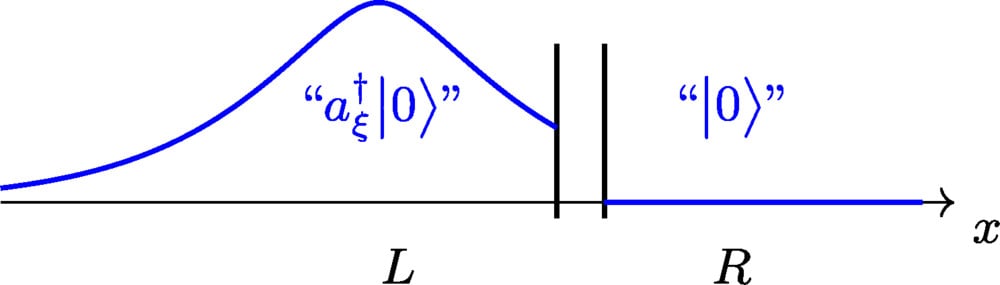
“The truncated photon state is thus an example of a very complicated state that produces the exact same measurement statistics as very simple states, as long as one is interested only in local observables to the left or right of the transition region,” the researchers added in the study.
Again, the study is entirely theoretical; no actual photons were harmed during the course of this project. However, the exercise demonstrates a previously unexplored behavior of key concepts in quantum field theory. The experimental design isn’t too complicated, so it wouldn’t be impossible for experimentalists to replicate the calculations in real life.