More often than not, anything “quantum” makes you think of stuff on the tiniest of scales. But in reality, quantum phenomena govern everything—including cosmic giants scattered across the universe. And, as proof, astronomers may have just confirmed an old quantum prediction by studying an ultra-magnetic star.
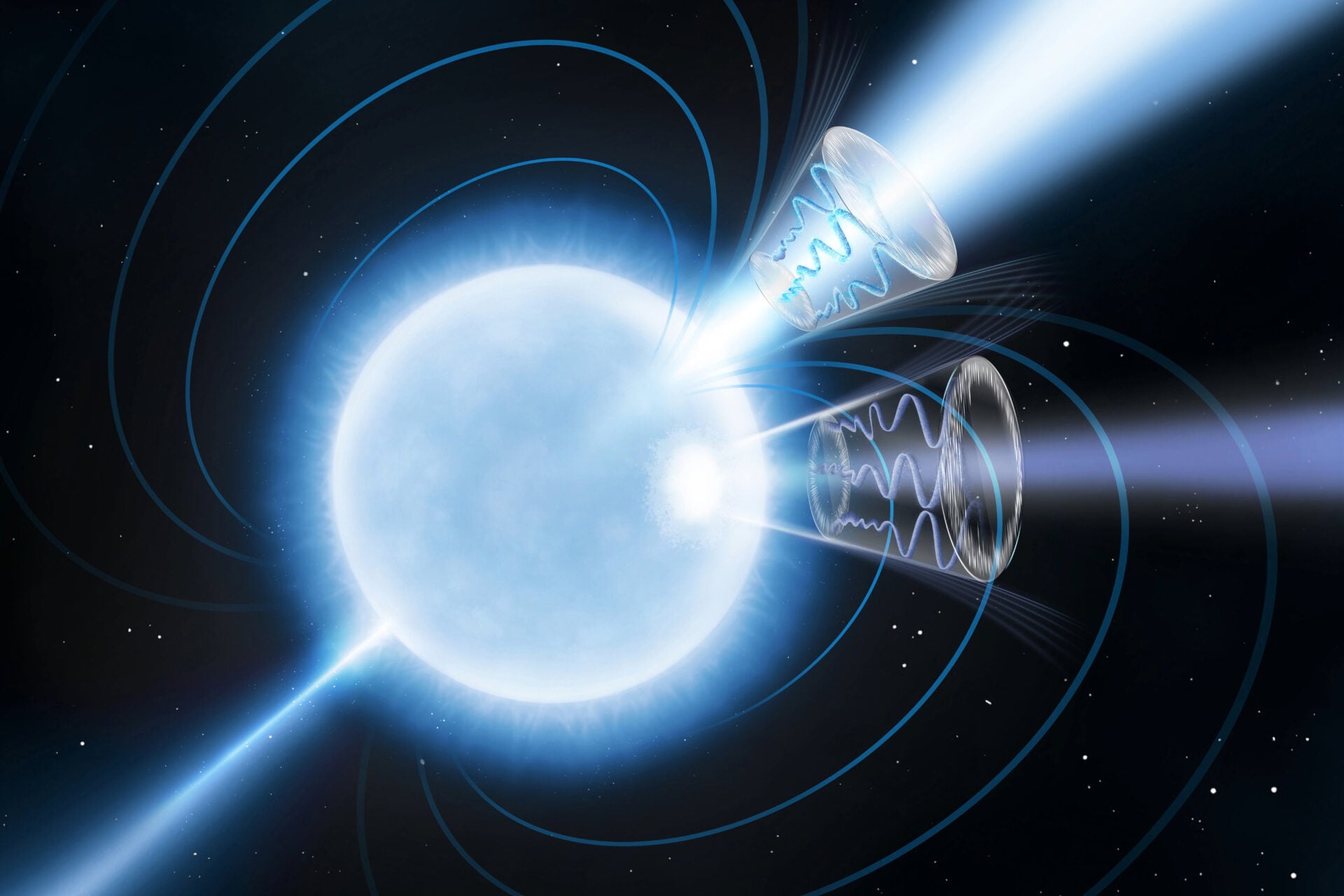
In a recent paper published in Nature, astronomers describe their observations of the star 1E 1547.0-5408. This star happens to be a magnetar—an isolated neutron star with extremely powerful magnetic fields and X-ray emissions. According to the study, 1E 1547.0-5408’s magnetic field—over a trillion times stronger than Earth’s—appears to be demonstrating a quantum phenomenon called “vacuum birefringence,” in which seemingly empty spaces alter the behavior of light. If true, the observation represents the first-ever detection of vacuum birefringence, which was initially predicted by physics pioneers Werner Heisenberg and Hans Euler in the 1930s.
“Detecting vacuum birefringence requires a magnetic field that is over 100 million times stronger than any we’ve ever made on Earth,” explained Marcus Lower, the study’s co-author and an astrophysicist at the Swinburne University of Technology in Australia, in a statement. “Thankfully, nature has provided us with magnetars, which are the perfect cosmic laboratories to go looking for this effect.”
Giant quantum blips
Vacuum birefringence has been central to Heisenberg’s account of quantum electrodynamics, a subfield in quantum physics that describes the relationship between light and matter. According to a NASA statement on the new findings, vacuum birefringence suggests that exceptionally powerful magnetic fields force vacuums—completely empty spaces—to act like a lens or prism, resulting in unusually high levels of polarization.
But for nearly a century, scientists haven’t been able to directly prove this actually happens in reality, according to an accompanying News & Views by Ekaterina Sokolova-Lapa and Joern Wilms, both astronomers at the University of Erlangen-Nuremberg who weren’t involved in the latest work.
Cosmic laboratories
Enter magnetars. To Physics World, study lead author Rachel Stewart likened these stars to a “natural lab,” as they are among the most magnetic objects observed in the universe. But 1E 1547.0−5408 in particular had a particularly bright radio and X-ray emission that made it an ideal candidate for studying these phenomena, explained Stewart, a Ph.D. candidate at George Washington University.
The team’s hunch was on the mark. For one, the polarization of light detected in the magnetar was three times greater than what’s expected from similar sources. Even more strange was the fact that the geometry of the magnetic field indicated certain sections of the field should show zero polarization, but that wasn’t the case.
“By carefully tracking the direction the radio waves and X-rays oscillate as the magnetar rotates, [we] found that the alignment of 1E1547’s magnetic and rotational poles was ideal for detecting vacuum birefringence,” Lower explained in the Swinburne statement. Despite all odds, the powerful magnetic field had pushed “Heisenberg’s virtual particles” to follow the direction of the field such that, to an external observer, it looked like a vacuum was twisting the light.
Pending judgment?
However, experts uninvolved in the work cautioned against taking this observation as solid proof. Sokolova-Lapa and Wilms wrote that the “validity of this interpretation hinges on whether the authors’ proposed magnetar geometry is correct,” as it’s possible that the star’s tilt made it seem like the radio and X-ray signals were aligned. It’s also unclear currently as to what the radio and X-ray observations exactly are telling us about the true nature of the star, Roberto Taverna, an astronomer at the University of Padova in Italy, told Physics World.
So we’ll have to wait for future investigations to confidently declare that Heisenberg and Dirac were correct. Either way, the observations show that quantum laboratories aren’t necessarily at the smallest scales.
“This result truly highlights the interdisciplinary power of the field of astrophysics,” Stewart said in the NASA release. “The information we obtained from looking at this distant star core also gives us clues about the nature of the fabric of reality as we know it, and I find that to be incredible.”