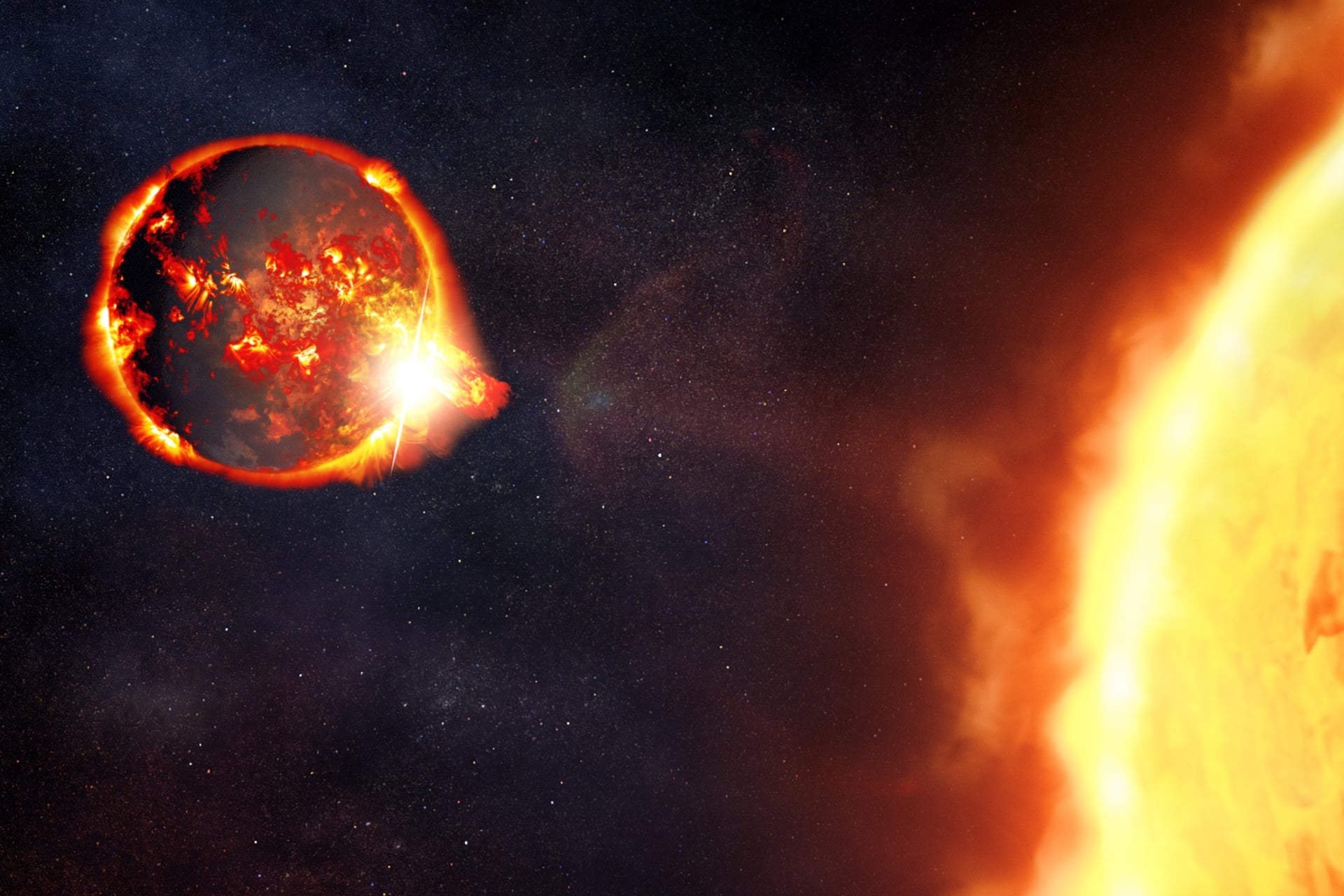
Our Sun is just like any other star. That is, eventually the Sun will run out of fuel and effectively collapse—taking out, presumably, most things in our neighborhood. That won’t pose a problem for those of us alive right now, but for those of you who still care: Scientists think the doomsday for outer planets might come earlier than expected.
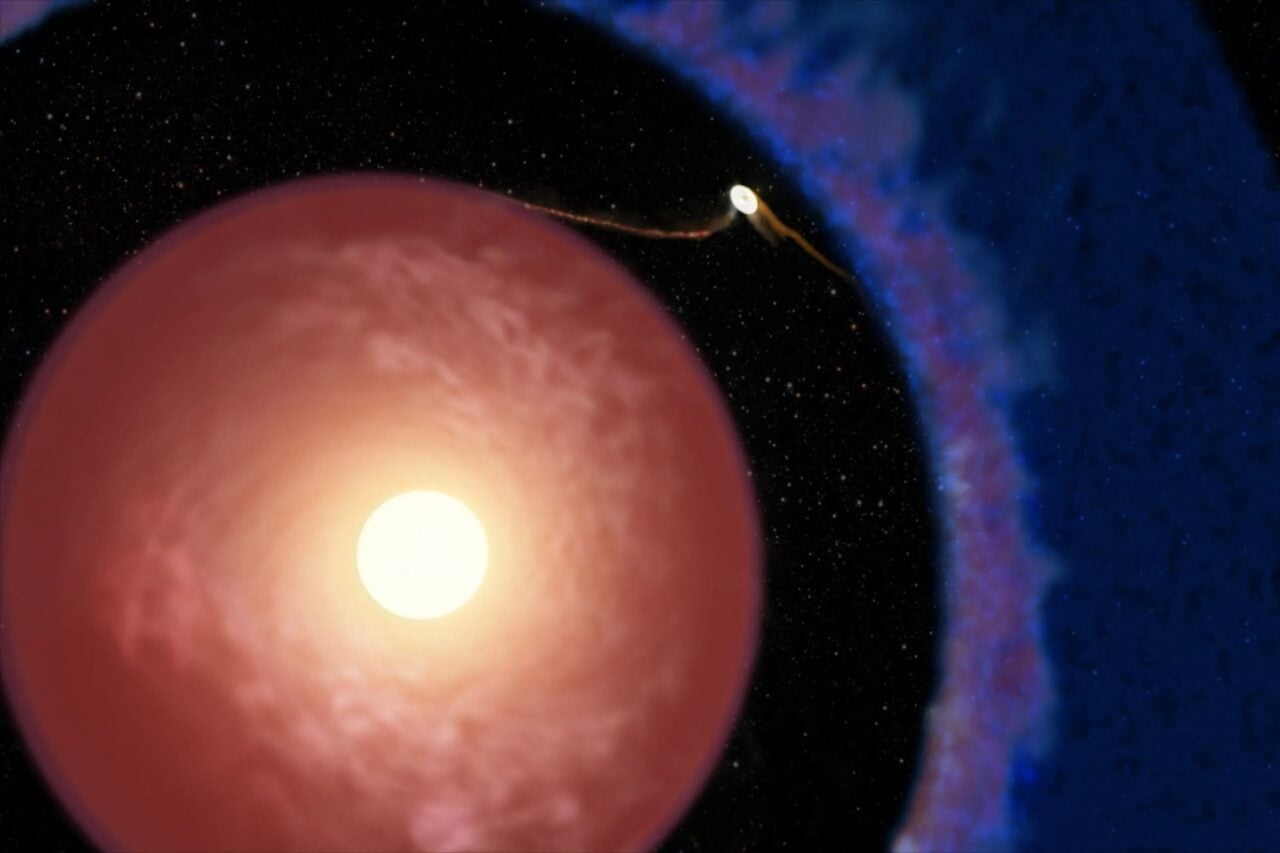
New calculations indicate that, once the Sun transforms into a white dwarf some 7 to 8 billion years from now, the outer solar system has roughly 1 billion years left—much lower than previous estimates ranging from 100 billion to a whopping 1 quintillion years, according to a recent study published in The Astrophysical Journal Letters. The latter number was so large as it assumed the Sun would lose its mass in a relatively smooth manner, Konstantin Batygin, the study’s first author, explained to Gizmodo. In reality, the Sun’s death will likely be bumpier, which introduces more chaos to the equation.
“What we’ve shown is that this timeline [of 1 quintillion years] gets front-run by the Sun’s own death,” said Batygin, an astrophyscist at the California Institute of Technology. “Because planetary dynamics is chaotic—exhibiting sensitive dependence on initial conditions—no single simulation tells you what will happen, only what could happen.”
Cosmic traffic
According to Batygin, the stability of the solar system depends on whether its planets travel in “well-ordered, non-intersecting orbits” on astronomical timescales. This is determined by factors such as the spacing between orbits or the web of orbital resonance among the planets. It’s also a physics question with a long history; Isaac Newton himself wondered if gravity would eventually make planetary orbits fall apart.
Physicists have since sort of answered Newton’s question—sort of, because new insights into the stability of our solar system appear to raise new questions. This is something that has become extremely clear to Batygin, who has explored this topic for decades.
There’s that overarching question, then the smaller question(s) on different dynamics for the inner and outer planets. This particular study obviously focuses on the latter, and if we ignore astrophysical processes—and that’s a huge if—the outer solar system is “remarkably stable,” he added. That was why scientists predicted it would take 1 quintillion (that’s a 1 followed by 18 zeros) years for chaotic diffusion to put Uranus out of commission. That’s even longer than the current age of our universe.
Terminal instability
But again, that rests on a pretty gigantic “if,” and once real astrophysical chaos enters the scene, this picture “fails at its foundation,” as the team wrote in the paper. Namely, as the Sun approaches the end of its stellar lifetime, it won’t be losing its mass in neat packets of star stuff. It’s much more realistic to assume that it’ll do so via episodic ejections over time.
And this irregular shaking will quickly destabilize the orbits of larger planets within a billion years of the Sun’s transformation into a white dwarf, Batygin explained. To test their own hypothesis, Batygin and colleagues ran large sets of different simulations that treated the solar system’s instability as a “probability rather than a definitive forecast,” he added.
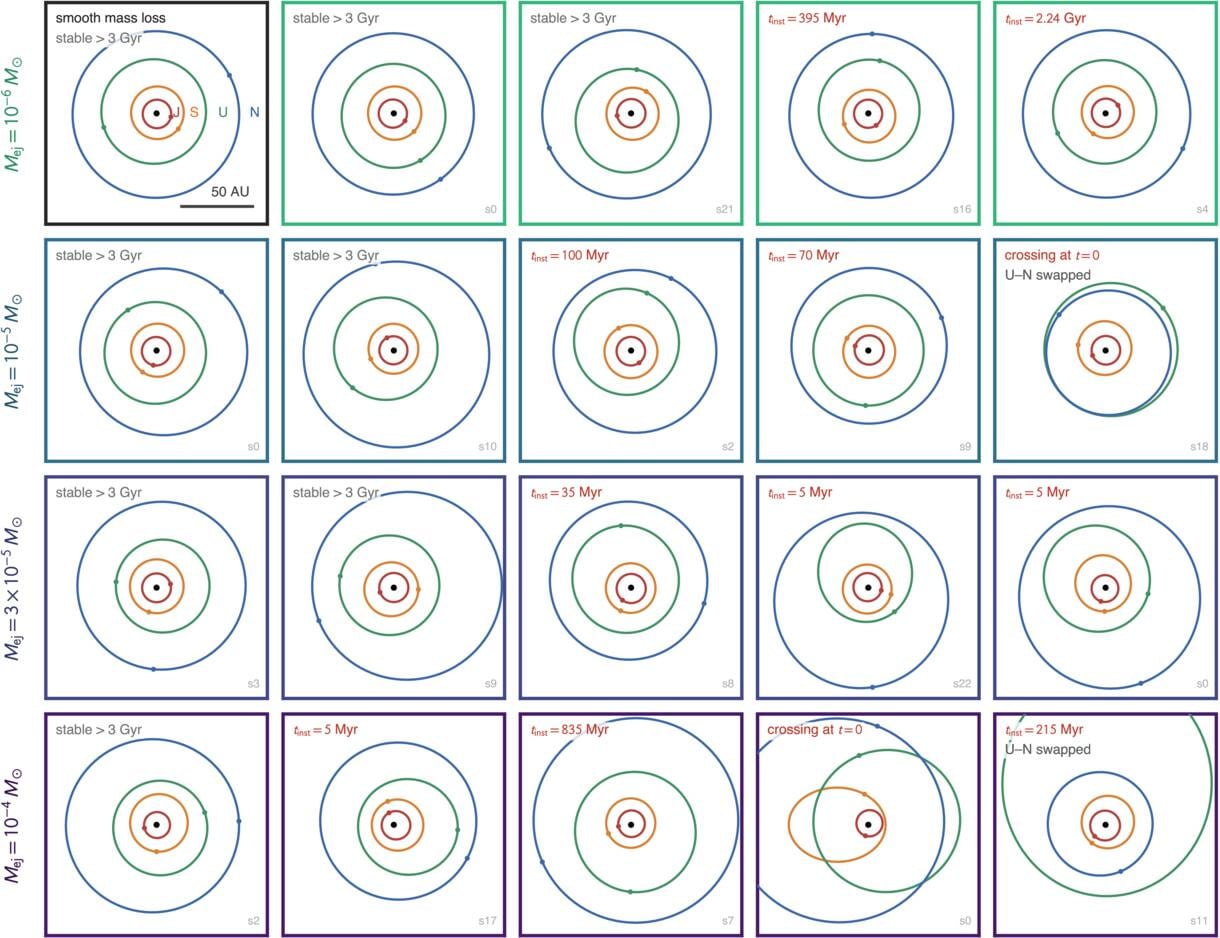
The team evaluated 672 scenarios, tracking when and how much the Sun could lose its mass on its way to becoming a white dwarf. The tests included instances in which the Sun did smoothly shed its mass. Even so, around 96% of these hypothetical planetary systems spiraled into chaos within 3 billion years of the Sun becoming a white dwarf.
“In short: as the Sun dies, it will take the outer solar system down with it,” Batygin explained. “The Sun’s death is not an event the planets will quietly survive—it is the trigger for their orbital undoing.”