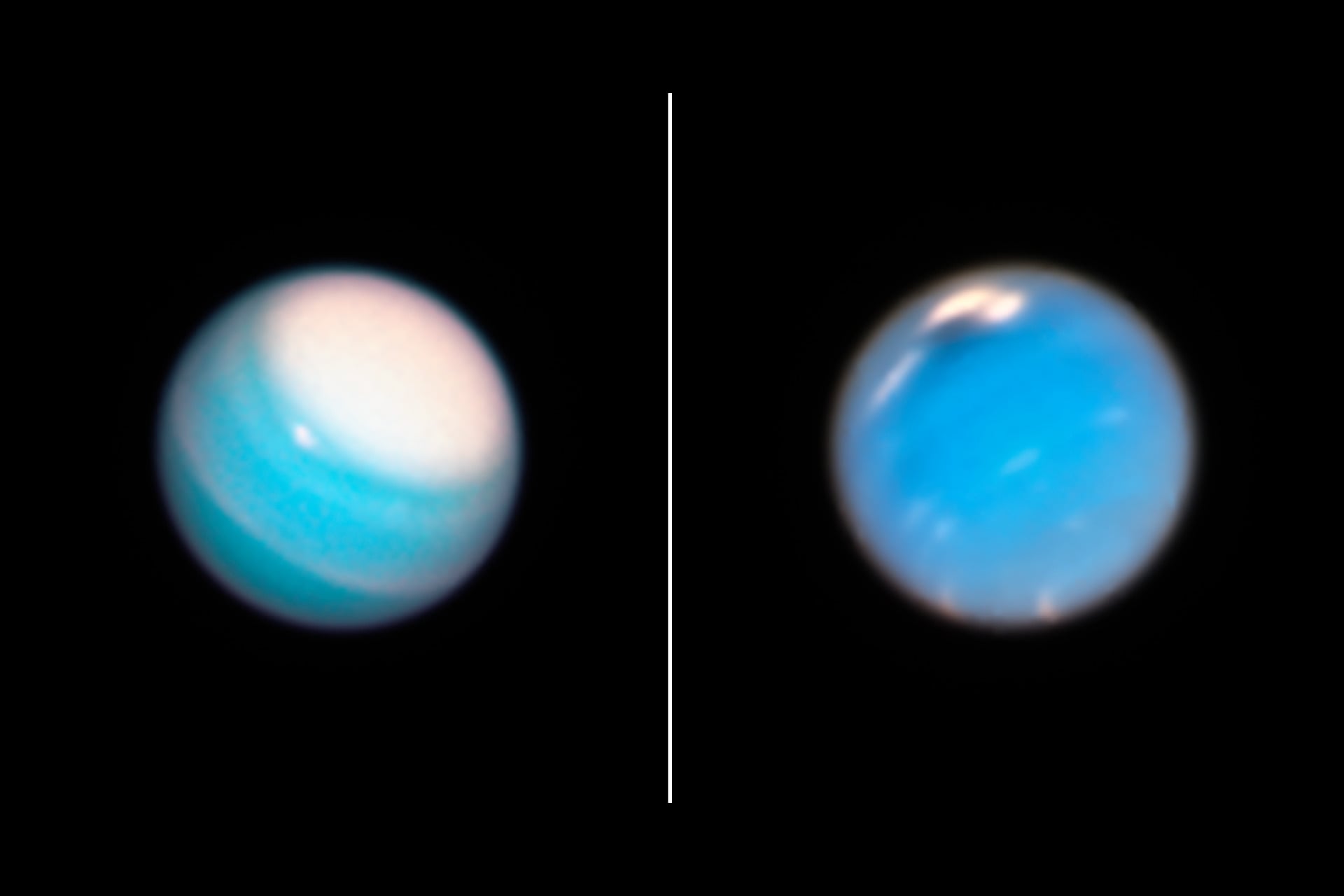
Despite the iconic documentary, Uranus and Neptune are arguably the real “blue planets” in our solar system. And their visual similarities in part convinced astronomers that they were evolutionary and chemical twins—but looks can deceive, as a new study has found.
In short, the similarities we observe today between Uranus and Neptune may be a coincidence, according to research published in Astronomy & Astrophysics. Studying recent measurements of carbon monoxide revealed that Neptune’s deep atmosphere has more oxygen than that of Uranus. Using this information, the team ran models to track regions of the protoplanetary disk—a rotating “platter” of gas and dust that forms planets—that birthed Uranus and Neptune. Surprisingly, the analysis strongly suggested that Uranus and Neptune weren’t from the same section of the protoplanetary disk, which would also give them different chemical origins.
“Uranus and Neptune may resemble twins today, but their chemistry is telling us that they are more like cousins with very different histories,” Olivier Mousis, the study’s co-author and a planetary scientist at the Southwest Research Institute, said in a statement. So their similarities today actually point to a “noteworthy coincidence,” he added.
The blue planet(s)
The team explained in the paper that exoplanets resembling Uranus and Neptune “dominate the exoplanet population.” For astronomers, this means that Uranus and Neptune serve as the best (local) reference sheet for studying foreign planetary systems. But nature hasn’t been so generous in giving up its secrets. According to the paper, Uranus and Neptune have long heliocentric distances and low temperatures, which “severely limit” astronomers’ ability to study them. The ice giants are also enveloped in thick clouds and gases that not even the best radio telescopes can reliably pierce through, the team added.
Then again, scientists always find some way to get around these natural barriers. In this case, Mousis and colleagues searched for “chemical tracers [that] allow us to probe the conditions hidden beneath their visible clouds,” as he explained in the statement. The team settled on carbon monoxide (CO), which is abundant in the upper troposphere of many planets, Mousis added. And recent measurements have “unambiguously” detected CO in the tropospheres of Uranus and Neptune, according to the study.
“Using this data, we can model the chemical evolution of the protoplanetary disk and the origins of its material,” he went on. Specifically, from the CO measurements, the team derived a set of possible ratios of oxygen, hydrogen, and carbon in the planets’ deep atmospheres, then ran a model to simulate how different volatile compounds from the protoplanetary disk evolved to form the planets as we observe them today.
Two planets, two histories
The analysis strongly suggested that Neptune’s “building blocks” were actually closer to the young Sun than Uranus and later migrated outward, according to Mousis. It’s “difficult to reconcile” Neptune’s chemistry with the idea that it came from the same “reservoir of cosmic materials as Uranus,” he added. It makes more sense to assume that the protoplanetary disk essentially tossed Neptune’s building blocks a good distance away from where they first emerged, and these blocks eventually accreted into the ice giant as we see it today.
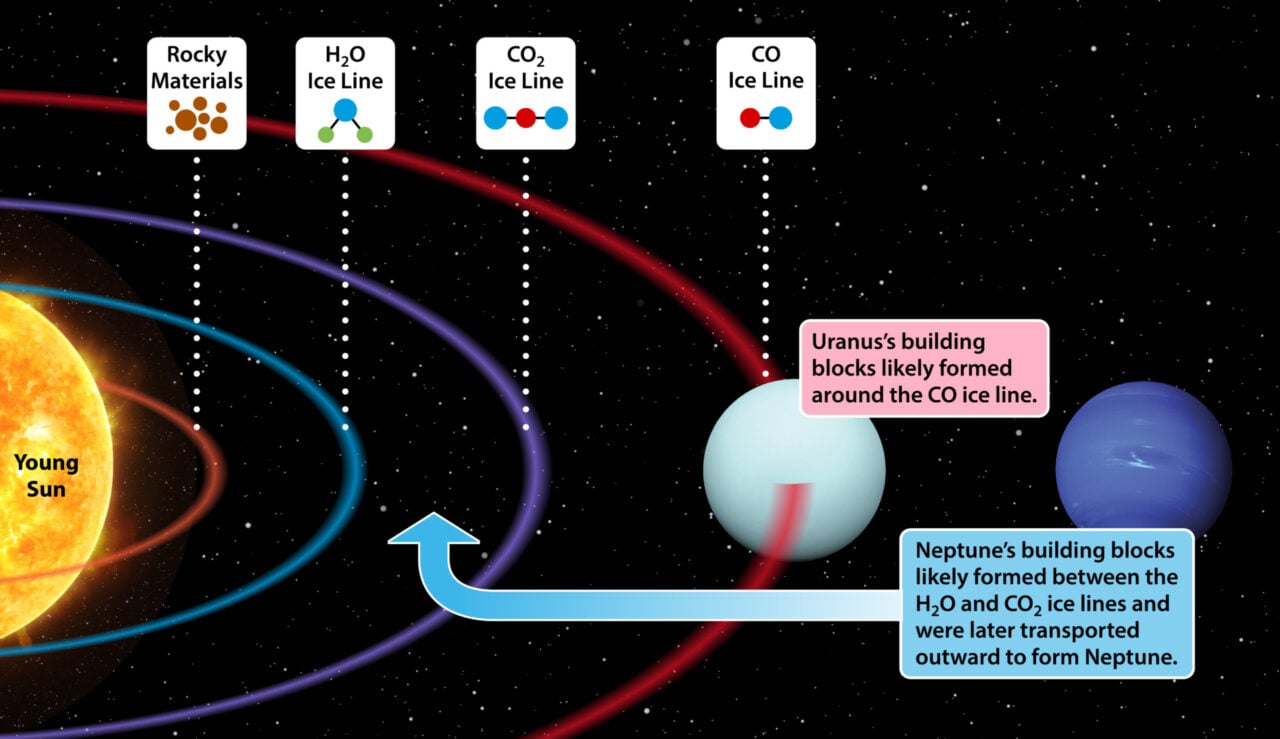
“In short, two superficially similar worlds may have reached their present locations and formations through two very distinct evolutionary paths,” Mousis said.
That said, as the team admitted in the paper, its biggest limitation is arguably the most obvious one: we don’t have any in situ (on site) measurements of Uranus and Neptune’s atmospheres. While the modeling data may be as convincing as scientists can make them, we won’t really know for certain until we actually get some real samples—which will hopefully come if missions like NASA’s Uranus Orbiter and Probe manage to launch.
“Our findings have implications beyond Neptune and Uranus and even far beyond our solar system,” Mousis said. “Similarly sized planets are common around other stars, which is why Uranus and Neptune are essential benchmarks for understanding how planets form and evolve throughout the galaxy.”