Physicists have many delightful theories about how our universe might end, including one that suggests it isn’t in its most stable state. If it transitions to that state, we could all be squelched into quantum oblivion. Delightful, I know. But a new study suggests this haunting scenario may be less likely than feared—so there’s that, at least.
It’s known as false vacuum decay. In this hypothetical scenario, the universe appears stable to us, the local observer. But some calculations suggest that the universe isn’t in its most stable state, in which it has the minimum possible energy—a true vacuum. If the universe decides to tunnel into a more stable state, reality as we know it would be wiped out. This cosmic transition would create an apocalyptic quantum bubble that expands at nearly the speed of light—completely rewriting the rules of physics without warning.
However, a research team claims to have identified a mechanism by which the early universe’s rapid expansion triggered quantum effects that locked it into what the team calls a “cosmic lockdown.” So, even if the universe indeed exists in a false vacuum, it’s unlikely that it’ll decay into something else, as the team explains in a recent paper published in the Journal of Cosmology and Astroparticle Physics.
“The result does not prove the universe’s current state will remain stable forever or determine the specific likelihood that the Higgs field [which gives elementary particles their mass] will eventually decay,” the researchers explained in a statement from Syracuse University, where co-author Gregory Kaplanek serves as a postdoctoral researcher.
Some quick physics lore
The story starts with the Higgs boson, which assigns mass to an otherwise soupy universe. Fundamental particles like the electron acquire mass by interacting with this particle-field, and it was from exploring this very useful metric that physicists realized the universe might not be at its most stable state.
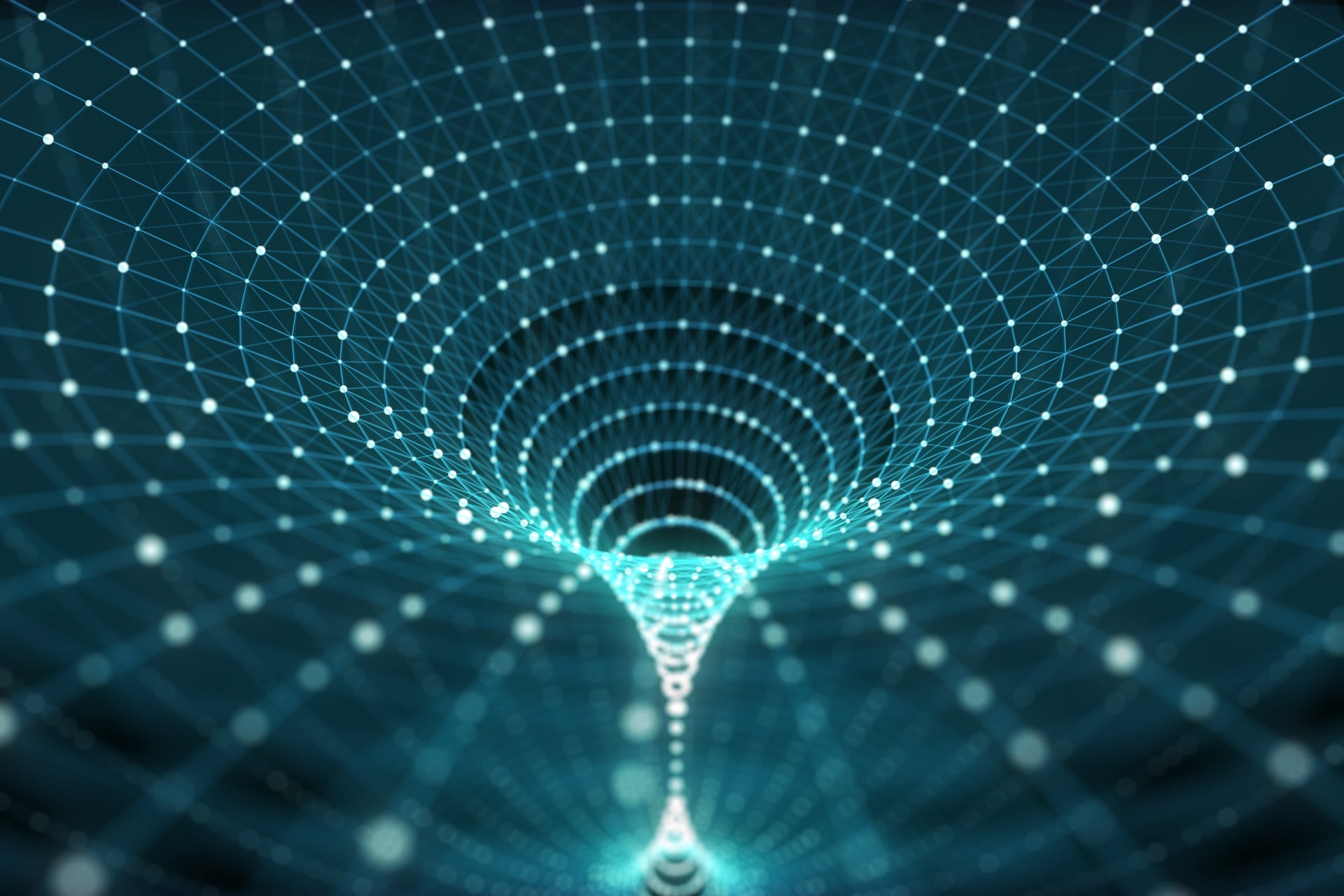
“A useful analogy is a ball moving through a landscape of hills and valleys, where the ball represents the state of the field and the valleys represent different possible vacua,” Kaplanek explained in an email to Gizmodo. “The valley we are trapped in would be the false vacuum: it appears stable because the ball sits comfortably at the bottom, but it is not the lowest-energy state available. The deeper valley is the true vacuum.”
And quantum mechanics introduces the “remarkable possibility” for the field to tunnel through this hill, Kaplanek said. This would lead to dramatic changes in the properties of particles and forces, “fundamentally changing the universe as we know it,” he said. That makes it “important to understand whether there are physical mechanisms that can make a false vacuum more stable,” he added.
Quantum interactions
The latest findings argue that quantum fields don’t exist in isolation. The team’s model evaluates how quantum fields evolve in a rapidly expanding space, a setup Kaplanek clarified was “motivated by and applicable to inflationary cosmology.” From the calculations, the team found that a quantum field’s tunneling capabilities become curbed by decoherence—a phenomenon in which quantum systems break down after interacting with their environment, acting more like classical systems.
There are two possible scenarios. If the field calculated in the paper were heavier relative to the rate of the universe’s expansion, the universe would likely approach a true vacuum. If it were lighter, then the “system cannot keep up with the changes” and would probably fall into a false vacuum, Robson Christie, the study’s first author and a physicist at the University of Portsmouth in the U.K., told Quantum Insider.
No squelching here?
Either way, decoherence would help “lock” the system into whatever localized minimum it ended up in. This is due to the quantum Zeno effect, which explains how a monitored quantum system seemingly has trouble transitioning from one state to another. In this case, the environment itself “effectively acts as a continuous monitor, because interactions continually carry information about the state of the field into its surroundings,” Kaplanek told Gizmodo.
That said, the team explained this framework does not completely rule out the possibility of false vacuum decay. Although the model accounts for previously overlooked factors, it’s still a simplified iteration that doesn’t consider other relevant elements, such as a changing cosmic expansion rate or the field’s own influence in gravity, the researchers added in the statement.
Whether this mechanism is currently protecting our universe is beyond the scope of the new work, Kaplanek told Gizmodo. That would require a “considerably” more realistic calculation, he added. Still, the new findings offer one mechanism that might stabilize a false vacuum. And hey, if that protects us from quantum squelching, I’ll take it.