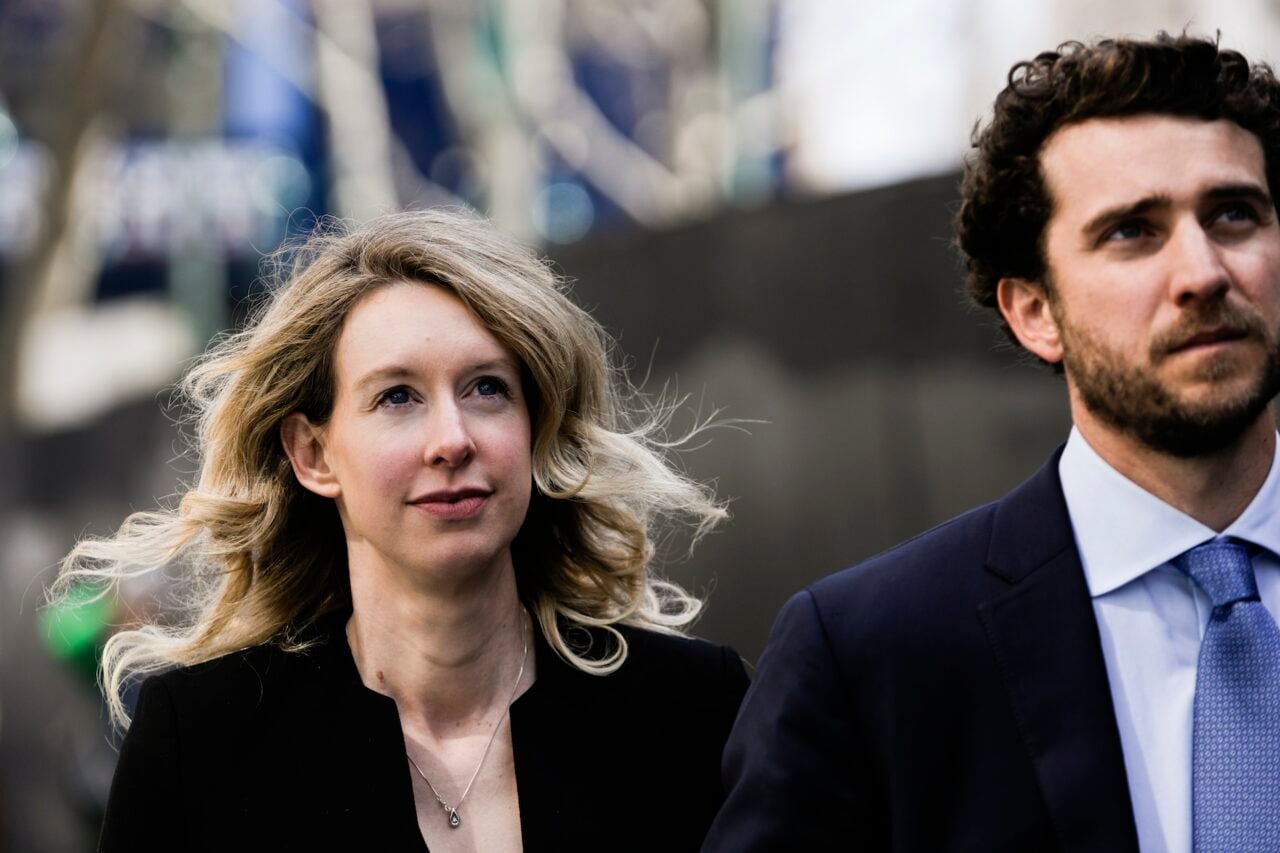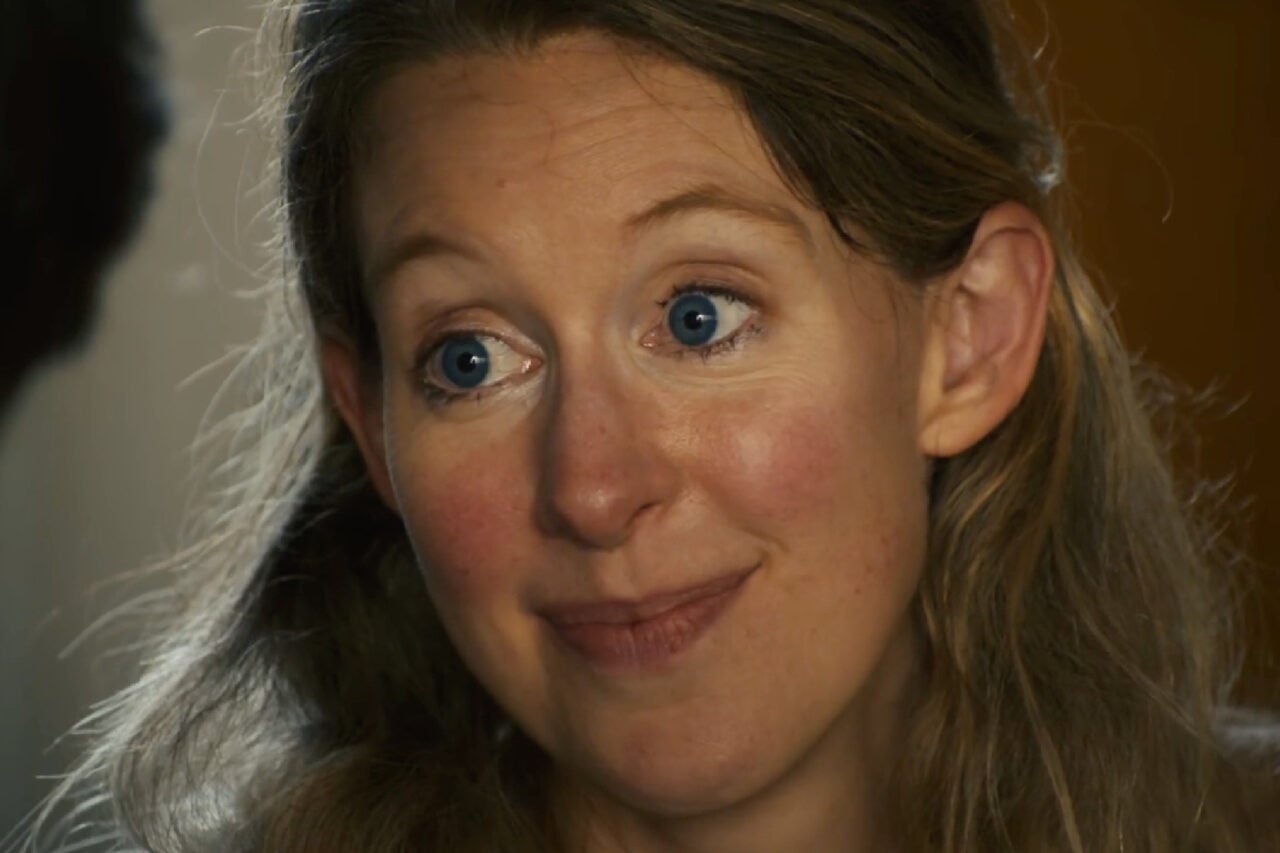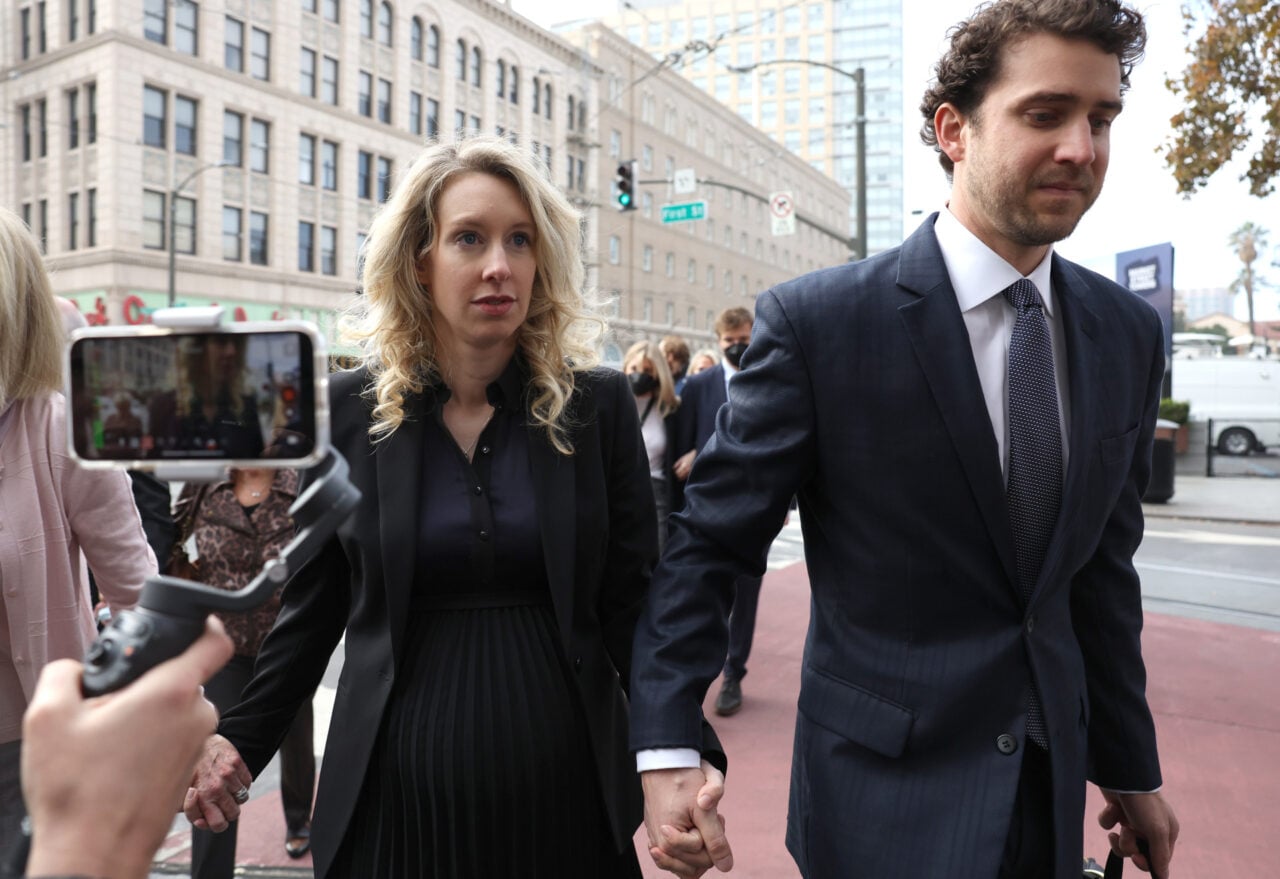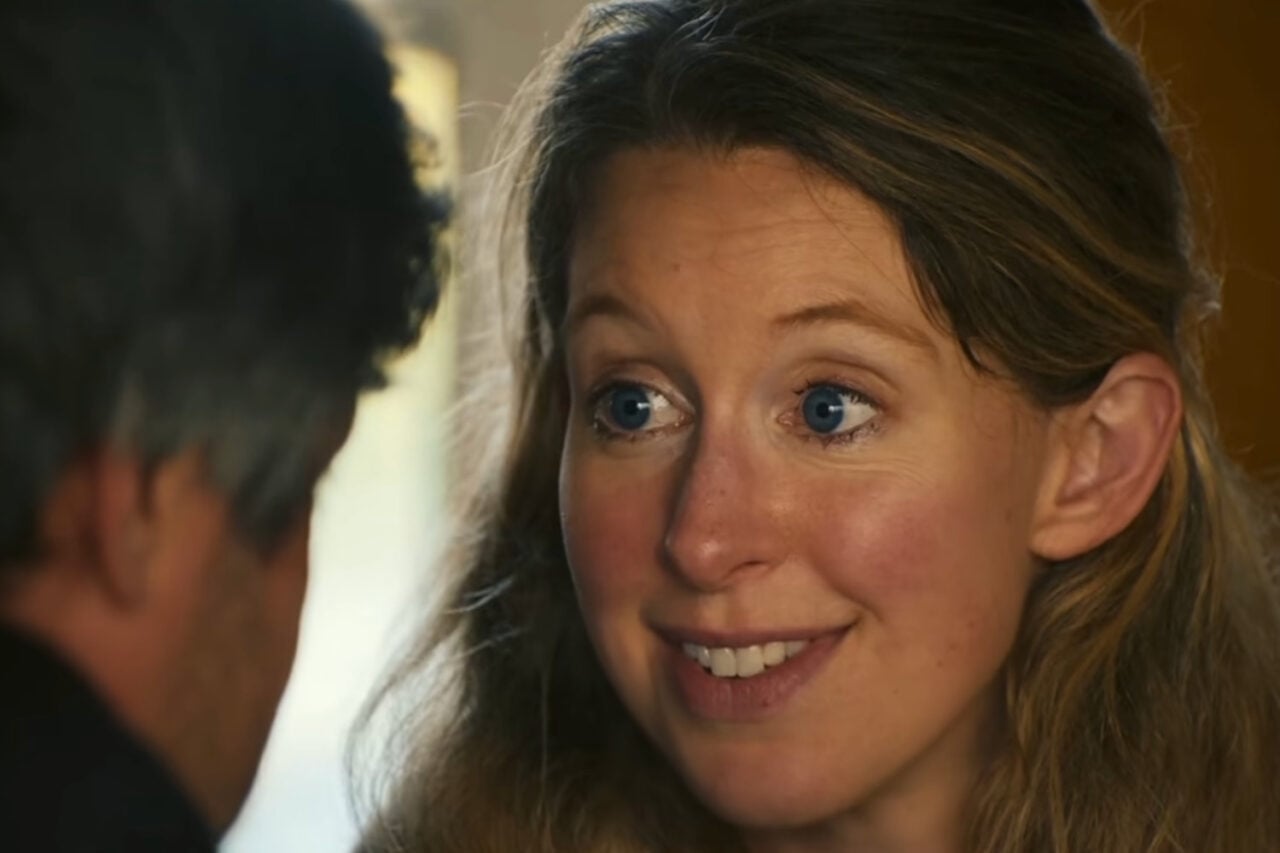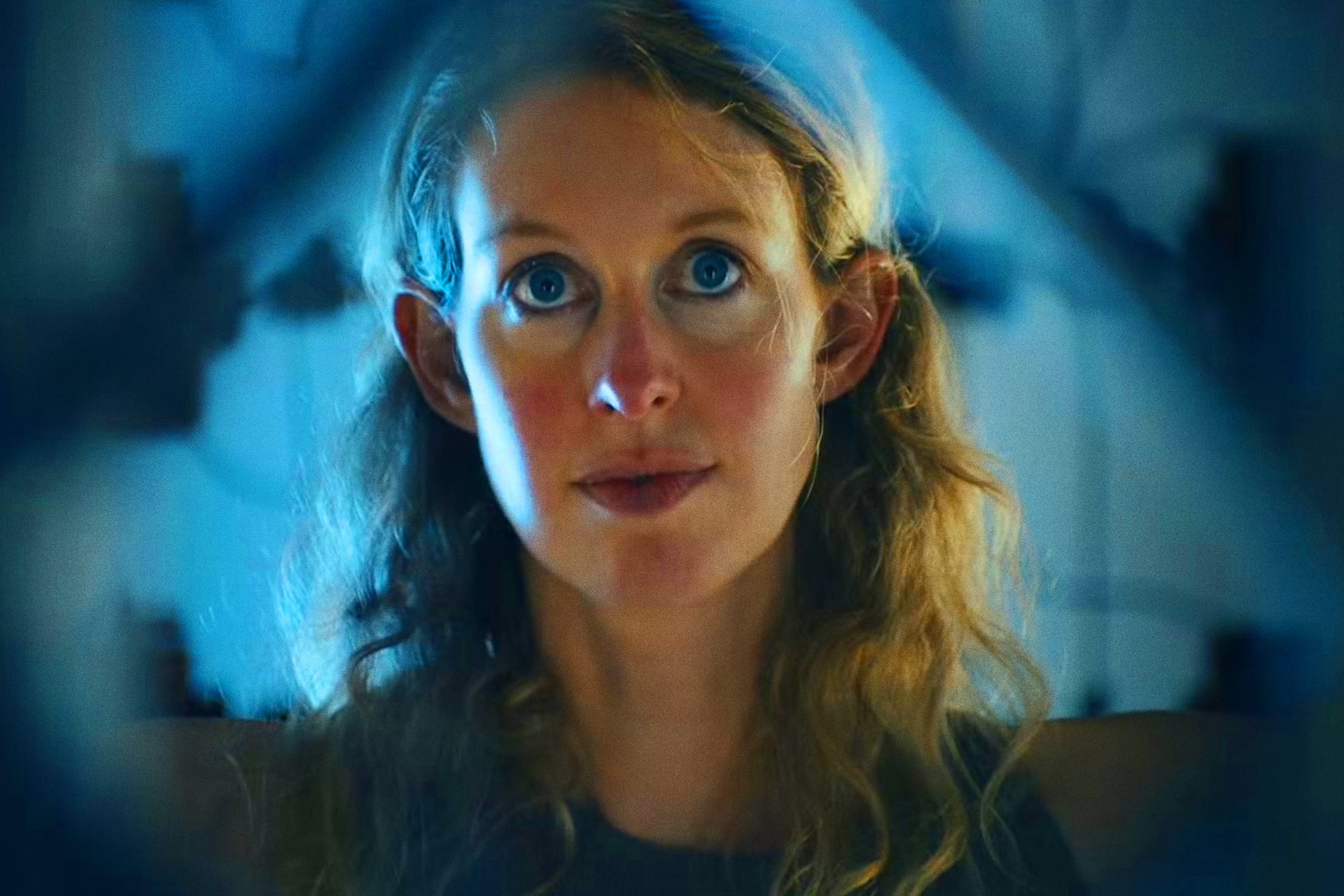
Nathan Fielder and Lance Oppenheim’s sublime documentary, You Can See Everything, has established itself as nothing short of a cultural seismic event. The three-hour brain melter that’s taken over the discourse had an historic opening weekend at the box office, kept the momentum going during its second weekend expansion to 2,655 screens, and is already being positioned to map uncharted territory at next year’s Academy Awards. All this with a logline that almost feels cheekily quaint once you’ve seen it: Fielder encamps with disgraced Theranos CEO Elizabeth Holmes and her family during her last weeks of freedom leading up to the start of her 11-year federal prison sentence.
I went into my YCSE screening with no expectations for what was about to happen, content to just sit back and let the maestro work. It’s a testament to Fielder’s genius that, even with that blank slate baseline in place, I left the theater not only with my head swimming in questions about Holmes’ work, but also interrogating my own.
I’ll join the critic and audience chorus urging you to go see this generational film—in a theater, and as soon as possible, knowing as little about it as possible—before its virality turns every new conversation into a potential spoiler minefield. That said, as much as I’ll try to thread the needle of discussing parts of YCSE without revealing its magic tricks, if you’ve yet to catch a screening, read ahead at your own peril.
Perhaps because I, too, earned a business degree in college before going on to build a creative career centered around seeing what I can get away with, I’ve always felt a certain kinship with Fielder. I’ve been proselytizing his reality-warping projects since the pilot episode of Nathan For You, a show that culminated with 2017’s Finding Frances, a series finale that was itself a staggering investigation of the malleable space between fact and fiction in which documentarians operate. When it aired, industry luminary Errol Morris praised Fielder’s doc debut as “some of the most interesting ‘reality’-based work yet made.” Little did we know what was to come. As the scale and scope of Fielder’s projects heightened, those of us who’d been parasocially witnessing his career arc quietly nodded in approval of the growing flock. More were finally seeing the world through a Fielder lens, where rules are made up or unspoken, as well as potential instruments in their own circumvention.
But then Nathan pulled off a trick nobody saw coming—using The Rehearsal’s second season to affect material change IRL. Past fourth-wall breaks like Dumb Starbucks were fun, but ephemeral pop-up portals to alternate dimensions. Getting a bill that impacts the future of air travel passed by the Senate leaves an indelible mark on this world. We suddenly had proof that Fielder’s powers were more than comedic tools. They could be vehicles for much-needed improvements. What else could he do, given the budget and freedom?
Whether or not he intended it, YCSE seems on track to zhuzh our shared existence as well, if only as a booster shot of incredulity as literacy rates fall off a cliff while veracity-clouding hazards flourish. The new doc does this by building upon Finding Frances’s foundational text with a deeper dive into the patently corrupted result of a wrangle over narrative control. Though many facets of the human condition are touched over the course of its three-hour runtime, the central themes explored are the intrinsic unknowability of another person’s interiority and the difficulties that opacity presents while attempting to search for and present the truth, whether in a legal, journalistic, or artistic setting.
The film’s audit begins with a quote published in The New York Times that bolstered the case against Holmes, but she disputes having ever said it. It’s the first of many words and actions Fielder and company scrutinize, all through the lens of a horror film, which results in an unreliable narrator story that ends up feeling more like The Thing than Rashomon. However, the film’s brilliance truly blossoms once Fielder widens his field of vision beyond attempts to suss out the truth in moments with his hosts and begins to grapple with the existential factors fogging up his own lens.
How can a documentarian hope to establish authenticity in a simulacrum of “real life” that’s contrived and often controlled by his subject? With enough time focused on a subject, might even the most honest and well-intentioned effort to present the truth be subconsciously stymied by the familiarity-founded biases likely to percolate within the documentarian? Even if those pitfalls are navigated or accepted as the cost of doing business, how best to proceed?
Like many great magic acts, YCSE’s illusions involve (figurative) mirrors. It was Fielder’s exploration of the above topics and the shock of suddenly seeing my own reflection that gave me one of the most unexpected surprises in a film already bursting with them: a fresh pair of eyes to look at my own industry and career. I’ve now seen countless metatextual discussions about the movie spreading across social media platforms and amongst my friends like wildfire—still-reeling viewers feverishly unpacking not just every on- and off-screen element of this story, but also how it fits into our shared reality. It’s clear to me there’s some appetite out there for some sausage-making secrets from within the world of tech journalism. Because what I’m divulging is essential to understanding how a scandal like Theranos ever happened. It’s also, hopefully, a wake-up call that instills a baseline skepticism about the ways in which any company is presented to you in the media.
The Price of Access
Much like the documentary’s directors, I was recently presented with an unexpected invitation to personally observe something I likely wouldn’t have looked into organically. Mine came from NordVPN as a press trip offer to fly me out to the company’s headquarters in Vilnius, Lithuania. Their email pitch indicated I’d be one of “a small group of US journalists” learning about the dark web at the company’s Cyber City campus before attending a startup fair the following day. Frankly, neither of those prospects excited me all that much. Nonetheless, I have a personal policy about never refusing free trips to unfamiliar destinations. So, I replied to Nord with my RSVP and got the wheels in motion.
I’m a freelancer, beholden to no particular outlet’s approval, and I am at a stage in my career where I’m confident in my ability to ferret out some story of intrigue from whatever foreign ecosystem I’m parachuting into. I would do this on my Lithuania trip with Nord, as I have done in many other countries as the guest of various entities including regional tourism offices, a bottled water company, and even a mobile game developer. I’ve gone on each of these trips with the earnest intention of finding a story. In almost every case, I hit my goal. What I’ve never done (and always make clear I won’t do) is offer the trip provider any assurances about what sort of write-up they can expect from me, if any at all. Even if some “coverage” was a naturally occurring byproduct of my visit, there’s no guarantee that the topic, angle, or tone I select will be to my benefactor’s liking.
There have only been a handful of flagrantly quid pro quo propositions I’ve been forced to flatly refuse over the years. Usually, I’m just presented with offers that are fully aware of and amenable to these stipulations. Because why get into the sordid business of attaching strings to anything when the SOP of an unspoken agreement has been working so well at achieving their end goals?
The already patently fraught relationship between journalist and subject matter got exponentially thornier once the powerful figured out they could stealthily reach the public via a Fourth Estate Trojan Horse. By welcoming reporters into spaces of spectacle and conviviality where products and people are presented in their most flattering and managed light, the Public Relations teams promoting something—be they an in-house crew or outsourced external firm—accomplish so much more with these proactive charm offensives than they would by getting the word out with an ad buy.
Each successful function, activation, event, and trip where journalists like myself are wined, dined, and gifted the sort of experiences and products the customers these companies are trying to reach have to pay their hard-earned money for, the baseline objectivity of the work we’re meant to be doing erodes just a little bit more. The line between professional and personal life blurs. The symbiotic relationship strengthens between two factions who, in theory, should be at least somewhat at odds.
My Gizmodo contract is pretty lax regarding press trips, allowing them as long as I “disclose in the story that the company paid for [my] travel and lodgings,” which NordVPN did—excluding the extra day I tacked on to do touristy stuff at my own expense.
However, concerns about potential improprieties and the effects of freebies on journalistic integrity (or, at least, the audience’s perception of it) have led to the establishment of blanket bans on staffers accepting trips, samples, and the like at most hard-nosed investigative news outlets. But even those institutions will often establish or absorb designated sponsored content (“SponCon”) offshoot sites (e.g., The New York Times’s Wirecutter) that allow them to continue accepting gifts, nurture B2B relationships, and bank all the ad and affiliate link revenue those heavily-trafficked “reviews” generate from a consumerist society like ours. It’s a technical separation of church and state, one that occurs on this very website. So why does stating it plainly feel like poking the bear?
How Tech Journalism Lost Its Teeth
Obviously, there are and always have been incredible, upright journalists out there covering tech and everything else who tirelessly flip over rocks and put the screws to their subjects. But that slice of the industry is shrinking in the 21st century. As Silicon Valley and Wall Street are increasingly intertwined, their unholy matrimony has spawned a new breed of digitally-savvy and digitally-focused billionaires, eager to buy and/or build the ways we receive news. We now live in a world where right-wing oligarchs have captured nearly every part of the media and social media landscape.
Tech journalism proved a particularly soft target for neutering and weaponization in this brave new world. Once acquired by capitalists, the outlets that formerly investigated new startups were rendered tools of legitimization for their growth cycle. As the legacy tech media ecosystem consolidated, a feature-not-bug emerged as it lost many of the seasoned (i.e., expensive) reporters who had the deep expertise to ask necessary probing questions.
Compounding the issue is the new generation of enthusiasts, influencers, and content creators hand-selected to replace the old guard. Sometimes beautiful and charismatic, always exceedingly agreeable, this lot mingles among the few reporters left scrutinizing, slowly shaping public perception about what a trusted source and “journalist” can look like. Their on-the-scene “reporting” at early-access activations and product “reviews” make sure to hit the key talking points provided by the PR teams that shipped them. Their final verdict about the product always seems to land somewhere between pretty good and amazing, with a perfunctory minor drawback or two thrown in to keep the kayfabe of integrity alive. Crucially, their independent, vaguely defined status opens them up to massive payouts for their endorsement—five, sometimes even six figures for a mention. No wonder there’s an agency arms race to sign these cash cows.
Though FTC rules require social media influencers to disclose paid partnerships, most don’t—and the brands paying them often encourage the concealment. They get away with it because the FTC rarely enforces its own rules, while the platforms hosting the deceptive content largely look the other way. Both the influencers and the platforms benefit: Undisclosed advertising keeps users engaged and spending more time on their apps.
A textbook example of industry degradation converging with the corrosive effects of proximity brings us full circle to the infamous Fortune article that first deified and later damned Elizabeth Holmes. In publishing a feature that gave more word count to the CEO’s personal story than the dry procedural aspects of Theranos’ core product, author Roger Parloff allowed some crucial claims to skate by unchecked. What printed would elevate Holmes’ status, making Fortune an unwitting accomplice in Theranos’ ongoing investor fleecing.
What’s tough here is that Parloff’s a seasoned journalist and the feature was far from a fluff piece. He clearly did his best to qualify things, paint a complete picture of the suspiciously miraculous new company, and uphold the journalistic standards he knew best. But the next year, after The Wall Street Journal knocked over the first domino in Theranos’ downfall with a story that called their tech into question, Parloff was compelled to publish a warts-and-all follow-up detailing the ways in which Theranos rolled him. In the mea culpa piece, he admitted to lacking the technical expertise necessary to properly interrogate the company’s assertions as well as his failure to doggedly probe into Holmes’ increasingly opaque non-answers.
And therein lies the perniciousness of access journalism. It allows the reporter to believe they’ve pulled no punches without realizing they boxed with kid gloves.
The Things I Chose Not to See
Throughout my years of press trips, I made sure to continuously check in on (but conveniently never doubted) my own integrity. I saw myself as a fox in the henhouse—taking advantage of the PR industry’s (correct) read of the loosened boundaries their field fomented, somehow above it by dint of perceiving it. These people were fully aware I had no obligation to provide them any return on their client’s investment in me, and I’d disclose everything to readers if I did write something. I assured myself that it wasn’t my problem if nobody did the due diligence to look into my past work and clock the unpliable demeanor I was likely to bring to the trip. Besides, even if I didn’t pan out as they hoped, that possibility was already baked into their cost/benefit analysis, and I’d be a good hang along the way.
But after watching YCSE, I reflected on several of those junkets and saw the previously unrecognized ways I’d been quietly sedated by the inherent intimacy of these experiences.
When a vineyard owner once complained to my gaggle about how unappreciative his migrant workers were of the “high rise apartments” that had been built to facilitate their seasonal labor and how he wished he could “take three months of vacation” in regard to the grape pickers’ annual returns to their home countries and families, my inner Fielder kicked in without warning. I didn’t respond to his screed by pointing out that, as the multimillionaire boss of the operation, he could kind of take a vacation whenever. Instead, I changed subjects, excitedly asking if he could next tell us about some of his favorites in the garage directly behind him that housed his collection of vintage sports cars. Taking me at face value, he happily obliged. As he spoke, my PR handler silently stared at me in horror from across the group, eyes agape. I deflected her daggers with a shit-eating grin. I was just being a lil’ stinker at that moment, creating fun for myself to break up the monotony of the tour. But as someone who purports to care about labor politics, didn’t I have an obligation to do more than tell one of my editors about that funny moment and make a better effort to find a proper home for what I knew in my heart could be a compelling journalistic showcase of The Contradictions?
Fielder wrestles with similar questions about what he might be leaving out of his final cut of the documentary. An on-screen accomplice asks whether he might feel protective of Holmes. Some viewers, apparently unfamiliar with the recurring bit of “Nathan Fielder” being helpless to resist falling in love with any pretty woman he encounters, have even wondered whether he developed genuine romantic feelings for the felon. But more important than the fact that Fielder almost certainly didn’t is that Holmes almost certainly hoped some sense of personal familiarity would work to her advantage when she and her partner hatched their plan to shop around this fishbowl pitch. Fortunately for us, they ended up with one of the few potential buyers equipped to draw out and dissect the full extent of their scheme.
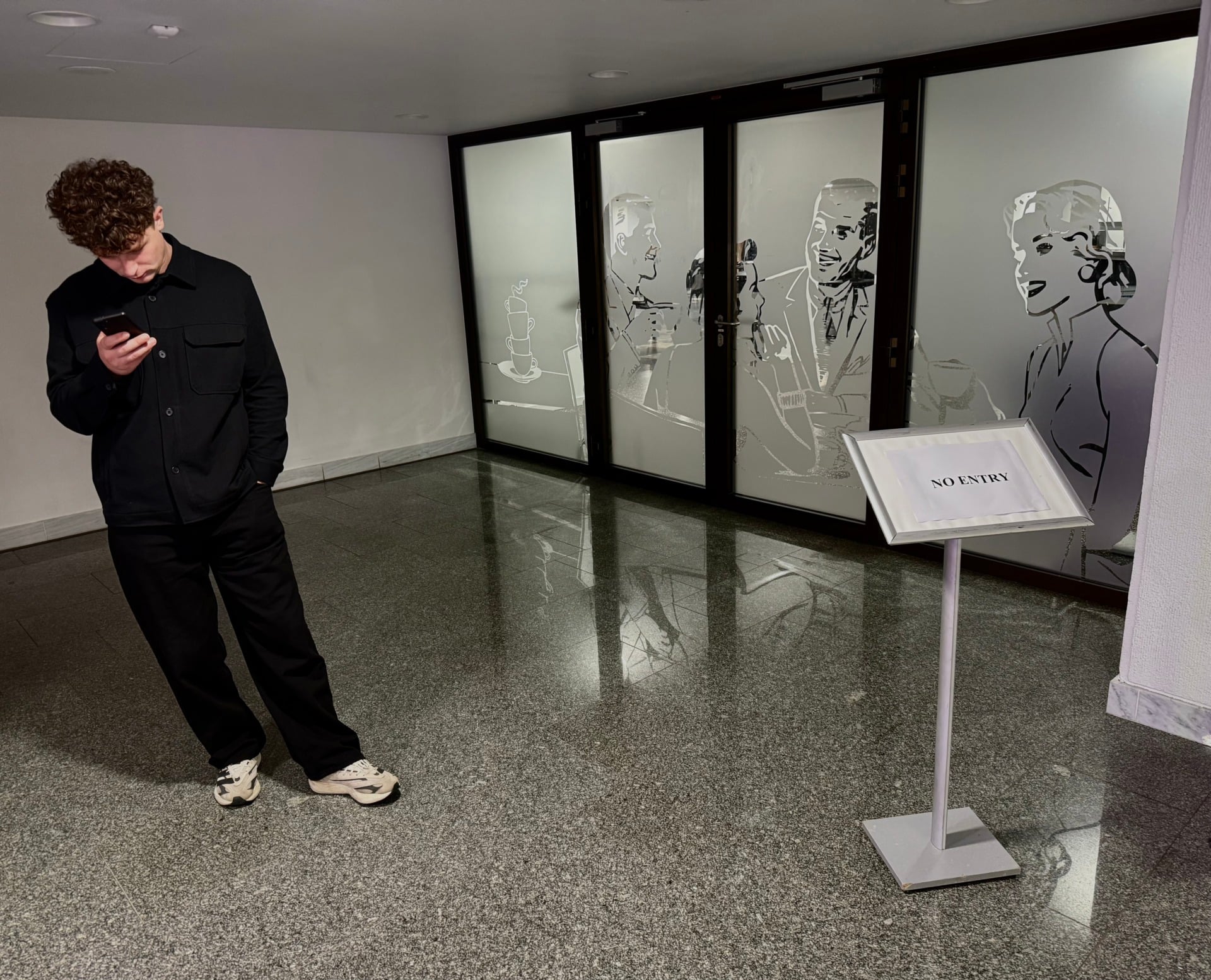
Though I wound up being the only American journalist in Lithuania, my NordVPN handlers were exceptionally gracious hosts who laid out the red carpet. My first full day in Vilnius began at the company HQ, where the LCD marquee in the lobby welcomed me by name and a bunch of pics pulled from my socials. After that, we went up to a conference room where various teams across the company presented back-to-back slide deck presentations about the dark web. This endurance test was broken up by a heavy meat-and-potato lunch of the country’s national dish, Cepelinai. I was nearly comatose by the time we got back and the afternoon’s PowerPoints began.
After the info dump gauntlet (and a brief siesta), my wonderful hosts and I met once more for a farewell dinner in the revolving restaurant at the top of a repurposed TV tower. Approaching the base, I was told about the massacre that had occurred there in 1991, when Soviet tanks invaded the newly-independent nation and ran over and killed those defending the tower. Not knowing how else to respond, I offered a respectfully solemn “wow.” After our meal of great food, drink, and conversation, we said our goodbyes, and I was handed a gift bag containing a rain jacket emblazoned with the NordVPN logo, a Nord special blend of single-origin ground coffee, some (more) Saily eSIM vouchers to keep me online while abroad, and a jar of mystery gummies that I still need to translate before eating.
Silicon Valley, Everywhere
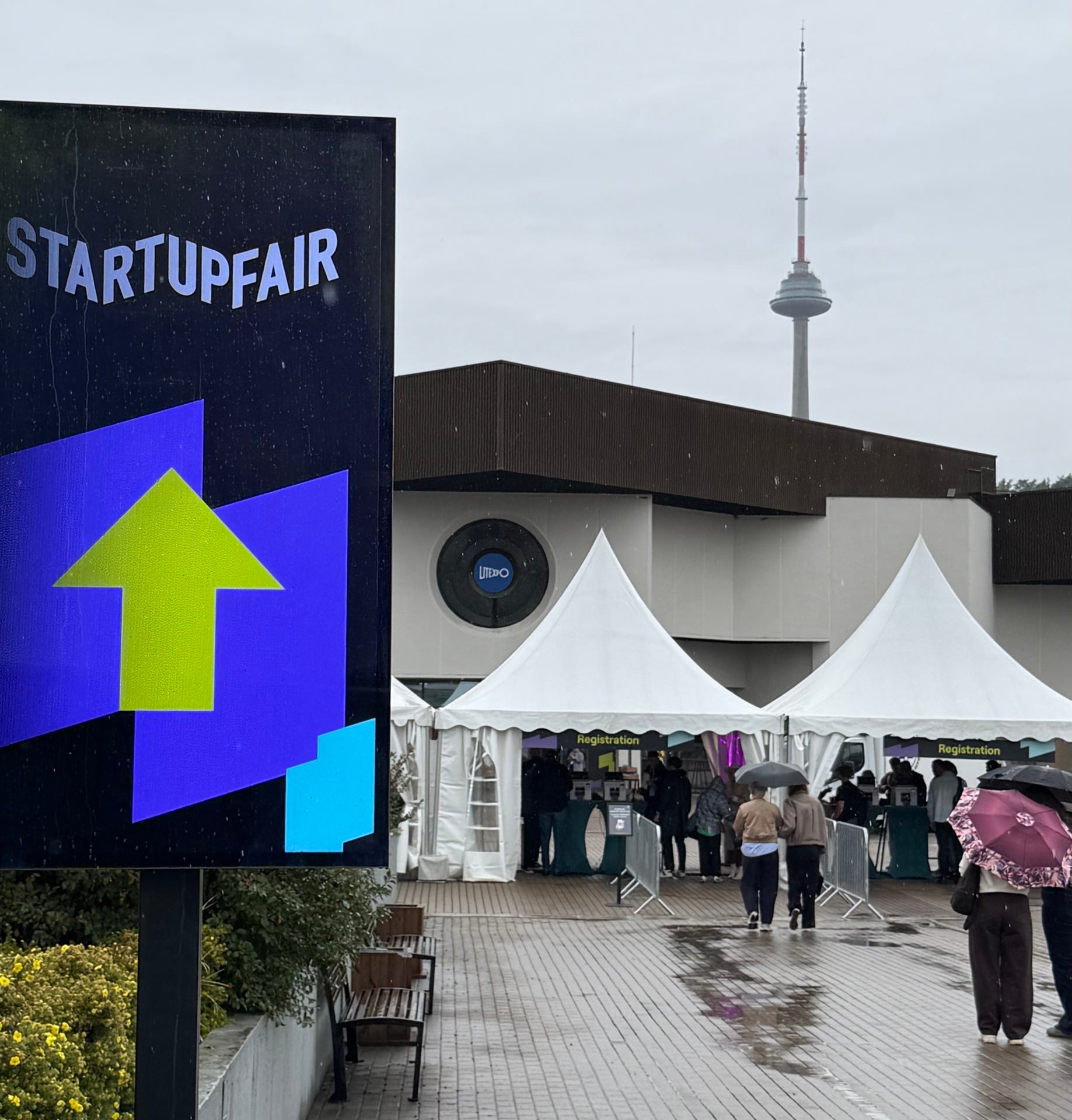
Day two was spent at a grim startup fair, the scene perfectly set by intermittent gray-skied drizzles. Inside the convention was what I can only describe as the LinkedIn brain disease recombining with delusional AI optimism. I was immediately floored by how borderless and homogenized the trappings of startup culture had become. Everyone here looked, spoke, and moved like their Silicon Valley counterparts, albeit with a bit more European style. Some of the fledgling businesses were taking eyebrow-raising big swings like trying to treat schizophrenics with LLM chatbots. There was also frivolity, like an AI slop filter photo booth I got to try before the people at that pro-data center party. Though not surprising, I was nonetheless concerned that every startup I encountered involved AI in some way. I’ve made peace with America’s elite betting our entire future on a bubble that will eventually burst after they’ve made their clean exit. I hadn’t yet considered how much that plan relied on a Pied Piper Ponzi scheme of sending smaller nations off the cliff behind us.
As I waited in line for a coffee, I got to chatting with the guy in front of me and heard his pitch. His startup had an AI model run 25,000 iterations of a query—a number he repeated so much that I wondered what I was missing—to determine how that business would show up in the results.
His go-to example was asking it for a “good pizza” recommendation in the area. I asked him to tell me, like I’m an idiot who knows nothing about AI, what prospective clients would even be paying for—a dataset from those findings? Insights into them? And why would they come to him when they could run those same queries themselves? And once he’d determined that the model’s just pulling from Yelp, Reddit, etc. to compile its pizza rec list, isn’t the more salient task to have the AI explain its own collection procedure and/or the methodology its sources use in their own rankings so as to find ways to game these systems and boost a lesser-known pizzeria up in the rankings?
My new friend said he had not considered these factors, but was intrigued by my idea of providing customers with analysis. Undeterred by or oblivious to my confusion about what his company even does and noticing that my “MEDIA” lanyard differed from his own, he then asked for my LinkedIn and whether I might be keen to write a story about him.

Most of my conversations that day were similarly uncanny—me smiling and nodding along like an empathetic psychologist while the patient on the other side shares their delusions of grandeur and the magical thinking they’ve used to chart their path to that successful outcome. But it’s hard to not feel like you’re the crazy one in a room where everyone else is clearly there to be (or be wooed by) an Elizabeth Holmes type—prior to her downfall, of course. As YCSE’s case study shows, it matters less and less if a belief is delusional or grounded the longer you keep at it. Whether you knowingly cocoon yourself in a false reality through lies or subconsciously for comfort, that distortion bubble eventually becomes “your truth.”
What Made Theranos Different?
The larger, lesser-acknowledged scandal surrounding Theranos is the sheer number of successful companies out there that built their businesses by committing the same sort of crimes that took down the biotech startup’s executives. These success stories simply had the runway and institutional backing to white-knuckle through the lawless days, start turning a profit, and thus become too big and lucrative to prosecute.
Take Uber, a company built by intentionally and systemically violating laws. “We’re just fucking illegal,” executives boasted over emails found in a trove of leaked files. Oracle notoriously sold vaporware for years, building minimum viable products after the deal was closed.
Holmes was clearly swimming in the same “move fast and break things” waters as the above “success” stories. Of course she’s an avaricious, manipulative psychopath. They all are. And our government and economy are designed specifically to nurture and reward those who exhibit that behavior. Like so many before her, Holmes just had the misfortune of being left holding the bag when Theranos’ house of cards was exposed at the moment and in the manner it was. Once it was clear Theranos had no chance at weathering the storm, the more powerful figures she’d been toasting Kool-Aid cups with moments before saw her blood in the water as the opportunity to carve their pound of flesh.
Maybe they were quicker to sacrifice her at the altar because she’s a woman. Her defense team argued as much. While the scandal was in its early stages, some soft news outlets even provided her with journalistic cover, like this Good Morning America headline: “Youngest Self-Made Female Billionaire Elizabeth Holmes in Harsh Spotlight Amid Theranos’ Criminal Probe.” First they came for the Girl Bosses…
But for all the sexism that may have been at play in Holmes’s condemnation, her womanhood was also instrumental in her canonization. Well-meaning people, hoping to support the “women in STEM” historically relegated to the shadows, platformed Holmes and equivocated away concerns about her story they might not have otherwise.
“If she had not been a woman, I would have been less motivated. That was part of what compelled me,” journalist Caitlin Roper admitted to WIRED, recounting an old interview where Holmes misled her. “I felt sympathetic to the idea of her outfit and her weirdness, because I related to the idea that she was passing in some way in that environment, needing to assert herself.”
Even though I understand that the splash of cold water YCSE provided helped open my eyes and a story like this is one of my most heartfelt attempts at showcasing the truth I’ve ever written, I can’t help but feel like an asshole. PR folks aren’t bad people. Many are even great people who care deeply. They’re just doing their jobs, which revolve around finding ways to surreptitiously access consumer brains, where they can incept the client. The people at the startup fair aren’t there to try and commit fraud. They’re earnestly promoting the businesses they believe in. At least at first, Holmes presumably was too. If there was a future cautionary tale in my midst that day, I didn’t see it. Only time and prosecutorial discretion will reveal.
While I’ve wondered what it says about their estimation of tech journalists that they felt it necessary to explain a Tor browser to me during our time in the conference room, I want to make abundantly clear that, in no way, am I attempting to insinuate that NordVPN is anything like Theranos. From everything I’ve heard anecdotally, people seem to like their products. But I haven’t reviewed them, so I won’t comment. A few of the internal research findings they presented to me were intriguing. The black market rates for various bits of your personal data would have been the much shorter story I’d written had I not dragged my feet so long that a once-in-a-lifetime doc was able to blindside me with a reality check. It’s a shame that what seems like a decent company, particularly so when compared to the rest of Big Tech, wound up with the short straw and is now being sacrificially offered by me. It’s not fair to either of us that the norms of this business have become so perverted that it feels like a betrayal when a sudden bolt of moral clarity causes one party to unexpectedly perform their duties not just by letter, but in spirit too.
But they’ll be ok. I’ve seen their campus. And I won’t operate under the delusion that this article, now as long as YCSE, will solve tech journalism’s existential problems. I’m not even sure I can honestly promise I’ll never be seduced into accepting some form of access at an indeterminate future date. I’m hoping I’ll be a PR industry persona non grata for a while if this story does well enough. But history tells me they’ll eventually welcome me through the henhouse doors again.
In the meantime, all I can do is follow Fielder’s example—hoping I can do some good by offering the world my carefully-crafted glimpse of the truth I’m exposing, shaping, and questioning all at once.