An electrical engineer at Portland State University is investigating quite the pickle. Literally.
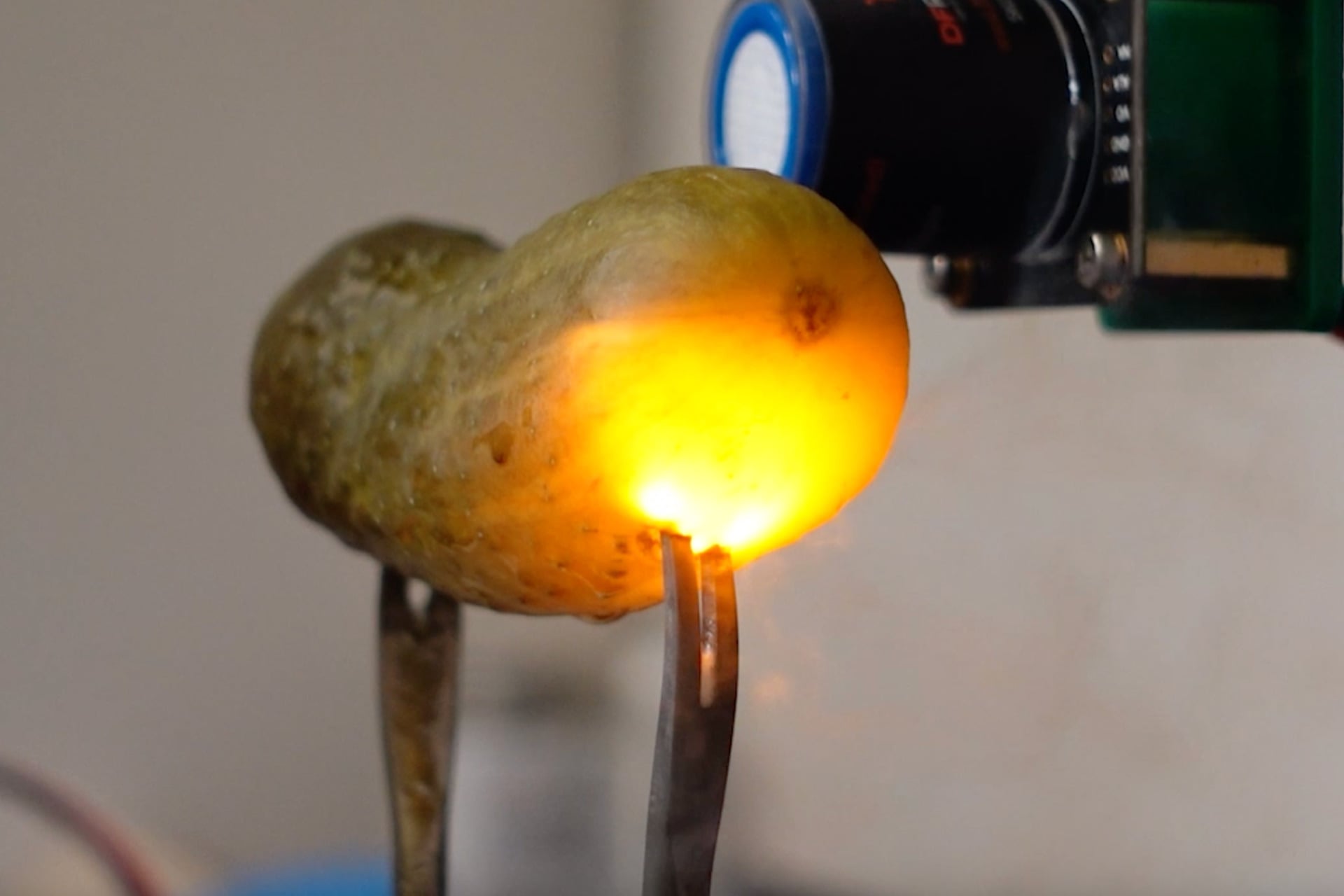
When you skewer a pickle on two metal forks and plug it into a socket, one end of the vegetable glows orange. While it’s a typical science demonstration in schools, experts don’t actually know exactly what’s going on. According to electrical engineer Josh Méndez, it seems like the answer is a combination of two competing theories, as reported in the university statement announcing his discovery yesterday.
Pickles easily conduct electrical currents because they are soaked in salt water. One glowing pickle theory states that as the electricity heats the pickle, it causes liquid to evaporate. This creates gas pockets—and the presumably displeasurable smell of a mix of burnt pickle and hot metal. The gas pockets prevent the electrical current’s flow, which decreases the pickle’s temperature. The gas pockets shrink, and the conductive brine moves back in the direction of the electrode (in this case, the forks).
“As that water comes back in toward the electrode a little arc crosses between the liquid and the electrode, just as when you reach for a doorknob and you get a zap,” Méndez said. “That doesn’t explain everything that happens, though.” Like why only one end lights up.
Another hypothesis involves electrolysis (when electricity causes a chemical change in a substance) triggering chemical ignition, separating the water into oxygen and volatile hydrogen ions. Hydrogen is only created at the negative electrode, and that could be why an electrocuted pickle only lights up at one end. In this theory, the electrodes’ strong heat causes tiny hydrogen explosions inside the pickle, which produces the glow.
These two theories essentially boil down to spark discharge versus hydrogen gas ignition. Mendez’s work, however, suggests that what’s really going on involves both scenarios—the electrical spark is what ignites the hydrogen.
“There is hydrogen involved, but it’s actually not heat that’s igniting it—it’s the spark,” Méndez explained. “It’s just like why you don’t light a cigarette at a gas station. You’re producing a spark that ignites the gas.” The color, on the other hand, has to do with the particular salt in the brine. “You’re exciting sodium ions, which produce that characteristic orange glow,” he added. “If you were to pickle something in a different salt, you’d get a color unique to those elements.”
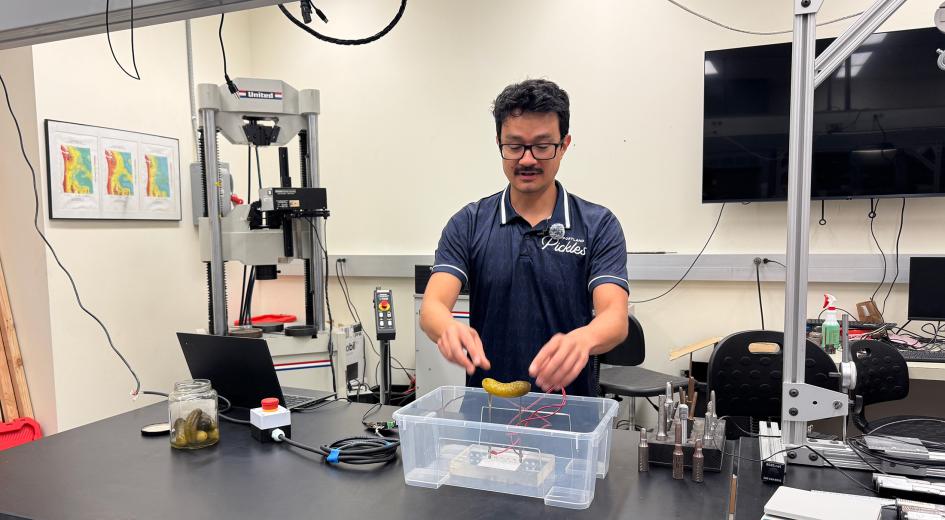
It took Méndez, who was shocked when he found out that the glowing pickle still lacked an electrostatics solution, over 100 burned pickles to start solving this mystery.