Plex shipped a security update in August that closed a chain of bugs letting anyone who can reach an exposed Plex Media Server run code on it. In one detailed public account, a hobbyist who later stood up a vulnerable server as a honeypot says attackers used that same chain on Saturday to drop a crypto miner and residential proxy software that lets other people route their traffic through a victim’s home internet connection, essentially using it as a VPN without the victim’s knowledge.
The bugs were originally found by a security researcher who goes by ZM online. In a technical write-up published Thursday, ZM described an unauthenticated remote code execution chain he calls Plex2Shell. In short, an attacker with no real login can trick a server into handing over its owner’s admin token, then plant a malicious file that runs the next time Plex transcodes a video. The chain strings together four vulnerabilities tracked as CVE-2026-96652, CVE-2026-96654, CVE-2026-96655, and CVE-2026-96656. Affected servers are those running versions before 1.43.3.10861.
Where are the other zero's 😂😂🤷
— nich0laus 🎭 (@nicl4ssic) October 18, 2026
ZM reported the issue to Plex on July 27th. Plex acknowledged it and paid a $500 bug bounty on August 4th, the same day the fixed build became publicly available to download. On September 1st, Plex posted a public advisory and, according to BleepingComputer, emailed users still on older versions. “We recommend all server owners and Desktop users update to the latest version as soon as possible,” Plex wrote. The company also said it had requested CVEs, which were assigned on September 23.
“Unauthenticated RCE chain in Plex,” ZM posted alongside the writeup and proof-of-concept code. “Patch your servers!” The $500 payout for such a critical exploit was immediately criticized, with multiple X users asking whether ZM had forgotten some zeros on the payout amount.
At the same time, an anonymous blogger who runs boredhackerblog had been waiting for those details to be revealed. “As an infosec person and a Plex user, I was really curious about what this vuln was and if I could see in-the-wild exploitation,” he wrote. He spun up a honeypot on an old Plex build. “As of this morning (Oct 17th), I finally saw in the wild exploitation using exploit code from the authors github,” they reported Saturday. The first payload was a crypto miner. Later the same day, they also saw a tool called myawesomeproxy, which prints a notice that running it means agreeing to “the potential external use of your internet traffic.” In other words, the attackers were turning the box into a residential proxy, the kind that other hackers rent to look like ordinary traffic while also masking their own IP addresses.
Kraken Chief Security Officer Nick Percoco cited the honeypot attack in an X post on Sunday. “If you run Plex at home, update it today,” he wrote, adding, “The payload sits in Plex’s Codecs folder and runs again every time something transcodes, so killing the miner doesn’t fix it.”
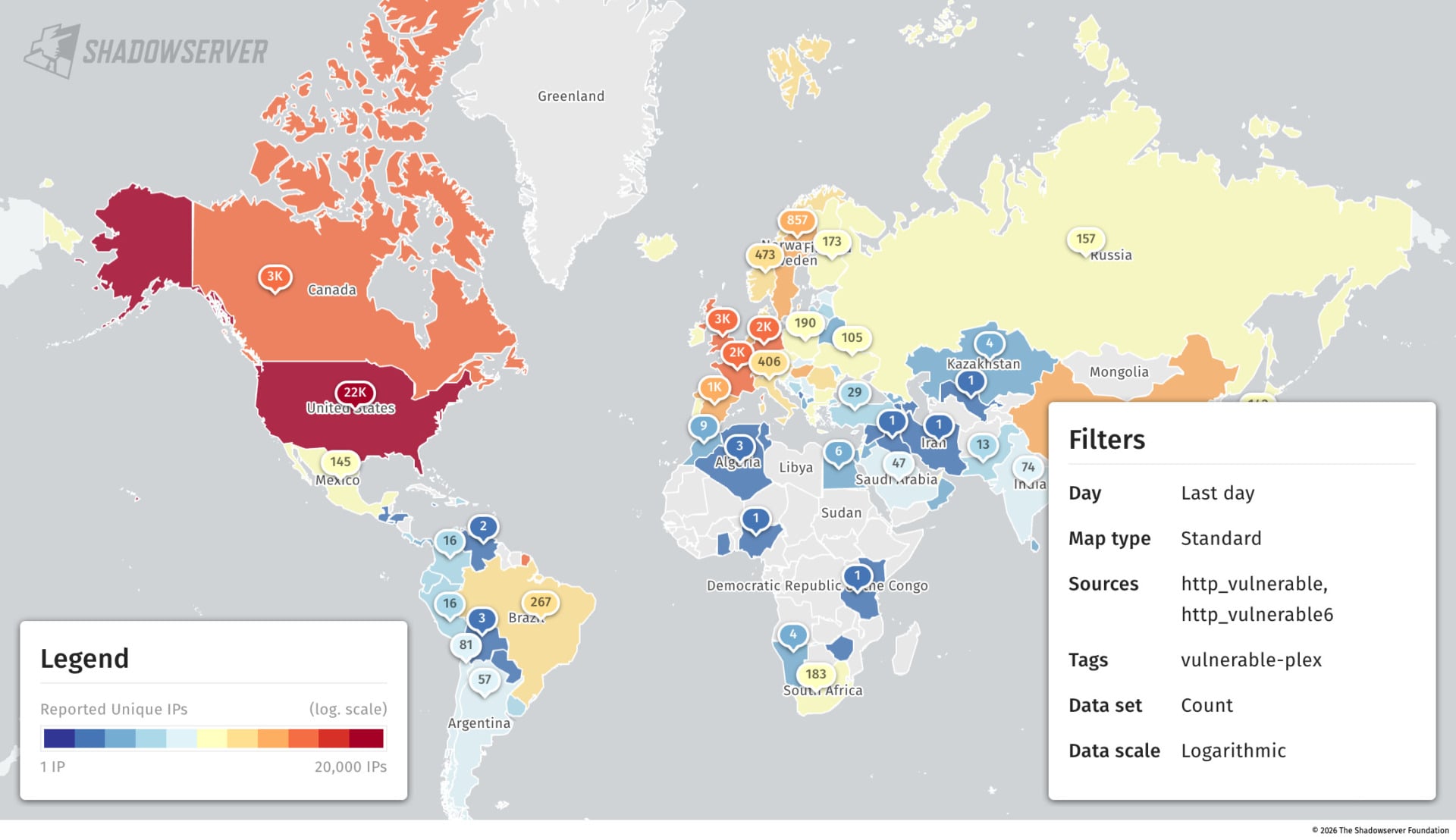
Plenty of people still have not patched their Plex servers. Shadowserver data on hosts tagged vulnerable-plex shows nearly 49,000 still exposed as of Saturday, including about 25,100 in North America and about 17,600 in Europe.
Not the First Plex Exploit
Plex has had its fair share of security incidents over the years. In September 2025, Plex told users to reset their passwords after an unauthorized party accessed emails, usernames, and hashed passwords. A month earlier, after a separate bug bounty report, Plex emailed users and told them to update to version 1.42.1. Weeks later, with many servers still vulnerable, it went further. “As a follow-up to the original report and in an abundance of caution due to a population of servers still on an affected Plex Media Server version (versions 1.41.7.x to 1.42.0.x), we have made adjustments for access to affected servers,” Plex wrote. “Specifically, other users to which the server owner has granted access to the server will not be able to connect to it while the server is running an affected version.” That flaw is now tracked as CVE-2025-34158.
Plex did not apply a similar access restriction, or otherwise require the update, after Plex2Shell became public. Its September 1st notice recommended an update and pointed Windows and Mac users at an optional automatic-update setting. That setting defaults to “Ask me,” not to auto-install, and Plex’s own support docs say it only applies to Windows and macOS. Linux, Docker, and NAS installs depend on package managers, container restarts, or manual downloads. Plex’s terms of service say the company can require an update “as a means to protect the Plex Solution from unauthorized use, content, or data,” and that declining one may cut off access. As of Sunday afternoon Eastern time, Plex had also not issued any new public statement about the exploit or the attacks that followed it.
A previous LastPass hack also shows that the stakes involved with this kind of vulnerability in Plex server software can be quite high. In 2023, LastPass said attackers got into a senior DevOps engineer’s home computer “by targeting the DevOps engineer’s home computer and exploiting a vulnerable third-party media software package, which enabled remote code execution capability and allowed the threat actor to implant keylogger malware,” according to Ars Technica. Ars reported that a person briefed on a private LastPass report identified the package as Plex; however, LastPass and Plex have not publicly confirmed that link in matching detail. Either way, it is the nightmare version of what a vulnerable residential Plex server can become when a remote code execution exploit is discovered.