No U.S. region is at greater risk of a catastrophic earthquake than Southern California. The hazard stems primarily from two volatile faults, the San Andreas and the San Jacinto. According to new research, stresses along these faults are the highest they’ve been in the last 1,000 years.
The study, published June 3 in the journal Journal of Geophysical Research, Solid Earth, underscores scientists’ concerns that this fault system is poised to produce a major quake, though the authors emphasize that it does not predict when such an event will occur. The findings also suggest that a critical fault junction northeast of Los Angeles could play a key role in how big the next major quake will be.
“The question of when and how the next major earthquake will occur in this region is one of the most pressing problems in applied geoscience,” lead author Liliane Burkhard, a geophysicist and planetary geologist at the University of Bern in Switzerland, said in a release. “Our results provide a clearer, physics-based picture of the current stress state of the fault system, and the framework we developed is not just applicable to California, but also for other complex fault junctions worldwide.”
Highest fault stress in a millennium
Video showing the stress accumulation time-series animation for the Southern San Andreas Fault System, spanning the years 1100 to 2025.
Earthquakes typically occur along the boundaries between tectonic plates. These fracture zones, or faults, accumulate stress as the plates slide past each other and become locked. Eventually, so much stress builds up that the plates suddenly slip, releasing all that stored energy in the form of an earthquake. The longer it’s been since the last big earthquake, the more stress may have accumulated along the fault.
The last major earthquake to affect the Los Angeles region was the Fort Tejon quake of 1857. With a magnitude of 7.9, it remains one of the largest temblors ever recorded in California. It’s been well over a century since this event, so scientists are concerned that the San Andreas Fault System could produce another major quake any day now.
To gain a clearer understanding of the present-day stress along the San Andreas and San Jacinto fault zones, Burkhard and her colleagues used computer simulations of the last 1,000 years of large earthquake activity to estimate how stress builds up on fault segments over time and how this affects neighboring segments.
Their physics-based earthquake cycle model simulates this process in three spatial dimensions over time. The researchers fed it with geological evidence of past earthquakes, such as radiocarbon dating, tree-ring anomalies, and historical records of ground ruptures. When they ran it, the results indicated that tectonic stresses along the San Andreas and San Jacinto fault zones have reached and, in some cases, exceeded the highest levels of the last millennium.
The critical role of Cajon Pass
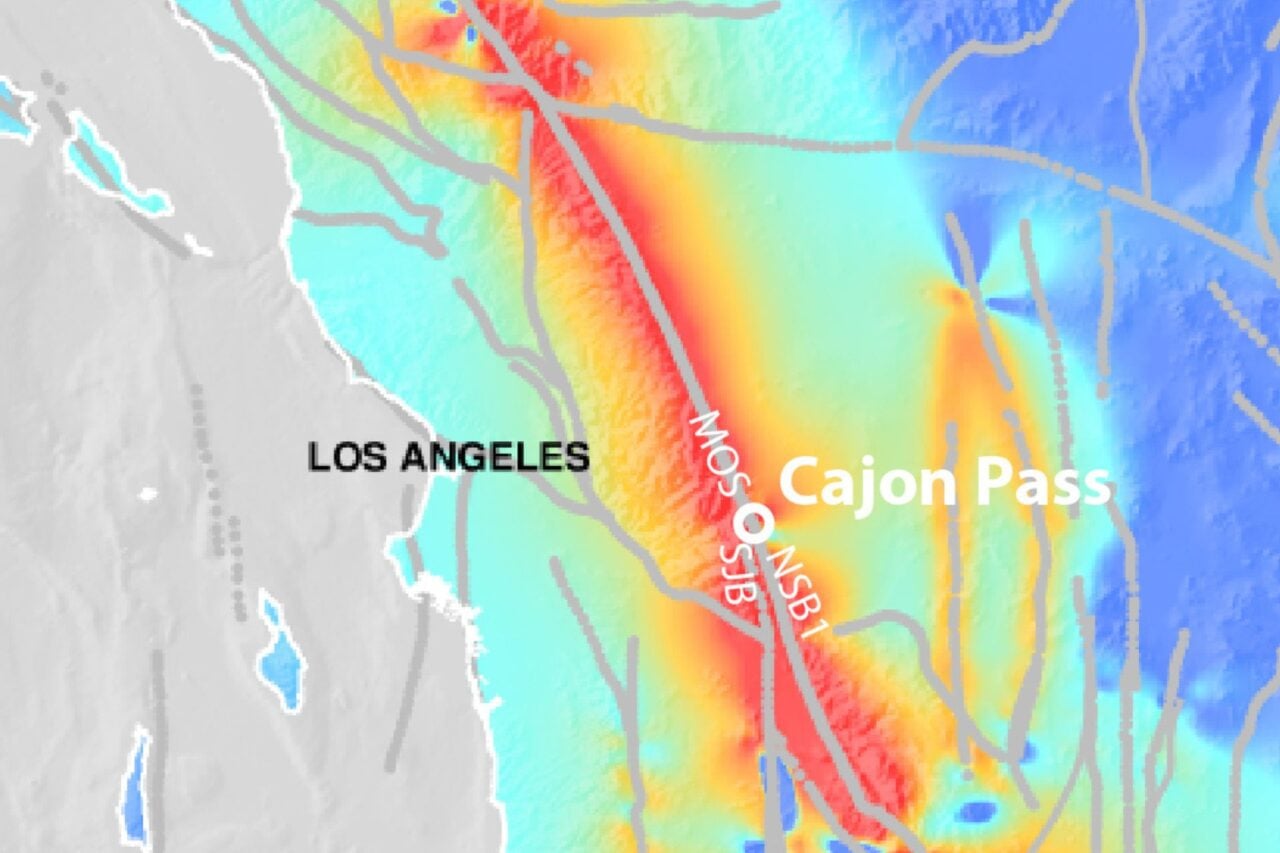
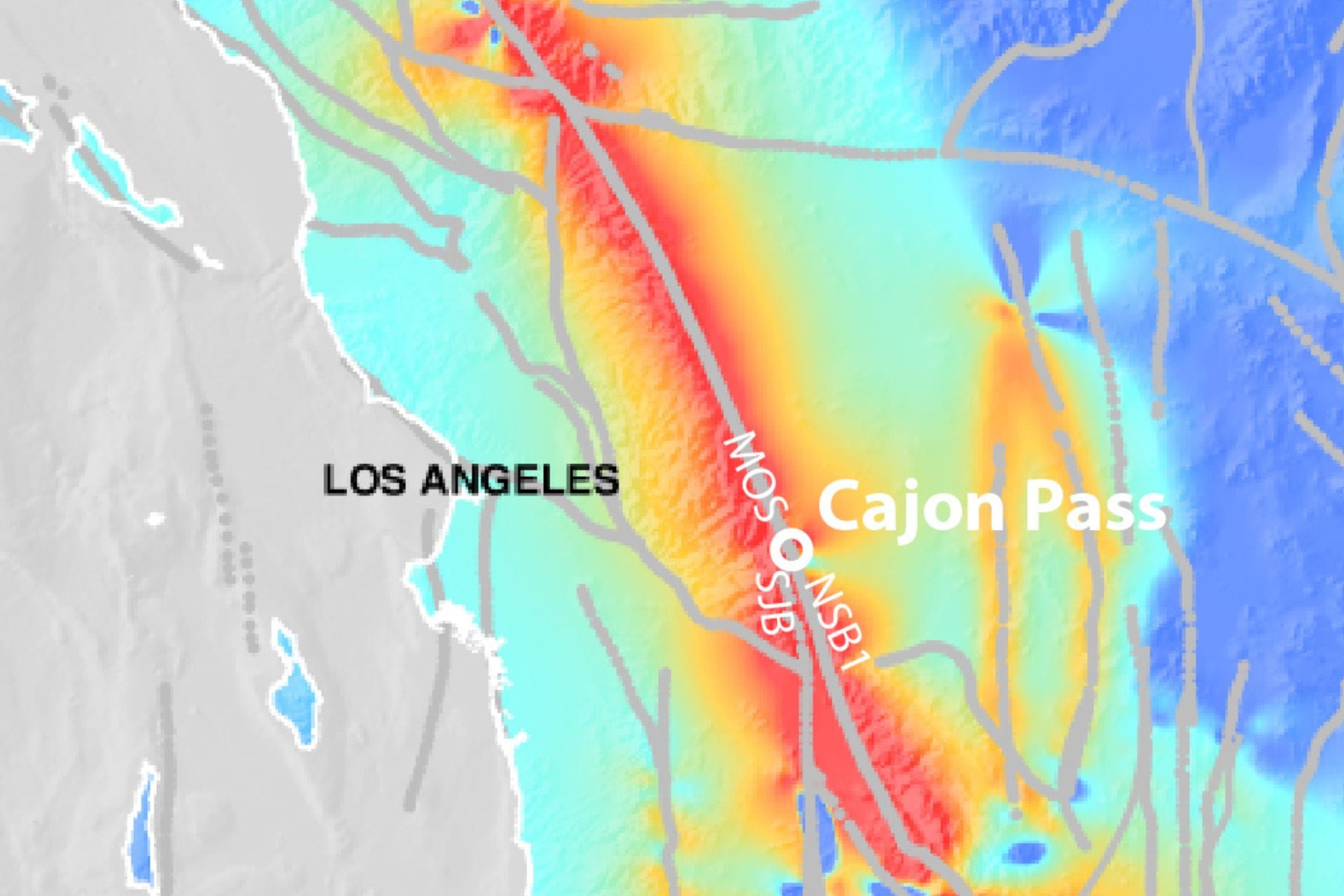
Cajon Pass is the tectonically complex junction where the San Andreas and San Jacinto faults converge. It’s located near several densely populated communities, including Los Angeles, San Bernadino, Riverside, and Coachella Valley. According to the study, this junction may pose a greater hazard to these areas than scientists previously thought.
Burkhard and her colleagues determined that Cajon Pass can act as a so-called “earthquake gate,” controlling whether large ruptures remain confined to a single fault or cross both fault systems. “The earthquake gate concept captures something important about how fault junctions work,” she said in the release. “Cajon Pass doesn’t simply block or channel earthquakes: It responds to stress conditions, and those conditions change over centuries.”
When stress on both faults accumulates simultaneously toward similarly high levels, it’s more likely that a large joint rupture will cross both systems, according to the study. The model showed that stress has reached 3.6 megapascals (MPa) on the San Jacinto-Bernadino section, the highest level seen anywhere in the 1,000-year simulation. Meanwhile, the neighboring Mojave South section of the San Andreas fault has accumulated 2.8 MPa of stress, indicating that both segments are under similarly high levels of strain.
“So not only is it concerning that the stresses are reaching historic highs, but also that the relative stress conditions between the two fault systems are approaching the range we associate with major ruptures crossing both faults simultaneously—and that is a scenario with much larger consequences for the region,” Burkhard explained.
Again, this study does not predict when the next major earthquake could rock Southern California, nor does it show that such an event is necessarily imminent. Rather, it offers a clearer picture of the region’s seismic hazard. This critically stressed fault system could rupture at any time, so communities need to prepare for the worst-case scenario. Burkhard hopes the hazard-assessment framework she and her colleagues built will help California and other seismically active parts of the world protect themselves against the next big quake.