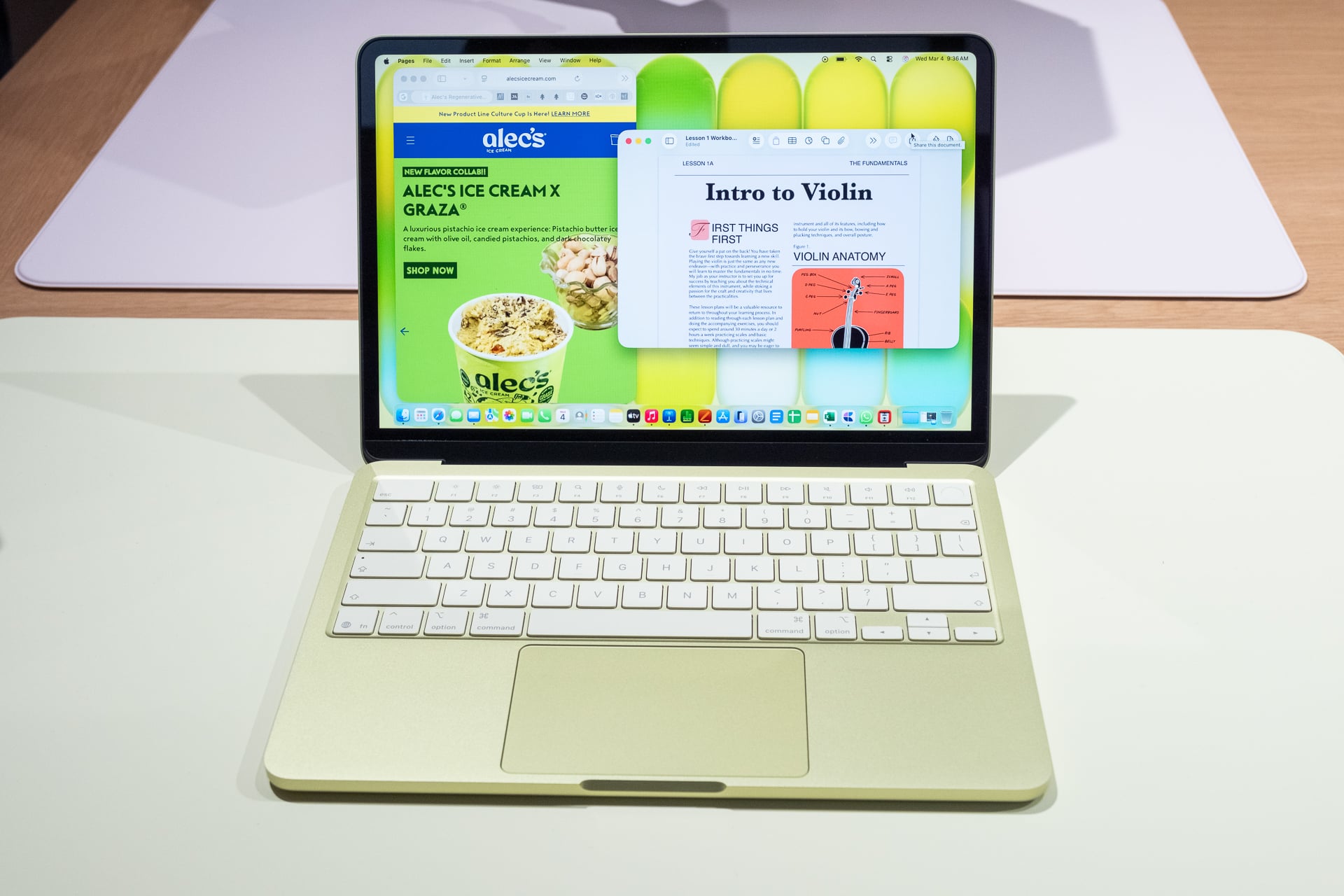
The first MacBook Neo rival has slunk into the saloon, spurs rattling, ready to square off on price and performance metrics. Multiple major manufacturers are already attempting to craft their own answers to its $600 price point. But whether Apple is even sweating, with all these big guns pointed at its face, remains a serious question.
Multiple major laptop makers are crafting their own answers to MacBook’s Neo’s price point with lightweight laptops. China-centric tech giant Honor unveiled its new X14 laptop over the weekend at a list price of 4,399 Chinese yuan, which converts to roughly $645. The notebook appears to be the first commercially available product to feature Intel’s latest Wildcat Lake chips, namely the Intel Core i5-320. It also packs 16GB of RAM and 512GB of SSD storage, more than the 8GB of unified memory and 256GB of storage you get on a $600 MacBook Neo (the $700 model comes with a 512GB SSD).
There are more similar laptops coming. Chinese retailer JD.com (via WCCFTech) listed several more Wildcat Lake laptops, including one from the Taiwan-based Asus. That’s notable, since Asus Chief Financial Officer Nick Wu said back in April that the Neo was “a shock” to the PC market. Though Honor’s gadgets won’t appear on Best Buy’s shelves any time soon, we expect similar lightweight laptops to come to the U.S. and other Western countries in due course. We’ll probably learn exact details and dates at the annual Computex computing conference next month.

Industry analysts, such as Patrick Moorhead of Moor Insights & Strategies, have told Gizmodo that Intel’s Wildcat Lake represents PC makers’ “best chance” to build a laptop that can compete with the MacBook Neo. Already, we’ve seen a few benchmarks of the Intel Core 5 320 and Core 7 350 make the rounds. The latter, more powerful chip beats Apple’s own A19 Pro by about 9% in Passmark’s multicore tests. However, the Core 5 320 may offer performance nearly on par with that of Apple’s mobile chip. It’s still enough to beat the current Neo’s A18 Pro.
Apple’s A19 Pro processor, which was first built for the iPhone 17 Pro, is beating the Core Ultra 7 by slightly more than 19% in single-core races. These tests are telling. Apple’s iPhone chips are designed for battery efficiency and to maximize how quickly your phone loads a browser page—hence the strong single-core performance. Intel’s chips are better built to handle multiple operations at once.
1ST @PassMarkInc sample of IC7 350 (WCL)
2.743 3DGMark w/only 2Xe3 18A cores=1.371 p/core (5.135 140V 8Xe2 N3B, 4.499 130V 7Xe2 N3B. 641 p/core approx)
Everyone was looking at PTL, I was looking at a top seller, I was looking at WCL!
Great Job Intel!
To be continued= IC7 360 pic.twitter.com/pdt5Znge0W
— X86 is dead&back (@x86deadandback) May 17, 2026
Those buying a MacBook Neo—Apple fans or not—aren’t the types who expect to do much more beyond typical browsing, multimedia, office work, typing, note-taking, or other tasks that don’t demand more performance explicitly. With 16GB of RAM, you should expect faster operation than the Neo’s 8GB, but by how much is a question saved for later.
Just like the man with no name in Sergio Leone’s seminal Western film A Fistful of Dollars, the MacBook Neo is walking into this gunfight with hidden armor covering its most sensitive bits. Apple’s low-cost Mac features an all-aluminum frame that helps it feel just as nice to hold or use as any of the company’s pricier Macs. They are equipped with a bright 2,408 × 1,506-pixel screen and speakers that are good enough to play your tunes without making you wince. Honor’s X14 promises a 1,920 x 1,200 display and 300 nits of brightness, less than what Apple is claiming.
The ultimate goal with these low-end clamshells is to feel as premium as a $1,000+ model without too many noticeable compromises. Apple has far more control of its entire supply chain than smaller PC makers, who will necessarily struggle to catch up. A cheap, well-performing chip may not be enough.