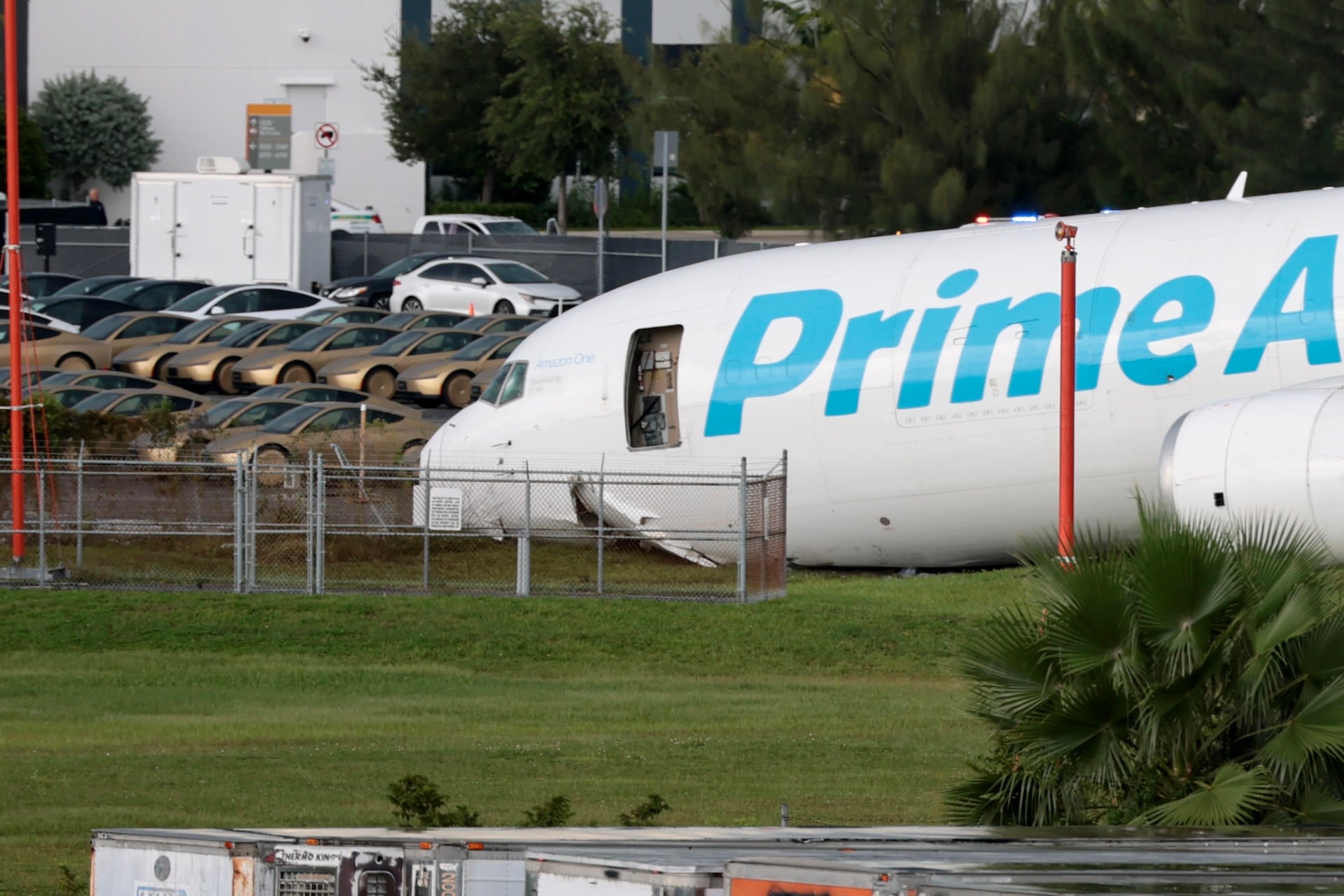
In an event Elon Musk has called “Weird,” the Amazon cargo plane involved in a tragic crash on Sunday in Miami very nearly wiped out a parking lot full of Tesla Cybercabs.
Last week, Tesla announced that Cybercabs, its gold-colored autonomous vehicles with no steering wheels or pedals, were now available to provide rides as part of the company’s app-based ride-hailing service, but only in a very limited coverage area in Austin, Texas.
On Sunday, an Amazon Prime Air cargo plane at Miami International Airport experienced some kind of malfunction in the air just before touchdown, and ended up overshooting its runway. In a horrifying turn of events, it crashed into a cargo van carrying an airport cleaning crew, as well as an SUV just outside the airport. There were five fatalities.
The plane skidded to a stop just shy of a parking lot where, for reasons unknown, Tesla Cybercabs were parked.
🔴 La FAA annonce la fermeture jusqu’à nouvel ordre de l’aéroport de Miami suite à la violente sortie de piste du Boeing 767 de Prime Air.
Les services d'urgence de l’aéroport signalent plusieurs victimes après l’accident. pic.twitter.com/bQrNaNw97l
— air plus news (@airplusnews) September 6, 2026
According to a map of the crash site, which relies on data from FlightRadar24 and the Federal Aviation Administration (FAA), the final position of the wrecked plane corresponds to a parking lot for truck trailers that can be rented by the acre. The day before the crash, EV influencer Sawyer Merritt shared someone’s video of that very lot with 35 Cybercabs parked in it.
As noted by the Tesla website, there is Tesla Robotaxi service in Miami, but there is not Tesla Cybercab Robotaxi service. That is to say, all the current Robotaxis in the Tesla autonomous fleet in Miami are Model Y vehicles with pedals and steering wheels. Until late last month, Tesla rides not only relied on vehicles with steering wheels and pedals, but also human safety monitors in the driver’s seat. But they appear to have gone fully unsupervised in Austin ahead of the limited Cybercab rollout.
The full Tesla fleet of Model Y vehicles in Miami is purportedly unsupervised, though at launch in early July it comprised just two vehicles, and then three two days later.
But according to Elon Musk, Cybercabs aren’t intended to exist only as the private property of Tesla, Inc. He says individuals are supposed to be able to buy them, both for personal transportation, and as a way of making passive income. Musk claimed earlier this year that private Cybercabs will cost $30,000 or less, and be available before 2027, which means in less than four months.
Tesla started manufacturing them in April, naturally at its Gigafactory facility in Texas. The company has the capacity to build 125,000 Cybercabs per year. A particularly snarky Sherwood News headline described Cybercabs as “piling up,” apparently unused. Tesla-tracking social media accounts sometimes count the number of Cybercabs that accumulate in the Gigafactory’s Cybercab outbound lot at a time. They sometimes total more than 100.
There appear to be 45 registered Cybercabs on the road in Texas, some portion of which is operating commercially in Austin. That small rollout appears to have triggered a safety investigation by the National Highway Traffic Safety Administration, which will examine Tesla’s own logic for certifying Cybercabs as compliant with NHTSA safety rules. “Among other things, NHTSA will consider the extent to which Tesla’s certification depended on determinations that certain [vehicle standards] are inapplicable to the Cybercab,” the NHTSA’s memo about the investigation says.
Social media users often spot Cybercabs on public roads outside of Texas, though often with Texas license plates. Often, positive news about the Cybercab becomes fodder for Tesla fans who then create memes attempting to dunk on prominent Tesla critics, as if the roads of America will soon be painted gold with Cybercabs. Some were spotted in a lot behind a Tesla dealership in Pittsburgh last month. Social media users spotted some in a lot in Las Vegas about two weeks ago. When they’re spotted moving outside of the state of Texas, they often have steering wheels and pedals.
The fact that a plane almost crashed into a parking lot full of Cybercabs that had no clear reason to exist yet is a reminder that even if America’s roads aren’t being painted gold yet, many of its vacant parking lots may be.
Gizmodo reached out to Tesla about the reason the Cybercabs were in Miami, and about whether the plane incident had affected any future Miami rollout of Cybercabs as part of its ride-hailing service. We had received no reply at time of publication.