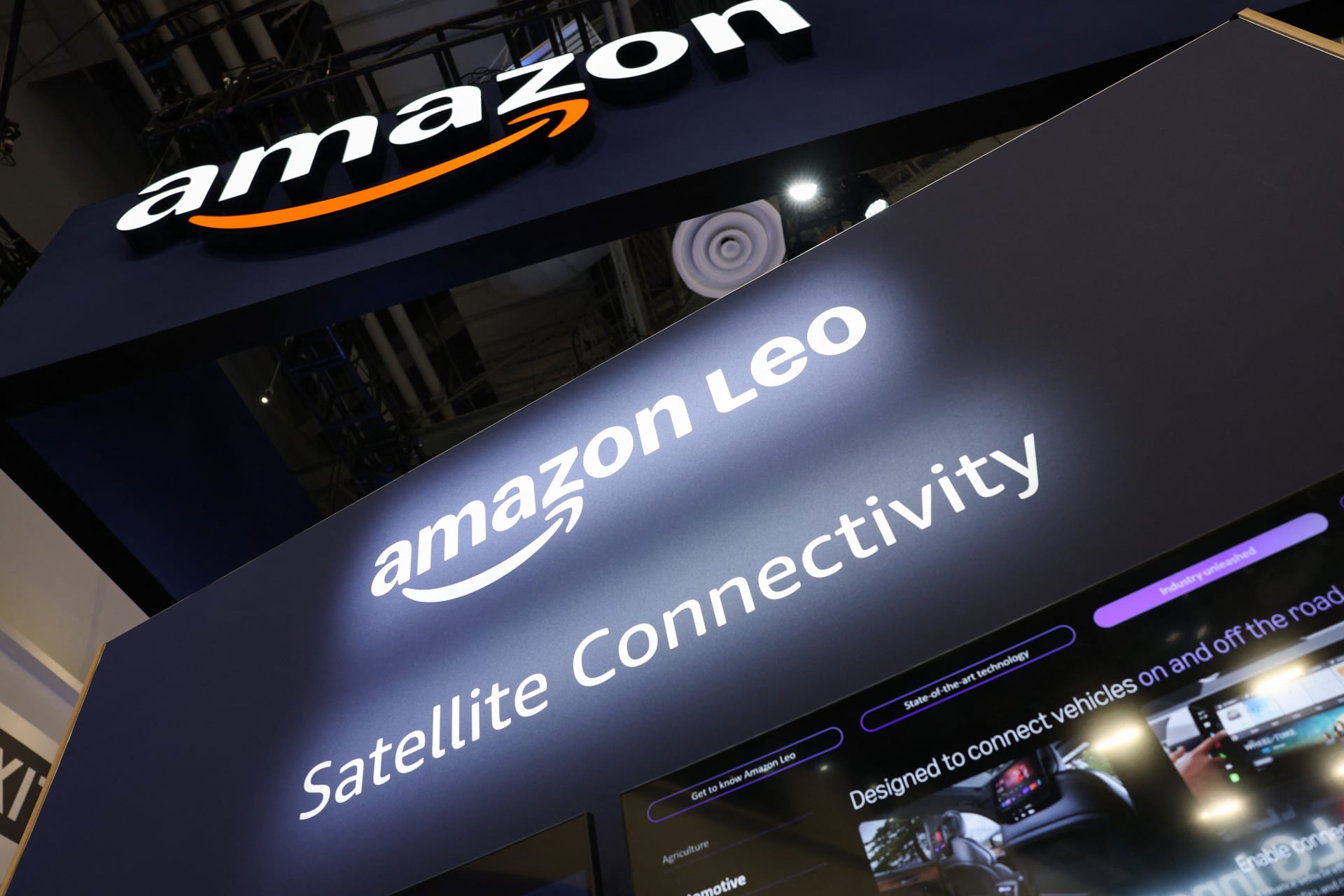
Amazon is acquiring satellite operator Globalstar, the tech giant announced on Tuesday morning. The acquisition is the latest signal that Amazon is determined to become a major competitor to Elon Musk’s Starlink.
Amazon began working on its satellite internet constellation Leo, née Project Kuiper, in 2019 in response to SpaceX’s Starlink, the world’s leading and fastest-growing satellite constellation. SpaceX has roughly 10,000 satellites in orbit, and the company launched its 1000th Starlink satellite this year alone, on early Tuesday morning. Starlink has over 10 million active customers across 160 markets around the country, the company said in February, and the technology is available to a range of customers, from major airlines like Lufthansa, which use it for in-flight wifi, to civilians caught in war zones.
Meanwhile, with only a little over 200 satellites in orbit and no commercial offerings yet, Amazon Leo has had a hard time catching up to SpaceX.
Nevertheless, Amazon is willing to put up a fight, and the tech giant has lofty ambitions for Leo.
“The complete Amazon Leo network will include thousands of advanced satellites in low Earth orbit and have enough capacity to support hundreds of millions of customer endpoints around the world,” the company shared in the press release.
Amazon CEO Andy Jassy said last week that services would officially launch mid-2026. Those ambitions are likely to benefit from the satellites that Globalstar already has in orbit, once the deal closes in 2027.
Globalstar is a Louisiana-based satellite telecommunications company. Apple owns a 20% stake in the company, and Globalstar powers Apple’s “Emergency SOS” features on iPhone 14 or later and Apple Watch Ultra 3.
As part of the acquisition, Amazon signed an agreement with Apple to provide satellite connectivity for Emergency SOS, Find My, and Roadside Assistance in current and future iPhones and Apple Watches.
Amazon also announced that it will deploy a direct-to-direct (D2D) satellite system in 2028. A D2D service, like Starlink Mobile, would deliver cellular service straight to user devices, such as mobile phones.
The competition between SpaceX and Amazon has been slowly heating up, and while Amazon has touted big goals, its ability to deliver on said plans has been questioned. That lack of faith was in full display in a recent public spat between Amazon, SpaceX, and the Federal Communications Commission.
Earlier this year, SpaceX asked the FCC for permission to launch up to 1 million satellites as part of Elon Musk’s efforts to build a giant constellation of space-based data centers. Amazon petitioned the FCC in March to deny SpaceX’s request, claiming that the plan seemed a little too ambitious and that launching a constellation of 1 million satellites could take centuries. FCC Chairman Brendan Carr snapped back at Amazon via X for the petition, saying that the tech giant “should focus on the fact that it will fall roughly 1,000 satellites short of meeting its upcoming deployment milestone, rather than spending their time and resources filing petitions against companies that are putting thousands of satellites in orbit.”
The FCC requires Amazon to have 1,600 satellites in orbit by July, a deadline the tech giant has recently asked to extend.