
When archaeologists encounter a site of interest or a collection of artifacts, they piece together a narrative to explain why and how they ended up there. And while experts do their due diligence to arrive at a reasonable interpretation, sometimes these can end up being hasty conclusions.
At least, that appears to be the case for atlatl use by Clovis hunters, according to a new study published today in the Proceedings of the National Academy of Sciences. Atlatls are handheld, rod-shaped devices used to throw flexible spears and darts. For a long time, archaeologists believed that Clovis culture, who occupied the Americas around 13,340 to 12,710 years ago, primarily used atlatls to hunt a variety of species, including large mammals. However, a statistical analysis using 66 radiocarbon dates for known atlatls strongly suggests that this hypothesis is poorly supported.
“Well, we’ve never found a Clovis atlatl—ever, in the archaeological record,” Metin I. Eren, the study’s first author and an archaeologist at Kent State University, told Gizmodo during a video call. “What our data shows is that the likelihood of finding an atlatl [from that era] is low, and there’s a 3,000-year gap between the projected earliest use of the atlatl and Clovis people.”
The earliest Americans
The Clovis culture is named after Clovis points, or spearheads with characteristic shapes discovered in the city of the same name in New Mexico. Atlatls, on the other hand, were first discovered in Europe and date back to the Paleolithic era, around 20,000 to 30,000 years ago. For a long time, the European upper Paleolithic was the “center of the Stone Age for a lot of folks, especially in the 70s and 80s,” Eren explained. Then the story became that the earliest Americans carried atlatls from Asia into North America, he added.
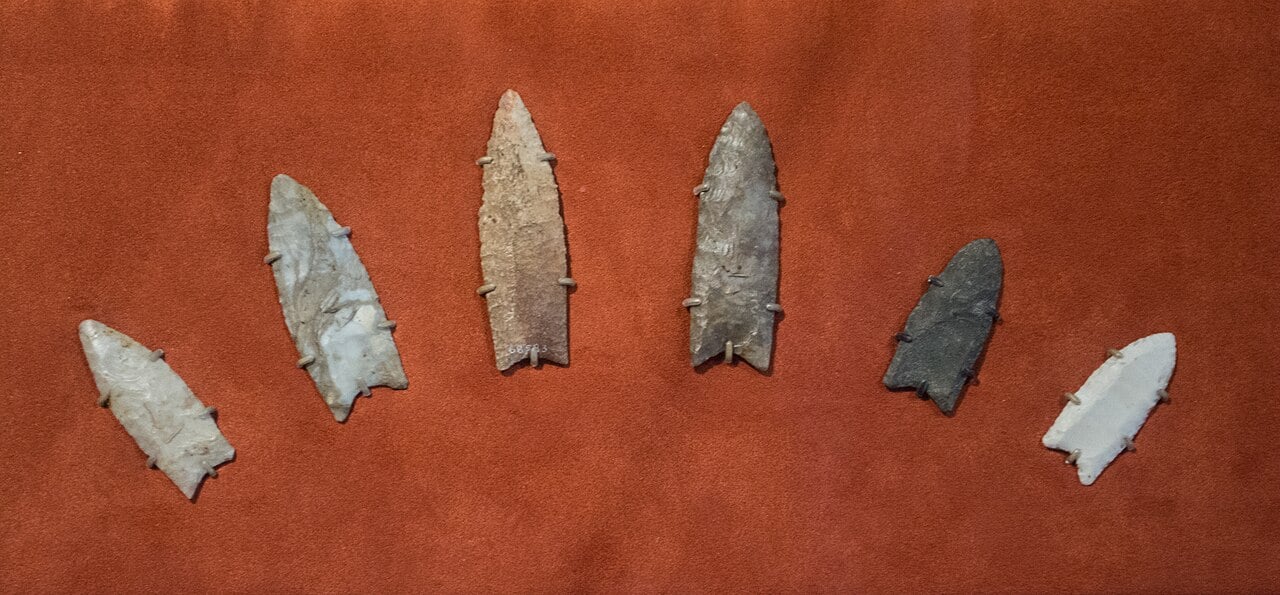
“But you know, it’s funny,” Eren said. “We’ve never found—as we say in the paper—preserved specimens of the atlatl in Asia, nor Stone Age Australia and Africa. So I think there was an idea of almost a hyperdiffusion of this technology.”
Following the trails
To test this hypothesis, the researchers used a statistical model from evolutionary biology that infers the predicted timing of a species’ arrival and extinction from observational data. In this case, the timestamps concerned the atlatl’s arrival and departure in the archaeological record of the American continent, based on 66 directly dated archaeological atlatl or dart specimens. According to their calculations, the oldest possible date for the appearance of the atlatl in the Americas was 9,996 years ago—roughly 3,000 years after the Clovis people.
Given these considerations, Eren and colleagues hypothesize that atlatl technology in the Americas might have evolved independently in a case of convergent evolution, separately from its invention in Europe. Eren added that such cases of technological convergent evolution are rather common in history, as humans, “faced with similar problems around the world…evolve similar technological solutions,” he added.
“To me, the lasting value [of this study] is that it should stop us from treating Clovis atlatl use as a settled fact and push archaeologists to take spears, javelins, and even bows seriously as hunting weapon alternatives,” Justin Pargeter, an archaeologist at New York University who wasn’t involved in the new work, told Gizmodo in an email.
On this point
The study’s quantification of atlatl ages demonstrates “how little hard evidence actually underpins” the assumption that Clovis hunters primarily used atlatls, Pargeter explained. That said, Pargeter added that the results don’t necessarily rule out atlatl use by Clovis hunters. The dated record of artifacts like atlatls “really tracks where and when those materials happen to survive, places like permafrost and ice patches, more than when the technology first appeared,” he said.
“The same chronological test run on wooden spears or cordage might yield results that ‘erase’ things we’re confident existed in the past,” Pargeter concluded. “So I read the paper as an honest measure of how perishable and patchy this kind of evidence is.”
Indeed, the study also affirms this idea, noting that it doesn’t reject the atlatl hypothesis. Rather, the results indicate the need to seriously consider different avenues for explaining Clovis hunting practices.
“The statistical analysis by itself doesn’t say they didn’t use the atlatl,” Eren said. “And the fact that we’ve never found evidence doesn’t mean they never used it. But when you put all of those things together, the notion that we should assume they used it is falsified.”