
NordVPN, Proton VPN, and ExpressVPN issue Indian IP addresses from servers in Singapore and the UK, which keeps them outside India’s VPN logging rules. Each unblocked JioHotstar in our tests, and ExpressVPN’s UK-hosted location was fastest from Europe at 182.82 Mbps. NordVPN comes first for its Mumbai location and a kill switch that kept traffic blocked even after a reboot.
Steps to Get an Indian IP Address in October 2026
- Subscribe to NordVPN, which has an India location.
- Install the app on the device you stream or bank on.
- Select India and connect. NordVPN lists it as Mumbai.
- Look up the new IP address to confirm it’s Indian.
- Sign in to JioHotstar or your bank. A stale cookie can still show the international version, so delete it and reload.
How to Get an Indian IP Address With a VPN
An India location in a VPN app assigns the device an Indian IP address. Changing your IP address this way also encrypts the traffic, as our guide to why you should use a VPN explains.
Pick a VPN With an India Location
Make sure India appears in the app’s location list before subscribing. We use NordVPN, which lists India as Mumbai. Choose a plan on NordVPN’s website, create an account, and pay.
Install the App, Connect, and Confirm the Indian IP Address
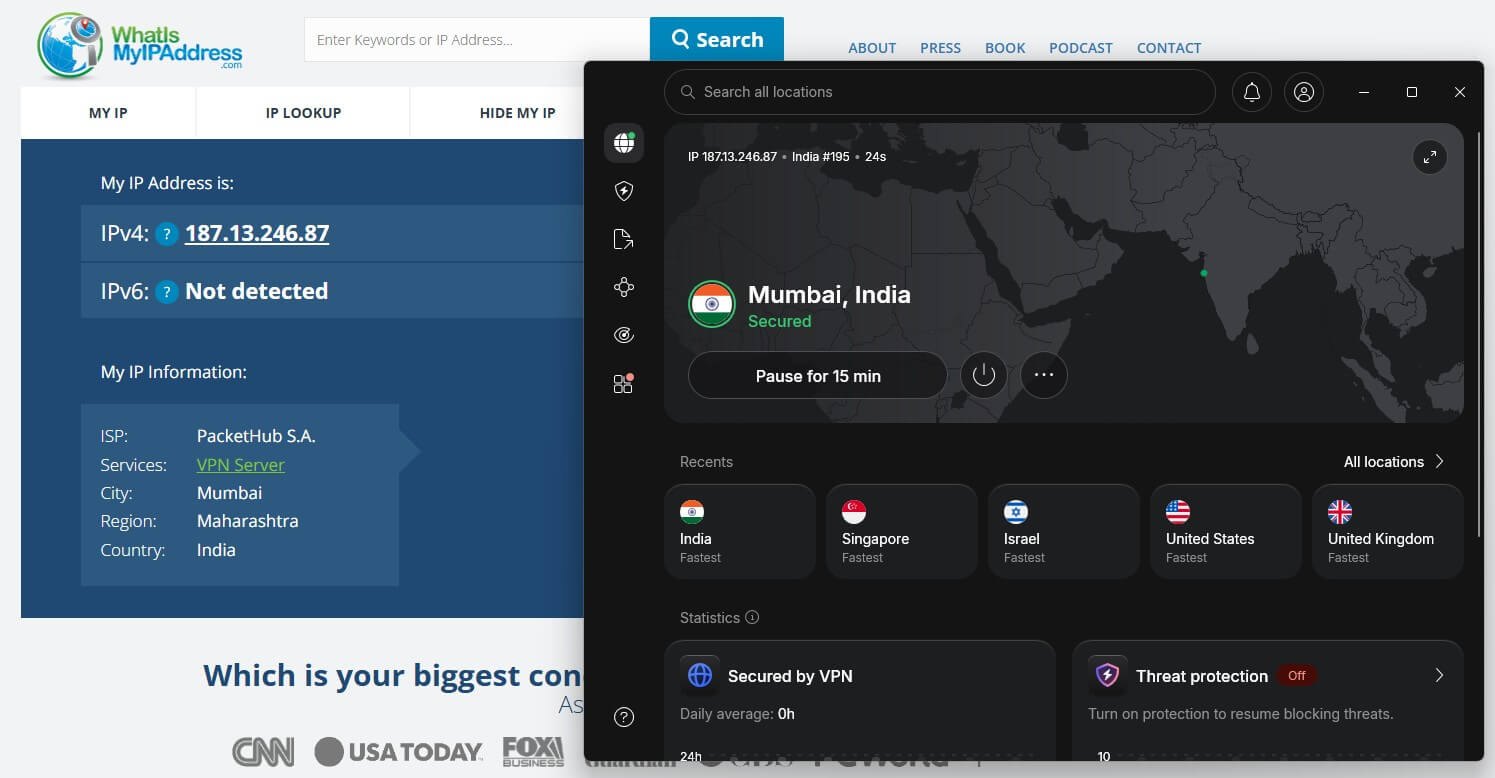
Install the app from the VPN’s site, the App Store, or Google Play, sign in, and search for India. NordVPN connects to Mumbai, while ExpressVPN offers two India locations: India (via UK) and India (via Singapore). Visit whatismyipaddress.com with the VPN on, and India should appear as the country.
Why Indian VPN Locations Are Hosted Abroad
In April 2022, India’s CERT-In ordered VPN companies with servers in the country to keep customers’ names, contact details, IP addresses, and reasons for using a VPN for five years. NordVPN, Proton VPN, and ExpressVPN removed their Indian servers and now issue Indian IP addresses from other countries:
- NordVPN: a Mumbai location, launched in January 2024, on a server in Singapore.
- Proton VPN: Smart Routing servers based in Singapore.
- ExpressVPN: India (via UK) for Chennai and India (via Singapore) for New Delhi.
The host country affects speed. Viewers in Europe should try ExpressVPN’s UK-hosted location first, and viewers in Asia the Singapore-hosted one.
What an Indian IP Address Unblocks
- JioHotstar with cricket: JioHotstar launched in the UK, Canada, and Singapore on September 2, 2026, without live sports, including the IPL. Cricket still requires the Indian service and an Indian IP address.
- Indian catalogs: SonyLIV and Zee5 keep some titles for India, and Netflix and Prime Video switch to their Indian selections, as our guide to VPNs for streaming covers.
- Banking: Indian banks can request extra verification when a login comes from a foreign IP address, and an Indian IP address removes that trigger.
Indian IP Address VPNs Compared
Download figures come from Speedtest on each India location, tested in October from a Windows 11 machine with 190.36 Mbps of baseline speed in Europe.
| VPN | India location | Server hosted in | India download | Price, longest plan |
|---|---|---|---|---|
| NordVPN | Mumbai | Singapore | 170.95 Mbps | $3.49/mo |
| Proton VPN | India | Singapore | 104.10 Mbps | $2.99/mo |
| ExpressVPN | Chennai / New Delhi | UK / Singapore | 182.82 / 149.80 Mbps | $2.99/mo |
Best VPNs for an Indian IP Address
Our overall VPN rankings place NordVPN, Proton VPN, and ExpressVPN first, second, and third. For using a VPN in India itself, see our guide to VPNs for India.
- NordVPN: Best overall, with a Mumbai location hosted in Singapore.
- Proton VPN: Best for Swiss privacy, with Smart Routing servers for India.
- ExpressVPN: Best for speed from Europe, with two India locations.
1. NordVPN: Best Overall VPN for an Indian IP Address
Pros
- Post-quantum NordLynx
- Onion over VPN servers
- Browser location spoofing
- Native Apple TV app
Cons
- Virtual India location only
- Windows app connection errors
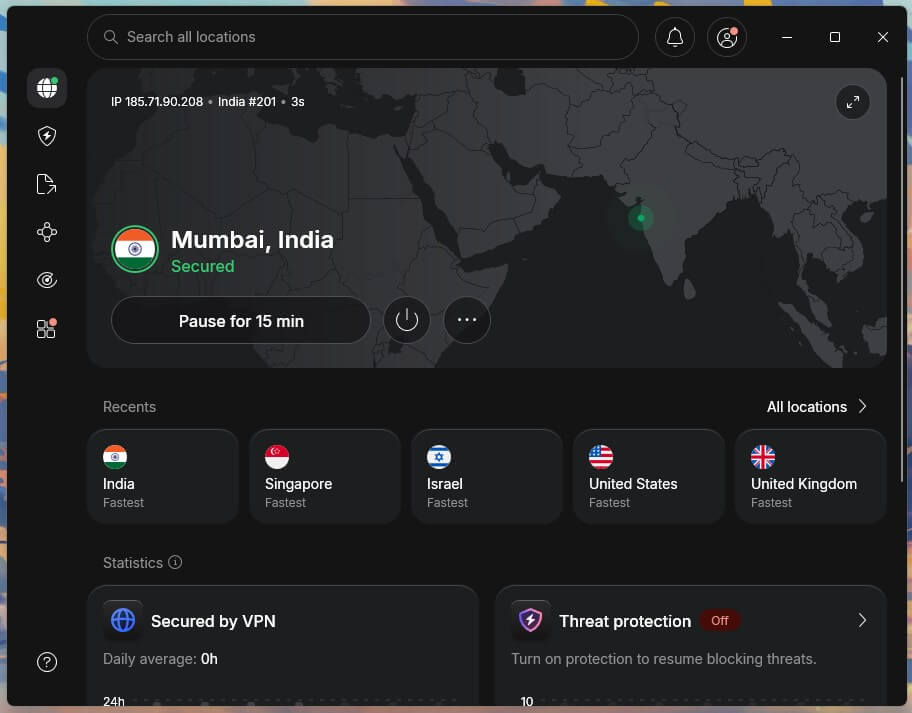
NordVPN added its Mumbai location in January 2024, hosted on a server in Singapore, and it recorded 170.95 Mbps in our India test. In our kill switch tests, NordVPN kept traffic blocked after a pulled cable, a force-closed app, and a PC restart. Its Chrome extension also works with the desktop app closed, which helps with JioHotstar in the browser.
We had to fix the Windows app on some days with its diagnostics tool before it would connect, and we found no pattern to the failures. On the Basic plan, $3.49 a month protects 10 devices for the first 27 months ($94.23 in total), after which renewal is $139.08 a year.
2. Proton VPN: Best for No-Logs Privacy From Switzerland
Pros
- Annual no-logs audits
- VPN Accelerator
- Open-source apps
- Swiss jurisdiction
Cons
- Slowest India result
- No post-quantum cipher
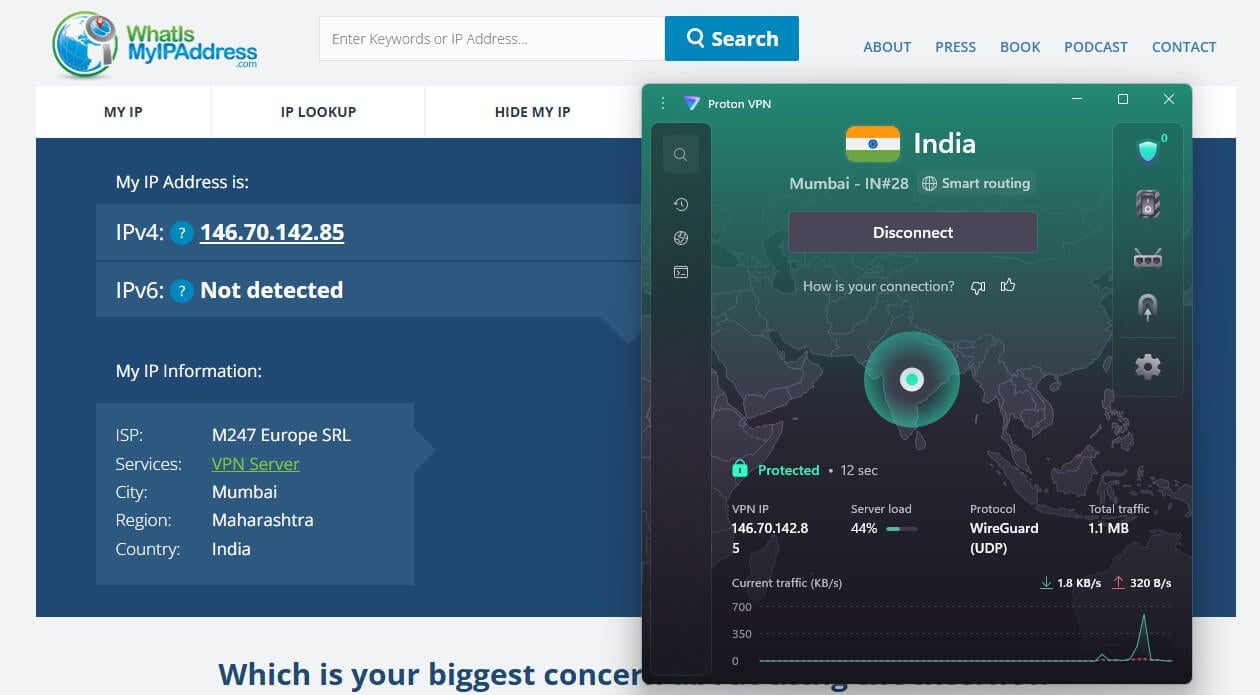
Proton VPN moved its Indian IP addresses to Smart Routing servers in Singapore in 2022 to avoid logging users. Its India location recorded 104.10 Mbps, the slowest India result we measured, though enough for 4K streaming. Its kill switch kept the connection sealed when we unplugged the cable and ended the app.
Viewers who want a faster Indian connection should choose NordVPN or ExpressVPN. The VPN Plus plan is $2.99 a month on the two-year term, $71.76 at checkout, and $83.88 a year after that.
3. ExpressVPN: Best for Two Indian Locations
Pros
- Post-quantum Lightway
- KPMG-audited no-logs policy
- RAM-only servers
- Dedicated router app
Cons
- No Double VPN feature
- Limited customization
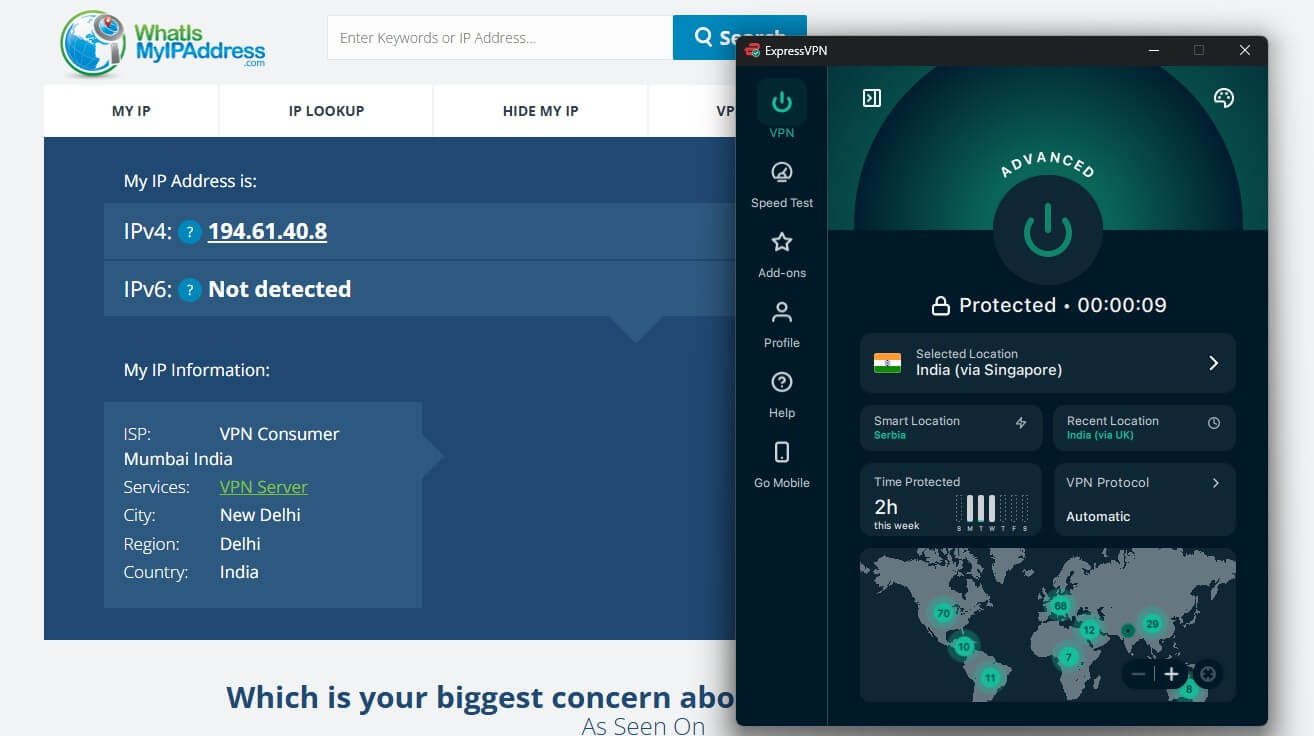
ExpressVPN offers India (via UK), which covers Chennai, and India (via Singapore), which covers New Delhi. From Europe, the UK-hosted location recorded 182.82 Mbps, the fastest India result we measured, and the Singapore-hosted one 149.80 Mbps. ExpressVPN also features among our fastest VPNs, and its split tunneling can keep JioHotstar on the India location while other apps use the local connection.
ExpressVPN’s Basic plan costs $83.72 across 28 months ($2.99 a month) and renews at $99.95 a year, with 10 to 14 devices allowed depending on the plan.
What to Do When an Indian Service Won’t Load
- Sign out of JioHotstar and back in. The app can keep the region from the last session.
- Switch India locations. ExpressVPN users can move between the UK-hosted and Singapore-hosted locations.
- Delete browser cookies. Bank and government sites can store the previous location.
- Keep the Indian SIM active. UPI apps and Indian banks verify logins with codes sent to the Indian mobile number.
Can You Get an Indian IP Address for Free?
Proton VPN, Windscribe, PrivadoVPN, and Hide.me, the free VPNs we recommend, have no India location on their free plans. A free VPN with physical servers in India has to log users under CERT-In’s rules. Android users can try NordVPN for 3 days through Google Play, which requires a card at sign-up. Several cheap VPNs cost less than $3 a month.
Which VPN to Use for an Indian IP Address
Viewers in Asia are closest to the Singapore servers behind NordVPN‘s Mumbai location and Proton VPN’s India location. In Europe, ExpressVPN‘s UK-hosted location was the fastest we measured, with NordVPN second at 170.95 Mbps. NordVPN stays our first choice overall for its kill switch and privacy features. Proton VPN adds Swiss jurisdiction and audited no-logs records at a lower speed.
FAQs About Getting an Indian IP Address
Are VPNs legal in India?
Yes. India permits VPN use, although VPN companies with physical servers in the country must keep customer records for five years under CERT-In's 2022 directions.
Which VPNs have Indian servers?
NordVPN (Mumbai), Proton VPN, and ExpressVPN (Chennai and New Delhi) have India locations, hosted outside the country. Surfshark and CyberGhost list virtual Indian locations too.
Is a virtual Indian server safe to use?
Yes. A virtual Indian server assigns an Indian IP address while the server stays outside India, so the VPN's usual no-logs policy applies and CERT-In's retention rules don't.
Can I watch the IPL on JioHotstar outside India?
Yes, with an Indian IP address and an Indian JioHotstar plan. The international JioHotstar app launched in September 2026 excludes live sports, including the IPL.
Can I get an Indian IP address without a VPN?
Yes, through a proxy or Tor, though neither is dependable. Proxies don't encrypt traffic, and Tor rarely assigns an Indian IP address and is too slow for streaming.