China is preparing to test an experimental supersonic passenger aircraft, which can travel at twice the speed of sound with a significantly reduced sonic boom.
The TMS-10 demonstrator plane has entered the final assembly phase, with a supersonic test flight planned by the end of the year, according to China’s Global Times. While still in the early stages of development, China’s experimental vehicle aims to lay the groundwork for a future 10- to 15-passenger jet that could travel from Beijing to Shanghai in around 30 minutes (compared to two hours on today’s commercial flights).
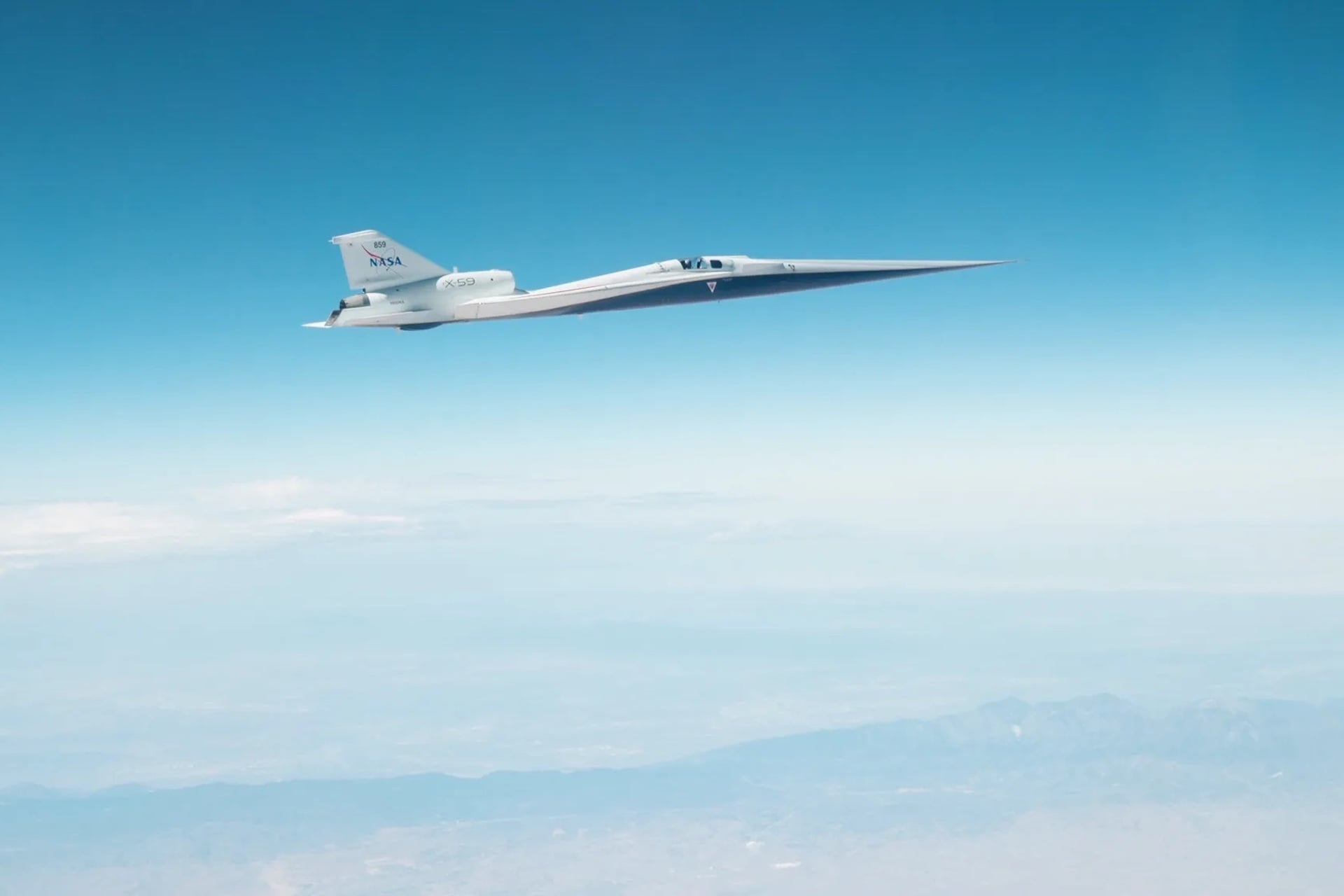
Similarly, NASA is developing a quiet supersonic jet of its own to help bring back supersonic flights over land. The X-59 is currently undergoing a series of flight tests after having broken the sound barrier in June, flying at Mach 1.4.
Sound barrier check
The TMS-10 is developed by the Chinese aerospace research institution Tianmushan Laboratory in collaboration with Beihang University. The experimental technology combines high-speed performance with lower aerodynamic drag and a significantly reduced sonic boom (the loud thunder-like noise created when an object moves faster than the speed of sound).
While NASA’s X-59 dampens sonic booms, the TMS-10 works to dissipate them. Its design is aimed at managing shock waves generated around the aircraft’s nose and wings, preventing them from merging into a more powerful wave, while its rear configuration helps redistribute and weaken the shock waves.
The aircraft’s aerodynamic configuration is optimized to reach cruise speeds of Mach 2, twice the speed of sound at roughly 1,534 miles per hour (2,470 kilometers per hour). It can also fly at subsonic speeds around Mach 0.95, or 730 miles per hour (1,173 kilometers per hour).
Clear for takeoff
Tianmushan has already completed aerodynamic wind-tunnel testing, flight-control design, and airframe manufacturing of its aircraft. In June 2025, a scaled-down model of the TMS-10 performed a low-speed test flight that remained below Mach 0.2 to validate the aircraft’s takeoff and landing, stability, and control.
For its upcoming flight, the team will push the aircraft through the sound barrier and measure the sonic boom it creates. The flight will also be used to evaluate the aircraft’s aerodynamic configuration, flight-control system, and integration between its aerodynamics and propulsion system.
The Chinese institution still has its work cut out for it before it can apply its experimental technology on larger-scale commercial aircraft, which require a more durable design for onboard passengers and steep operational costs.
Meanwhile, NASA’s X-59 is making steady progress toward testing its noise levels. The aircraft recently completed its 25th test flight above the Mojave Desert in California and will soon enter its acoustic validation phase, where NASA will use a variety of ground- and air-based tools to measure and characterize the X-59’s sonic thumps.
The X-59 is designed to validate quiet supersonic flight over land, aiming to revert a decades-old ban on commercial supersonic flight. Both aircraft are meant to bring back speedy, and costly, air travel in the near future.