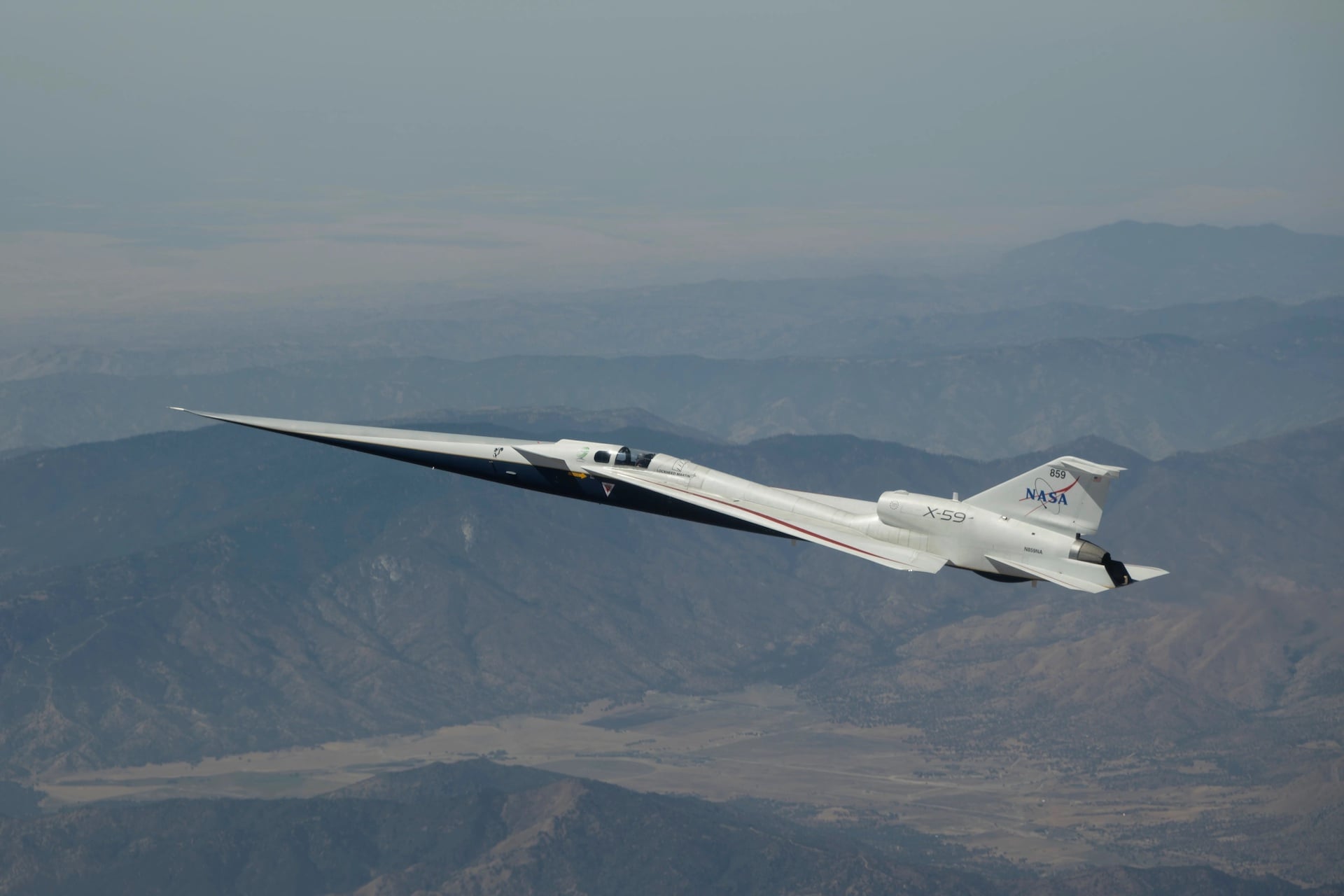
NASA’s experimental supersonic jet recently completed its 25th flight, racking up some serious miles in the air before its noise levels are put to the test.
The X-59 took off from NASA’s Armstrong Flight Research Center in Edwards, California on August 21 for the latest in a series of successful test runs. The aircraft flew for a total of 72 minutes, reaching a speed of Mach 1.2 and an altitude of approximately 49,000 feet (14 kilometers), according to NASA.
Like all of its previous test flights, the aircraft was accompanied by a NASA F-15 chase plane for monitoring. The chase plane’s sonic booms drowned out any noise produced by the X-59, but that won’t be the case much longer. NASA is finally preparing to evaluate the experimental aircraft’s much quieter noises later this year, putting its innovative technology to the real test.
Supersonic speeds
The X-59 is designed to break the sound barrier without producing the loud, explosive sound known as a sonic boom. Following years of development, the aircraft broke the sound barrier for the first time on June 5, reaching a top speed of approximately Mach 1.1, or 713 miles per hour (1,147 kilometers per hour).
Since then, NASA has continued to test the performance of its jet before advancing it to the next phase.
“Through our ongoing flight tests with the X-59, we’ve gained invaluable insights into both the aircraft’s performance and the unique challenges of the aircraft design,” Cathy Bahm, project manager for NASA’s Low Boom Flight Demonstrator project, said in a statement. “Each test point has validated our models and predictions, and it has strengthened our confidence in the aircraft’s performance. Every flight brings us closer to transitioning to the next phase where we will demonstrate the X-59’s quiet supersonic flight capabilities.”
During its acoustic validation phase, researchers will thoroughly measure the aircraft’s supersonic acoustic signature to confirm X-59 is indeed performing as intended and producing a sonic thump rather than a boom.
Instead of a sonic boom, the X-59 aircraft is meant to mitigate the noise and release a sonic thump, according to NASA. In doing so, the experimental aircraft could pave the way for commercial supersonic flight over land.
Make some noise
The aircraft has performed well during its test flights and not suffered any unexpected phenomenon, such as instability or excessive vibration, in response to aerodynamic forces, according to NASA.
Between each flight, pilots, engineers, and maintenance personnel review aircraft and flight test data in order to make any required adjustments. So far, the team has only had to make some minor adjustments to the aircraft’s control software to resolve an issue where its systems were interpreting nuisance alerts as caution warnings.
NASA describes the upcoming phase of testing as the “biggest benchmark for the X-59,” which involves measuring how it will sound at supersonic cruise speeds. “This is the phase we’ve been working toward,” Larry Cliatt, acoustic validation technical lead for NASA’s Quesst mission, said in a statement. “Building and flying a brand-new aircraft is an extraordinary accomplishment, but the next phase is where the real research begins.”
During the acoustic validation phase, the team will use a variety of ground- and air-based tools to measure and characterize the X-59’s sonic thumps. The aircraft’s sharp design is meant to reduce the pressure change that flows over the ground, while the engine is mounted on top to reduce the amount of noise from the plane that reaches the ground.
“Acoustic validation will put the tools and methods used to design the X-59 to the test — tools that could ultimately become part of the DNA of every future commercial supersonic aircraft,” Cliatt said. “It will be a complex and demanding flight campaign focused on demonstrating that the X-59 can produce the quiet sonic thump it was designed to achieve.”