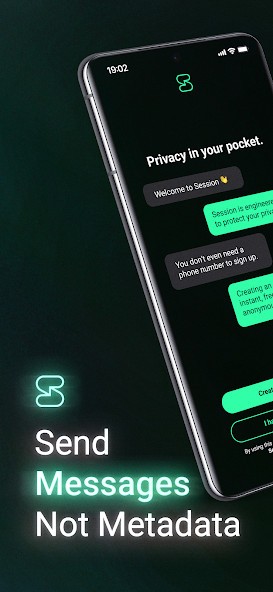
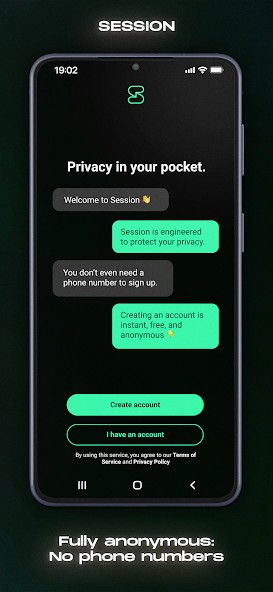
Session – Private Messenger is one of the applications that not only sends messages. It is based on something much more delicate – privacy. It is a messenger, yes, but it works without your phone number, without linking your identity to the app. It is not very common these days.
The service is operated on a decentralized onion routing system, which basically means your messages from one point to another will not be sent directly without some detours. They roam around, leading paths that are very hard to follow. It is like whispering a message from one side of the wall to the other till it gets to the right ears.
Session is for people who are concerned about being anonymous, who want to have no digital trail traced all the way. There are no read receipts, there are no typing indicators, and there aren’t any ads whatsoever. It feels quiet. The app does not render out shouts for attention. It is not meant to do a lot of things, but to do one thing really well – protect your conversations against wandering eyes. And behind the scenes, it’s doing so much complicated work, just trying to make things simpler for you.
Why Should I Download Session - Private Messenger?
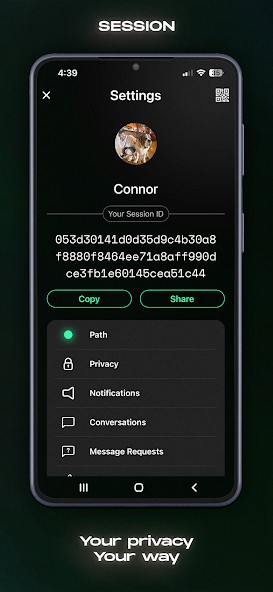
If ever there is a time to wonder how much of that digital life that you have should rightly be yours, then this is it. Most of the messaging apps know your name, number, device, location, and maybe more. Session doesn’t. That is among the things that people take note of first. No phone number is required, no emails, and no usernames that can mean your real identity. You open it, it provides you with a Session ID, and this is all you are inside the app. That would be sufficient reason to look at it if you care in the least about data privacy.
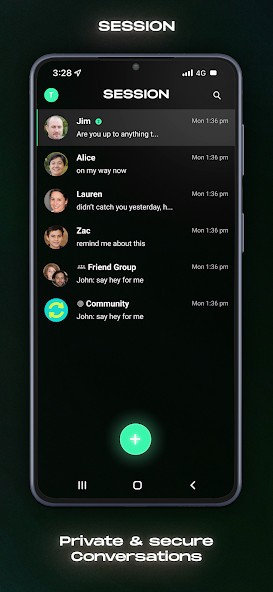
However, above the anonymity, there is a sense of calm to the whole thing. No noise. No pressure to respond instantly. No green ticks that tell, “They saw it”. Just you and the conversation. The UI is clean, focused. You are not overwhelmed with new updates or features you never requested. Merely text, voice messages, media sharing, private group chats – encrypted, protected.
And here’s the thing. It’s privacy-heavy, but it does not feel like it’s slow or clunky. Messages go through just fine. You never get that impression that you are using some experimental stuff that was made in the garage. It feels surprisingly ready. Stable. It works. And for those who happen to live in those parts of the world where surveillance is high or when freedom of speech is not a given, it is more than a choice; it is a tool. A provider that doesn’t collect metadata, doesn’t store logs, and doesn’t spy on you in the background.
There is also a bit of trust that gets developed after spending some time with it. You start noticing the little things – how it doesn’t try to shove itself into your face, how it doesn't ask you for your contacts, how the updates for the app aren’t obnoxious and demanding. And that trust is developed over a period of time. You don’t have to sacrifice parts of yourself to be some part of it. You can just live in it, speak your mind, and then go away if you’d like. That’s rare.
Is Session – Private Messenger free?
Yes. Session is free of charge and does not cost anything. You will not have to pay for features, nor will you be trapped in any subscription schemes around the corner. The app is paid for by grants and donations, so it’s not an app that is designed to sell your attention or your data.
What Operating Systems Are Compatible with Session - Private Messenger?
Session runs on the majority of contemporary platforms. For the mobile, you can run it on Android and iOS. On the desktop, there is an option for all versions of Windows, macOS, and Linux.
This is what makes the switch between devices or synchronization of discussions among devices rather simple. The desktop versions are not stripped either – they perform the same as is the case with the mobile versions. Installation could not be any simpler, and what's more, it does not require much more than some taps and the Session ID.
What Are the Alternatives to Session – Private Messenger?
There are some other apps that tread the path of privacy, but have individually distinct approaches. Its examples include Threema, which has been here for quite a long time and traditionally approaches things. It’s a paid app, but it still does not make the identity connection too tight. You do not need to give a phone number as well, and messages are end-to-end encrypted. Threema employs trusted servers that are located in Switzerland and offers anonymous messaging, which means that it is a good solution for those who prefer simplicity and also value strong privacy practices. It’s not fully open-source, and this is the aspect that is considered by some people who care deeply about transparency in their choices.
Then there’s Signal. It is the better-known name here, in part because of the endorsements of people such as Edward Snowden. It does need your phone number, and that is a problem for some people. However, apart from that, Signal has by all means demonstrated its ability in encryption power, security tests, as well as overall simplicity of use. It is a more feature-rich replica of Session, such as video calls, stickers, and a generally more mainstream flavour. There are, however, some trade-offs that tag along with it. Signal gathers the metadata in the shape of timestamps, as well as contact-based discovery, but for the actual content of your message, nothing.
Lastly, there’s Olvid. It is not one of the better-known apps, but it has an unusually conservative position in regard to protecting users’ privacy. Your phone number is unnecessary for it as well, and it does not even require an internet connection when it starts to run for the first time. The thing that distinguishes Olvid from its competition is its use of sturdy cryptographic identity checks, and this is one of the choices that is more embraced in institutional settings, governments, and professionals who deal with sensitive communication. It is more formal in its usage, less “social”, but that’s the idea. It is not out to be your everyday messenger. It is trying to become a fortress.