Whenever the words “Batman: The Animated Series” grace your screen, you’ll invariably think of one of three things. You’ll want to rewatch the series for the umpteenth time, pine over Mark Hamill and Kevin Conroy‘s generational performances as The Joker and Batman, and reminisce over it being the best animated series of all time.
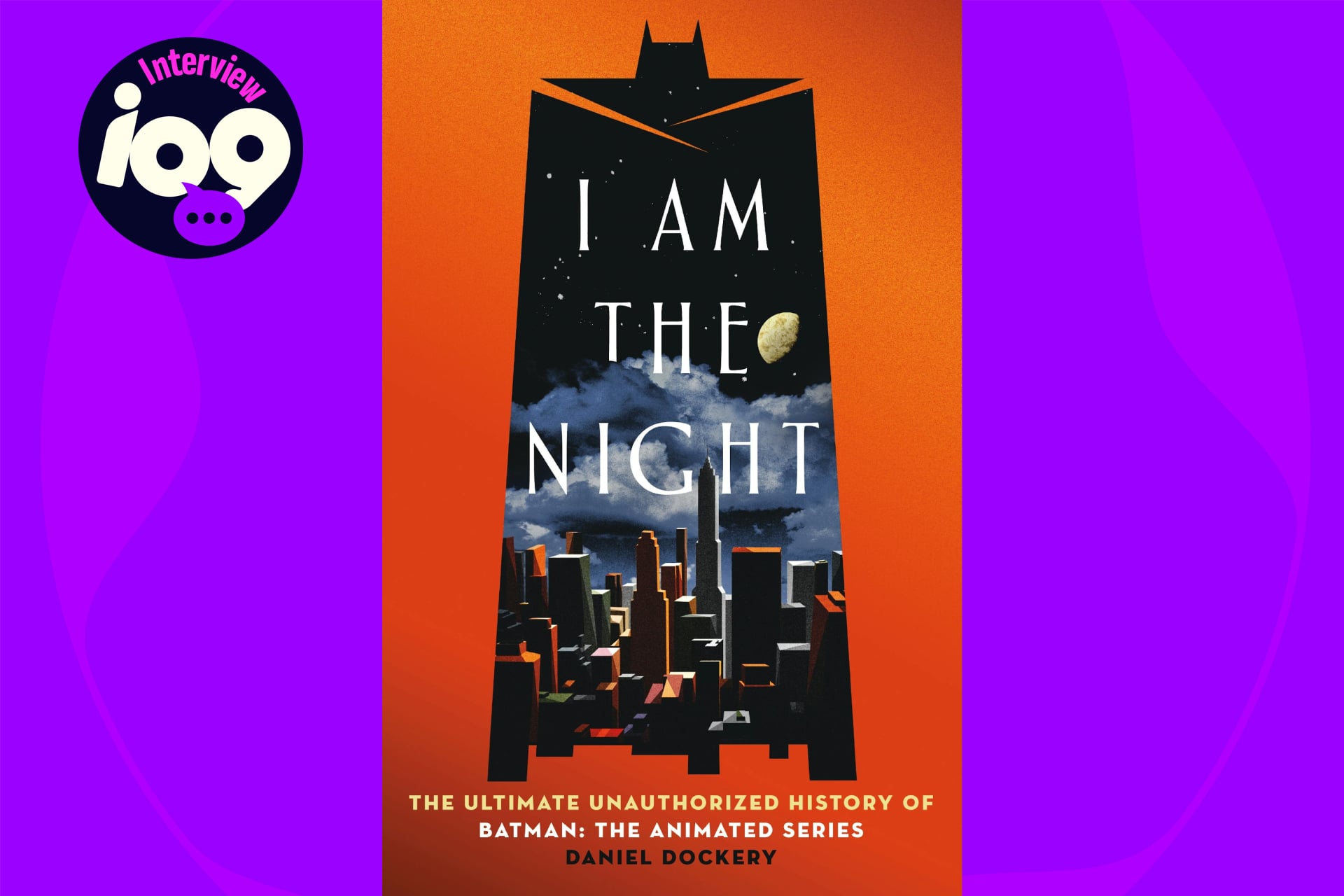
Although all of the above is a pretty lukewarm take, thinking about the DC Comics animated series often dips into nostalgic reminiscing that points to the incomparable Bruce Timm as the sole reason the show worked. He was essential, sure, but I Am the Night: The Ultimate Unauthorized History of Batman: The Animated Series, written by journalist and author Daniel Dockery (Monster Kids), moves past auteur worship to spotlight how the series was a collective gamble, made iconic by an entire creative village.
I Am the Night: The Ultimate Unauthorized History of Batman: The Animated Series chronicles BTAS‘ narrative history. Across 304 pages of archival material and exclusive interviews Dockery conducted with key staff members involved with the show, the book weaves in production anecdotes that examine the show’s dramatic shift away from the stigma of Saturday morning cartoons. To demystify BTAS’ meteoric rise, Dockery fact-checked even the most innocuous claims from its online fandom—digging through archives and tracking down people involved to verify details most viewers would never question.
“There were a few times when something that was taken as common knowledge everyone would say off the cuff as fact enough times that it becomes fact,” Dockery told io9. “It doesn’t sound like as big of a deal for me to say, ‘You know, Batman: The Animated Series’ time slot was against Goof Troop, and it was beating Goof Troop. I saw people say, ‘Oh, it was beating Disney’s time slot. I was like, ‘I wanna find a place where it says it. I wanna find a contemporary source. I was scouring Newspaper.com trying to find as many examples as I could to back up the outlandish claim that, yes, Batman: The Animated Series was beating Goof Troop in the ratings. Stuff like that might not matter to somebody posting on Reddit errantly, but it mattered to me, and I wanted to get it right.”
Admittedly, I fell into the same trap before reading Dockery’s book. Like plenty of Spider‑Man fans who judge every new contender against Sam Raimi’s sequel, I treated each new Batman animated project as a referendum on whether Timm was involved or whether it could recapture the awe of BTAS. Dockery’s work cuts through that parasocial auteur narrative, revealing the all‑star creative team that actually made the series such a formative part of my childhood. Folks like composer Shirley Walker, co-creator Eric Radomski, story editors Sean Catherine Derek and Michael Reaves, writers Alan Burnett and Tom Ruegger, and so many more.
“By just making it the Bruce Timm show, I feel like I would have been doing it a disservice to countless people who worked on [BTAS],” Dockery said. “In the case of Batman, it would be, ‘This person thought of the character, but this person wrote the script, but this person thought of the backstory, but this person, when they were directing, thought of this plot turn that would add a layer or change the angle of reflection for how you looked at a character. In doing the research, even if I was planning on saying this person did this, inevitably, somebody else had a major influence on [the show].”
Dockery doesn’t just dig into BTAS and its behind-the-scenes anecdotes throughout the book. I Am The Night expands its scope outwards. Dockery explores how its creators, who came from humble beginnings working on shows like Duck Dodgers, Tiny Toon Adventures, and shows of that ilk, banded together to form BTAS‘ team. He also examines how BTAS affected the wave of other animated series airing contemporaneously with it, like Captain Planet, Gargoyles, X-Men: The Animated Series, The Animaniacs, Freakazoid!, and Spawn.
Much like actors get shuffled between DC Studios and the Marvel Cinematic Universe, BTAS left its fingerprints on those shows because the same creative talent helped shape them. I Am the Night reads like a blend of Mad Men and a long-boy YouTube video essay—minus the debauchery of its ragtag crew and non sequitur ad breaks for products you’ll never use and subscriptions you’ll forget to cancel.
The book is packed with nifty bits of trivia, like the story of how DC Comics had to get Batman’s licensing back from a random fan; the team wrestling with outsourcing issues with animation studios because the show was illustrated on black paper; the anvil-hanging edict to keep their benefactor, Steven Spielberg (and all his money from Amblimation), happy; and creative cohesion and tensions that occasionally flared over how episodes should be written.
Something that especially surprised Dockery in his interviews was the intricacies of the show’s production. One example was how news clippings would characterize issues the show faced in production, like the changing of the guard of BTAS‘ story editors from Derek to Burnett, as a trivial, singular early issue in the show’s grander history. But, in reality, BTAS wasn’t all sunshine and rainbows. The series was far from the assured success fans think it was. Any road bumps it faced had ramifications that trickled down to writers still figuring it out as they went, a fact plenty of folks were candid about in their interviews with Dockery.
“To talk to people who worked during that first time of such butting heads, and for them to be like, ‘I didn’t like it. I didn’t like Warner Bros. I didn’t like the environment; it didn’t work for me.’ That whole situation was something that was really satisfying to me, but also really surprising to learn all the ins and outs of something that, for the most part, had been treated as kind of an inevitable speed bump on the show’s way to greatness.”
One moment from I Am The Night that I found especially illuminating was Dockery digging into the lore around Clayface’s two-part episode, “Feat of Clay.” Obviously, I’ve got Clayface on my mind with the release of James Watkins’ Clayface, which undoubtedly saw rewrites from Mike Flanagan’s original treatment of the script (which gave nods to the BTAS episode). Ironically enough, I Am The Night highlights how the production of those banner episodes altered Reaves’ original script. Here’s an excerpt from the book that shows how the two-parter could have taken a slightly different, more romantic route.
Reaves’s script for it was long and ambitious but not without a few tender moments. The relationship between Matt Hagen and his friend Teddy is now usually framed as a homosexual one, with Clayface’s disgust at himself and wish to change reflecting the self-loathing that can occur in a minority community that’s often forced to hide aspects of themselves for fear of bigotry. Brad Rader, who worked on a majority of the storyboards, saw it that way, too. “What was in front of me was an unspoken gay relationship that I immediately clued into,” says Rader. “It informed how I boarded that episode and I tried to make it more sympathetic.” Kevin Altieri, who directed the episode and had pushed Rader to go all-out with Clayface’s abilities and to pay no mind to any budget concerns, loved the suspense of it all. There was espionage, with Hagen being employed to blackmail Bryce Wayne, and the slow reveal of Clayface’s transformation abilities. But there were still ways to tighten and punch things up, and Altieri was becoming notable for doing his own script editing when he felt things were lacking, sometimes to the surprise of the writers. So when he saw that Reaves had written an extended sequence involving Batman chasing a cop (eventually exposed to be Clayface), Altieri decided to pull the plug early and reveal Clayface with a kind of jump scare.
With animation from TMS Entertainment, the Japanese studio behind the madcap law-breaking adventures of the anime Lupin the 3rd, it was sure to look great. If anything, “Feat of Clay: Part II” was the crown jewel of the collaboration, with TMS soon pulling back on its BTAS efforts due to the work required of its artists and the compensation they were being accorded. The studio would move on to other Warner Bros. series, leading Timm to believe that the artists also probably just wanted to work with Spielberg. Altieri felt the ramifications of his edit immediately: “Both the story editors were furious. Hated what I did.” In Altieri’s mind, it was the economical choice and the more exciting one. “That was three pages of the script gone,” he says. And despite Reaves’s passion for putting the spotlight on Batman’s detective work, which he would’ve shown in belabored fashion as Batman trailed the clay cop, Burnett made the final call. Burnett even added a little touch, where Clayface, eager to shut someone up, tears a bit of clay off his cheek and slaps it onto the man’s mouth as a makeshift gag. Gross . . . but very cool.
“Feat of Clay: Part II“ is far from the smoothest example of animation as a community, as full as it was of bruised egos and creative disagreements (and then, somehow, spectacular results). Rader had also found himself angry at Altieri over changes to the episode. Throughout the storyboards, he’d honed in on the relationship between Hagen and Teddy, illuminating their bond as best he could (within the limits of weekday-afternoon cartoons in the early ’90s). Their chemistry, from the way Teddy hangs on Hagen’s arm in moments of joy to the open desperation of their crumbling connection, is very clear. The ending was to be one more visual tell: In a trope straight out of a classic Hollywood romance, “I had boarded it so that Teddy walks into the night, and the woman (Clayface in disguise) turns and looks, and she has a tear going down her face. Then she turns back and walks in the opposite direction,” Rader says. Altieri nixed it. In the ending we get, Teddy walks away and Clayface, his transformation into a monster complete, laughs to himself while disguised as a bystander woman. “He [Altieri] did it his way, and that really upset me.”
Unsurprisingly, the latter half of I Am The Night touches on that inescapable feeling that no other show will ever be like Batman: The Animated Series. Dockery told io9 the animators and writers he interviewed for the book share that sentiment. Much of that boils down to the animation industry as a whole not functioning the way it used to. In the era of streaming, it’s harder for a company like Warner Bros. (and its executives) to back a show with the budget and security needed to support a new crop of shows as creatively free to stretch their legs as the folks behind BTAS were.
“We’re going on maybe the second generation of animators that have been influenced by it. Towards the end of the book. Bruce Timm has a great moment where he’s talking to people who are writing for Batman Beyond, and they’re all trying to write Batman: The Animated Series episodes, and he’s like, ‘No, this is not that show. We’re doing Batman Beyond now,'” Dockery said. “[BTAS] is a show that’s now been passed down through the industry, and multiple generations are now finding it, and both are inspired by it and using it almost like a how-to guide for dealing with the corporate hand at play.”
You can read more about how the DC animated series came to be and how it continues to influence the landscape of animation as we know it in the era of streaming by reading I Am the Night: The Ultimate Unauthorized History of Batman: The Animated Series.
Want more io9 news? Check out the best movies and TV shows to stream this month and all the upcoming sci-fi, fantasy, and horror books that should be on your radar.