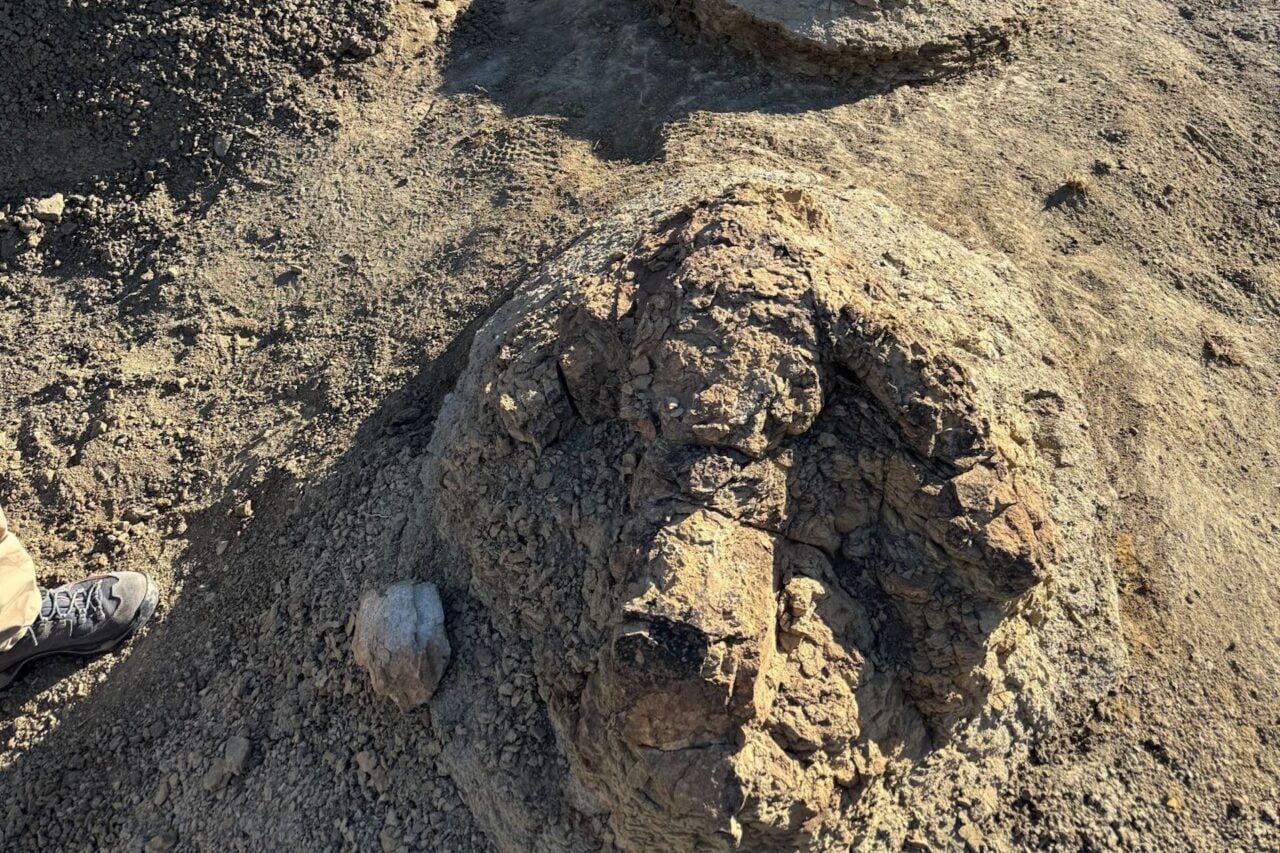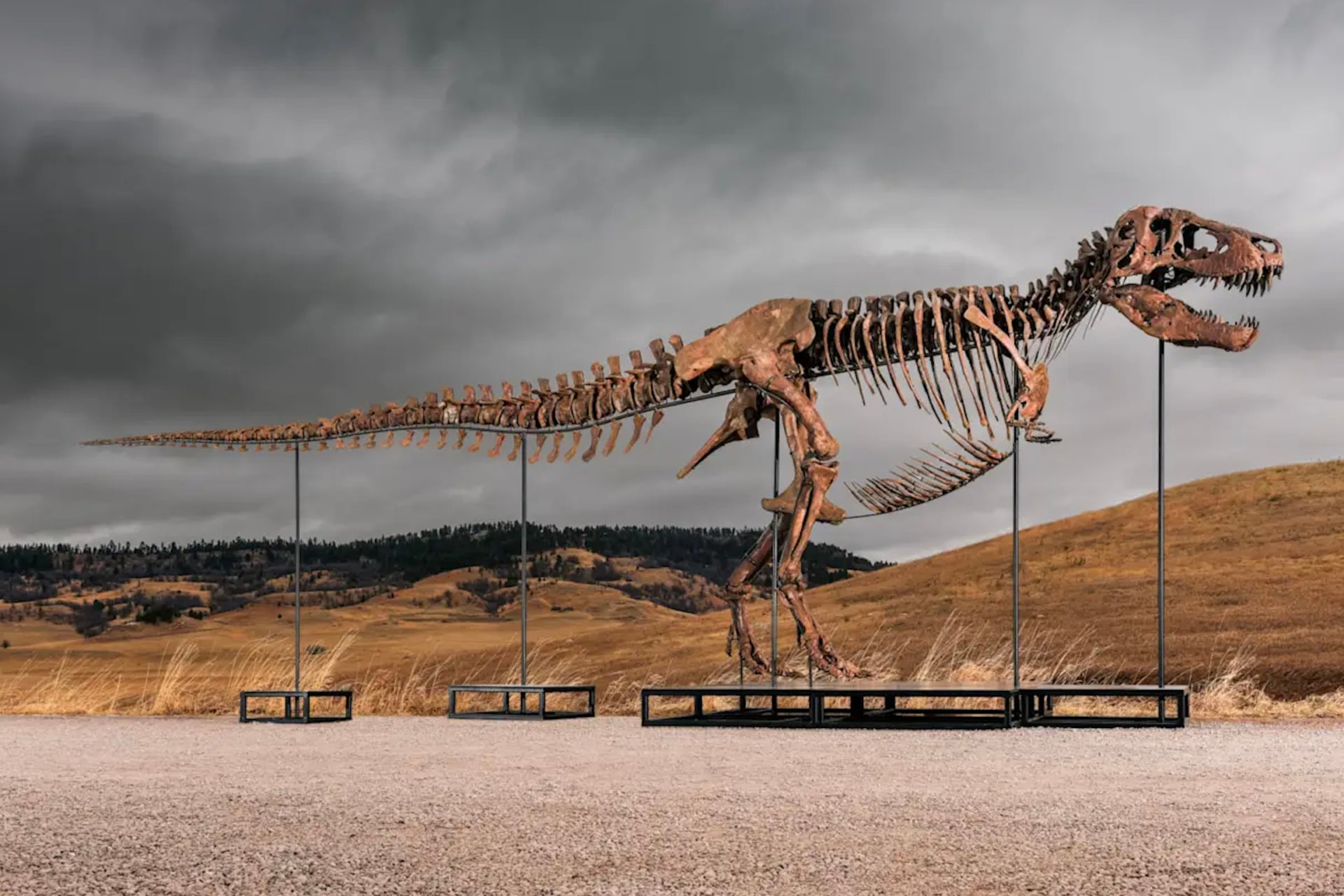
Dearly departed South Dakota cattle rancher Gary “Gus” Licking had a hunch that the small bone and teeth fragments he kept coming across on his 6,500-acre property might part of be something big. And, like a character in a Far Side cartoon, he was right: The dirt beneath his Harding County ranch hid one of the largest and most complete Tyrannosaurus rex skeletons ever discovered—a 38-foot (11.6-meter) long, nearly 12.5-foot (3.8-meter) tall monster now named “Gus” in his honor.
Reconstructed from 183 fossilized bones and roughly 63% complete, Gus the T. rex hasn’t looked quite this good since he walked prehistoric North America during the Maastrichtian period, roughly 72 million to 66 million years ago. The dinosaur is now slated for auction at Sotheby’s in New York, where Gus debuted for public viewing on Wednesday ahead of bidding set to begin this July 14.
Sotheby’s global head of science and natural history Cassandra Hatton said that it was “the completeness, the quality, the size, [and] the preservation” that made Gus stand out as a viable auction item, according to Reuters.
The opening bid for this towering slice of prehistory, per Sotheby’s online bidding registry, is set at $19 million. Please refrain from posting your Venmo in the comments.
Old Wealth
“What I think is really important for people to understand, when we talk about dinosaur fossils, is that they don’t come out of the ground complete,” Hatton told Reuters. “It takes highly specialized, careful, diligent, skilled people to recognize what they’re looking at, to tell the difference between a piece of rock and a piece of this animal.”
Perhaps for that very reason, the T. Rex fossil’s value has been assessed at somewhere between $20 million and $30 million. The price is reportedly the highest estimate ever for a dinosaur fossil at auction—although not the highest final price, a designation that goes to the Stegosaurus skeleton “Apex,” which sold for a staggering $44 million at Sotheby’s two years ago.
“The dinosaur market today is broader than most people realize—and widening,” Hatton, who is also Sotheby’s vice chair, told artnet via email this May. “Interest now comes not only from U.S.-based museums and private collectors, but also major international museums, foundations, and individuals creating destinations of their own. What unites them isn’t a single profile but a shared respect and curiosity for objects.”
‘The world’s hardest puzzle’
The task of carefully excavating and reconstructing Gus came down to a team of commercial paleontologists with Theropoda Expeditions, which labored over three summers from 2021 into 2023 to carefully remove these fossilized T. rex bones from the Licking ranch. Gus Licking passed away one year into the excavation, but his widow Dana has continued to follow the project.
According to Theropoda’s president, Thomas Heitkamp, the process of reassembling the T. rex was laborious, but rewarding. All told, the Theropoda team spent nearly five years on the project: the three years of excavation and research, plus another two years cleaning, identifying, cataloging, and ultimately assembling Gus. The process finally concluded earlier this year.
“It really does feel like tackling the world’s hardest puzzle, except we have to find all the pieces first,” Heitkamp said, according to a report in the Australian Financial Review this May. “All those bones separated for 67 million years that we can now, almost magically, fit back together.”
Naturally, opinions differ on the ethics of privately auctioning off these arguably priceless additions of our planet’s fossil record. Some scholars have argued that the practice “incentivizes” hoaxes, while others have pointed to rising auction prices for these dinosaur specimens as a barrier to both public museums and research institutions.
For her part, Hatton at Sotheby’s told the Financial Review that, in her view, “These sales are super important because they are helping us find fossils that would otherwise be lost to everyone.”