When American kids of the mid-1970s were asked what the year 2000 might look like, a quarter century into the future, it was a bizarre mix of ideas.
There were the optimistic predictions, like robot servants, living in undersea habitats, and bionic limbs. But there were also the incredibly pessimistic predictions, including worries about World War III, shortages of consumer goods, and people thrown out of work.
Does this strange mix sound familiar? It should to anyone who’s talked with a child recently. The New York Times recently asked a handful of 10-year-olds to predict what life might look like in 2050, 24 years from now. Their hopes and fears sound remarkably similar to those expressed by kids in the 1970s.
Below, I’ve put together some of the predictions from 10-year-olds today next to predictions that I’ve compiled over the years from kids in 1976 and 1977.
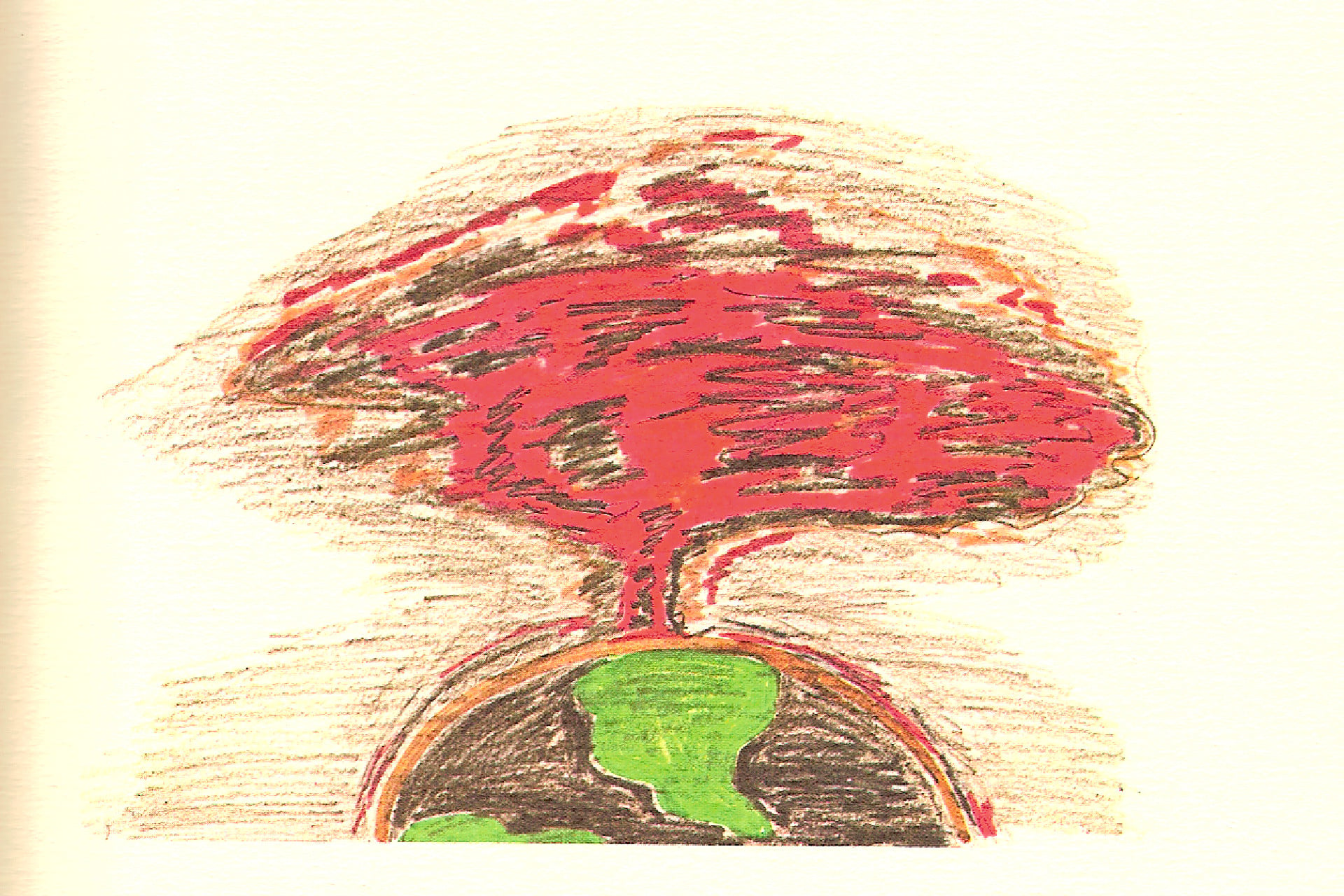
It was a common time for predictions, given the U.S. Bicentennial, and these predictions were published in newspapers across the country as well as in a time capsule called the Tricentennial Report. For example, the illustration above showing a mushroom cloud that presumably kicked off World War III was drawn in 1976 by a high school kid in New York.
Bionic limbs
The idea of supplementing the human body with robotic parts has a long history, dating to at least the 1920s. By the 1970s, the TV show The Six Million Dollar Man was more likely to be the inspiration for kids about what the future might look like.
(1976) Cindy Wade of Texas:
In the year 2000, your doctors might discover a way to make bionic arms and legs so that if you have an accident and you lose an arm, or a leg the doctors can replace it with a new one.
(2026) Grant VanHooser of Napa Valley, California:
People will have the choice to have robot body parts.
Bionic limbs have advanced tremendously in recent years, with some now able to provide neural feedback. In many respects, the future imagined by those kids in 1976 has already arrived.
World War III
Kids growing up in the 1970s were well aware of the devastation wrought by the Vietnam War. Some projected those anxieties into the future with visions of space war to come.
(1976) Billy McPherson of Texas:
Our space and areo-space divisions are ready for World War III coming soon.
Naturally, the kids of 2026 are viewing the Iran War similarly, though the kid who spoke with the New York Times didn’t imagine the war would make it to space.
(2026) Riley Grunch, Gainesville, Georgia:
There’s bound to be a war. The war against Iran right now is bound to spark a couple more wars. I really hope it doesn’t start World War III.
The U.S. military confirmed for the first time on Monday that it’s deployed weapons in space. The 1970s kids may have been on to something.
Robot servants
The idea of building your own robotic servant predates not just Rosey from The Jetsons but even the word “robot” itself, which was coined in the 1920s. The kids of the 1970s believed that students of the future would have robot teachers, and yes, robot maids.
(1976) Mary Bohen of Steubenville, Ohio:
In the year 2000, we will have all round buildings. We will have a robot teacher, a robot maid, and all workers will be robots, too. We will have a pocket computer that has everything you can name. We will even be able to push a button to get anything you want!
Kids of the 2020s are growing up in a world where AI dominates the conversation, so it’s only natural that you’d see any discussion of robots include that element heavily.
(2026) Amani Green of Denver, Colorado:
Higher-class citizens will start owning robot butlers. But I feel like with the rise of robot butlers, humans will start to lose competence and basic everyday skills.
The caveat that “higher-class citizens” would own robot butlers brings an interesting nuance to the discussion. Whereas kids of the 20th century largely thought everyone would have robots by the year 2000, kids of 2026 perhaps understand that the future will not be evenly distributed, as sci-fi author William Gibson pointed out.
Living Under the Ocean
The kids of 1976 seemed to believe that humans would be able to live in the ocean thanks to underwater habitats, which became a popular idea in futuristic kids’ books of the 1960s. The TV show The Undersea World of Jacques Cousteau premiered in 1968 and ran through 1976, which no doubt contributed to a broader interest in the future of the ocean.
(1976) Elida Buenrosta of Texas:
How are you? Fine? 2000 might be living under the ocean. What might be happening in the year of 2000. Maybe they have horses instead of cars, trucks and airplanes.
They might ride horses to the groceries and by me food for them. They might have spaceships over there. What else might be happening in the year 2000. There is something else happening there than that. They might ride horses to work and go to restaurants over there when they are at. They might even have carts to go with horses.
(2026) Sarah Fink of Denver, Colorado:
I want to live in the ocean, honestly. I want to be an architect, designing homes underwater — coral-friendly hotels and apartments and homes. They’ll have underwater taxis, too. Or you could swim. That would be like walking.
Work in the future
The rise of AI has devastated the younger generations that are looking for work. And at least one kid from 1977 predicted youth unemployment would skyrocket in the future.
(1977) Pietro Sincropi, Steubenville, Ohio:
I think by the year 2000 we will be riding bikes or driving solar-energized cars. By then more younger people will be unemployed. The price of gas will go up and so will the price of coal, silver, gold and oil.
The kids of today are perhaps more in tune with the anger that comes with that.
(2026) Amani Green of Denver, Colorado:
New York Times: What’s life going to be like in 2050?
Companies will start using A.I. instead of human workers. That’s probably going to cause a pretty big job shortage.
Times: What kinds of jobs will A.I. take?
People are already starting to hire an A.I. actress for movies. So people are going to be like, “That’s making so much money, I should do that!” That’ll make a lot of actors pretty mad.
Times: What will happen to people who lose jobs to A.I.?
Lots of anger. Probably protests. Just lots of outrage.
Travel to the Moon and Mars
The predictions from the 1970s and 2020s are anecdotes rather than a scientifically designed poll. But they still provide insights into what kids are thinking about. Perhaps most interestingly, none of the kids the Times spoke with here in 2026 seemed to volunteer the idea that they’d be traveling to the Moon or Mars. That was a much more common idea in the 1970s.
One child of today, Liam Kwon from Queens, talked about what people might do in space, but only after he was prompted by the interviewer at the New York Times:
New York Times: Will people go to space?
In the old days, they paid Americans to go to the West. They might pay people to go to space, because the population is so big that there might not be enough room.
The kids of the 1970s not only talked about traveling in spaceships; they specifically mentioned women becoming astronauts. Tim Villies of Ohio wrote in 1977:
The year 2000 may send ladies to the moon to explore and look and see if there are people living on the moon. And when you work you will push buttons and robots will come out and do the work for you.
In 1963, Soviet cosmonaut Valentina Tereshkova became the first woman in space, but Sally Ride wouldn’t become the first American female astronaut until 1983. NASA has received criticism for the planned Artemis III mission, which launches next year and will include only men.
Similar challenges
The 1970s posed unique challenges for kids who were imagining what the future might look like compared to the generations of Americans that had come before them. U.S. troops left Vietnam for good in 1975 after a prolonged and costly war where Americans ultimately lost. President Richard Nixon had resigned in 1974, and cynicism about politics was naturally becoming the norm. There was also the prospect of nuclear war between the U.S. and the Soviet Union that hung over kids of the 1970s.
The corruption of Richard Nixon almost seems quaint for those of us living through the Trump era. Our current president has put his own face on money, plastered his name on government-owned buildings, and enriched himself by at least $2.2 billion last year. There is no U.S. precedent for what we’re living through but you can still see how kids of the 1970s were struggling in similar ways.
Oil was at the center of American problems in the 1970s, and many of the predictions expected that life would get worse unless humanity could move on from fossil fuels. While the use of alternative energy has exploded in popularity, the world is still largely dependent on the oil that’s currently sitting on tankers in the Strait of Hormuz.
Every generation faces unique challenges. But it’s rather striking to see how many similarities there are when we compare the kids of the 2020s to the kids of fifty years ago.
One small difference may be catastrophizing about terrorism against U.S. targets, not just dying in a nuclear war. The kids of 2026 don’t remember the terror attacks of 9/11 because they weren’t born yet, but they’re well aware of terrorism, even if it’s just because of the school shooter drills they’re forced to do.
Young Mary Foster of New Jersey told the New York Times that “I think Mount Rushmore is going to fall down,” because “Someone’s going to bomb it or something.”