The cataclysmic impact winter that befell the globe after the infamous Chicxulub asteroid collided with Earth roughly 65 million years ago was a veritable feast for fungi ready to devour all of the decaying life suffering through the Cretaceous-Paleogene era’s mass extinction event. Some of the world’s earliest known parasitic “zombie” fungi were already busy feasting during the Cretaceous—but now researchers in China have found evidence that an entirely new family of fungal species arose in apparent response to the Chicxulub impact.
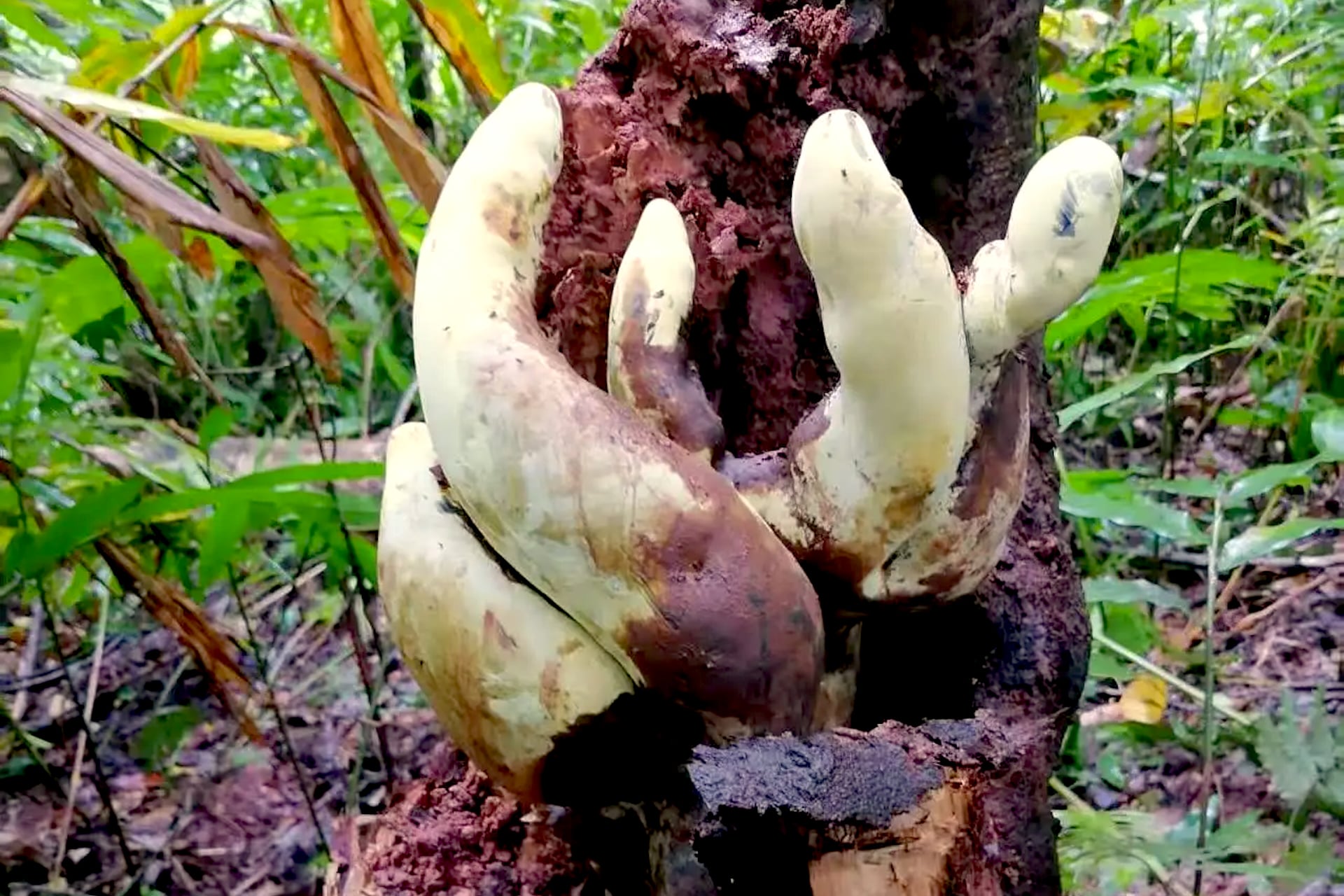
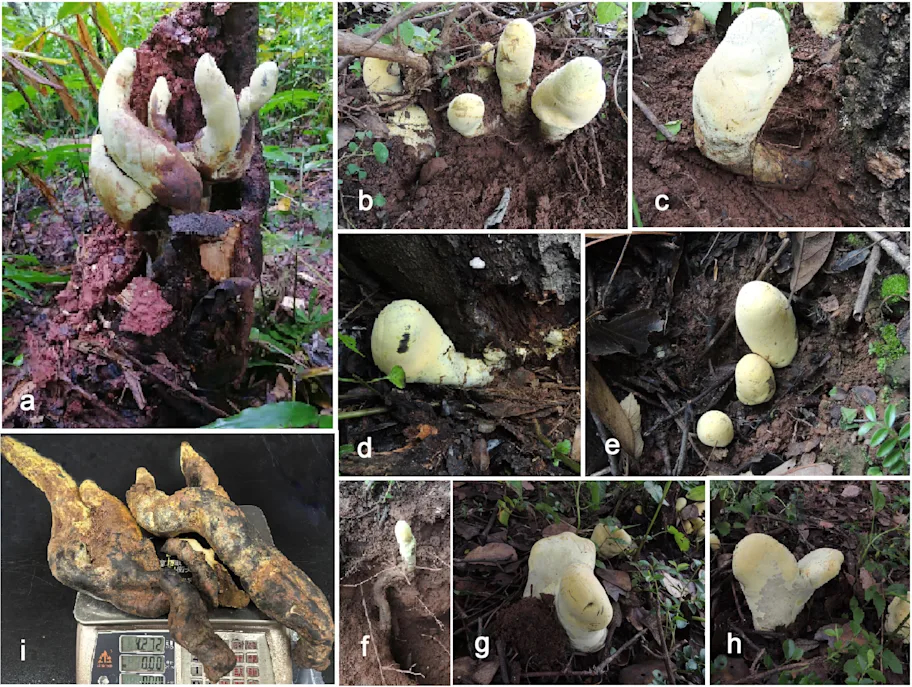
And it’s a behemoth. An international team of mycologists, botanists, and other researchers has uncovered a gigantic, nearly 20-inch (50-centimeter) tall, 4.9-pound (2.2-kilogram) new fungus deep within the forests of Yunnan Province in south China. The newly discovered species, a member of the order Xylariales known to consume dead wood, has been named Dianjunus rex (D. rex for short), in honor of its king size and prehistoric origins.
Mycology specialist Indunil Senanayake and her coauthors deployed a “molecular clock” technique to assess when D. rex first emerged, comparing its genome to the DNA of hundreds of other fungi whose evolutionary timeline is well documented. Tellingly, according to their new study published in Frontiers in Fungal Biology, Dianjunus rex appears to date back to somewhere approximately 65 million years ago.
“This timing raises an intriguing possibility,” Senanayake said in a statement. “After the mass extinction, forests experienced dramatic changes, including the sudden availability of large amounts of dead plant material. For wood-associated decomposing fungi, such environmental disruption may have created new ecological opportunities.”
Big Fungus
Prior to D. rex, the world record holder for the largest Ascomycota—the sprawling fungal phylum that includes the new species’ entire new fungal family, Dianjunaceae, as well as its surrounding order Xylariales—only grew fruiting bodies at most 7.9 to 11.8 inches (20 to 30 cm) tall. The fact that D. rex was found still active tens of millions of years later in the dense coniferous forests near Damaidi and Yipinglang in Yunnan Province, as well as in the tropical rainforest near Nanbang, offered some clue as to what ecological niche it’s carved for itself.
“A fruiting body which towers above surrounding vegetation and debris could have better dispersal of spores by wind in dense forests,” Senanayake speculated. “However, such a large structure requires substantial energy investment, suggesting that this strategy likely evolved only where the ecological benefits outweighed the costs.”
Genetically, the closest known species to D. rex is Graphostroma platystoma, a gummy, black-tar-like fungus known to grow on dying tree limbs and other hardwood across the northern hemisphere. Senanayake and her colleagues found genomic evidence that D. rex produces several carbohydrate-active enzymes that they suspect help to break down tough plant matter efficiently, with “low metabolic maintenance” required to keep that nutrition coming.
More in spore
According to Senanayake, who serves as an associate professor at the Germplasm Bank of Wild Species at China’s Kunming Institute of Botany, D. rex is likely only the beginning of the new fungal discoveries lying in wait within the Asian nation’s subtropical forests. Given D. rex’s size, you can imagine how much it stood out during the team’s Yunnan fieldwork, where it was first spotted growing out of the thick roots of Chinese cork oak.
“This region combines exceptional habitat heterogeneity, climatic stability, and complex biotic interactions that promote fungal diversification,” Senanayake noted. “Historically, however, fungal diversity in these ecosystems has been underestimated due to logistical difficulties in field sampling, the seasonal and cryptic nature of fungal fruiting, and a historical emphasis on economically important fungi.”
That said, D. rex has proven to be such an “extreme fungal body,” in Senanayake’s words, that it’s hard to imagine more effort won’t be put into investigating what other unknown fungi are lurking in Yunnan.
“The discovery illustrates how much fungus biodiversity remains to be discovered in East Asian forests,” the mycologist said.