With the dawn of the commercial spaceflight industry, rapid technological advancements have put previously inaccessible destinations within reach. NASA now hopes to land humans on Mars by the 2030s, for example. But as we endeavor to travel beyond the reaches of our solar system, we’ll need to take spacecraft propulsion to the next level.
It may sound like science fiction, but some experts have seriously proposed harnessing antimatter—the mirror twin of ordinary matter—to generate vast amounts of energy for propulsion. The concept remains entirely theoretical, but on Friday, SpaceX CEO Elon Musk and NASA Administrator Jared Isaacman both endorsed antimatter propulsion in a brief exchange on X.
While we’re nowhere close to overcoming the hurdles that stand in the way of achieving the first antimatter propulsion system, the fact that two of the most influential figures in spaceflight acknowledge its potential is worth paying attention to. Here’s what it would take to make this concept a reality.
I support antimatter propulsion.
— NASA Administrator Jared Isaacman (@NASAAdmin) June 19, 2026
Unlocking the cosmos with antimatter
Before we dive into the technology, a bit of physics. Every type of matter particle has a corresponding antiparticle with matching properties but opposite electrical charge. The two annihilate upon contact, converting mass directly into energy. The efficiency of this process is practically perfect, converting nearly 100% of the mass of the annihilating particles into energy.
Matter-antimatter annihilations produce about 10 billion times more energy per unit mass than chemical combustion (which powers most operational spacecraft propulsion systems) and about 300 times more than nuclear fusion (an emerging propulsion strategy).
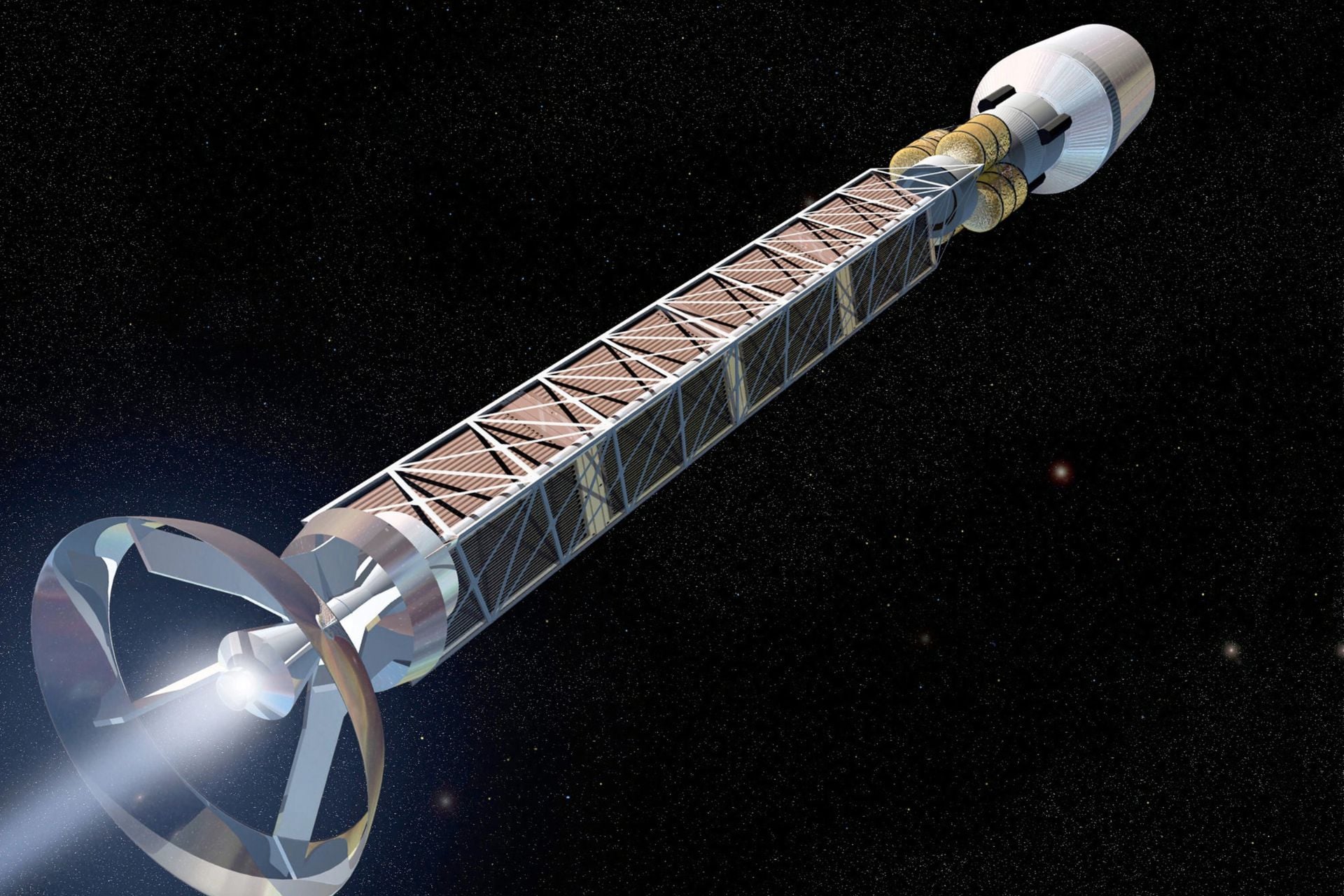
If scientists could figure out how to produce and trap large quantities of antimatter, then run matter-antimatter annihilations at large scale, they could theoretically harness the energy. Creating engines capable of this could enable high-speed space travel and allow spacecraft to carry more cargo, allowing humans to venture to other star systems. However, this is all much easier said than done.
While physicists at laboratories such as the European Organization for Nuclear Research (CERN) can successfully produce antimatter, they can only make small amounts that are not feasible for propulsion. Even if they did figure out how to produce antimatter at a large scale, they would still need to figure out how to store it and design engines that can safely harness its energy.
Despite these technical challenges, space agencies and companies have invested in antimatter propulsion development. One California-based startup, Positron Dynamics, claims it has figured out how to generate “intense beams of cold positrons” (the antimatter counterparts of electrons) that would allow for a rocket engine 1,000 times more efficient than current state-of-the-art ion thrusters.
NASA has supported theoretical research over the years but is not currently funding development of antimatter propulsion systems. Based on Isaacman’s response to Musk, it appears that could change under his leadership. With that said, the administrator is laser-focused on returning astronauts to the Moon, so NASA’s ambitions likely won’t extend beyond our solar system anytime soon.