Unless you’ve spent the last month hiding under a rock (or marooned in an endless maze of liminal spaces), you know that the Backrooms movie is huge. It’s so huge, in fact, that it’s all Backrooms everything on the internet at the moment, with a whole lot of people rushing to capitalize on the film’s popularity.
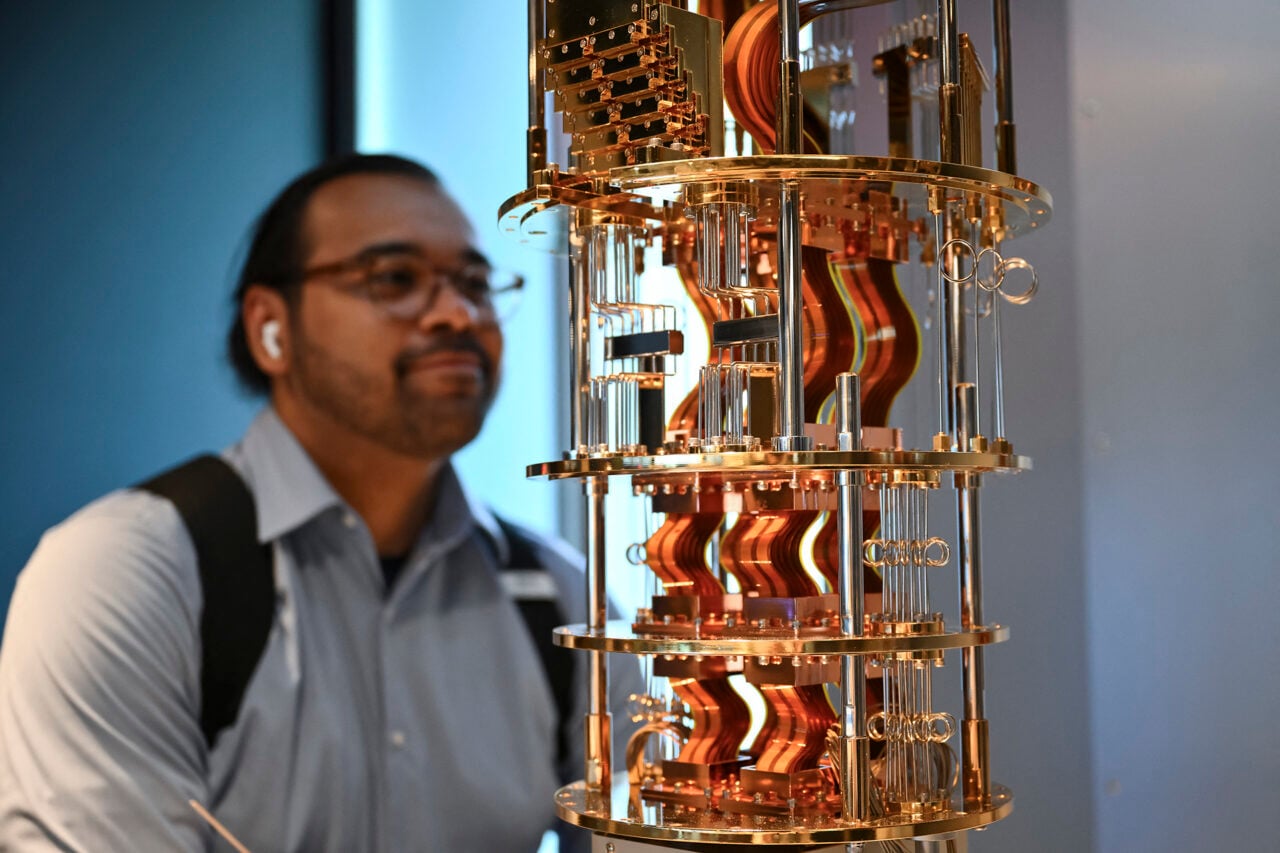
One of the more intriguing projects piggybacking on the Backrooms phenomenon is a recently released online game called Quantum Backrooms. The title might sound like a Deepak Chopra cash-in, but the game isn’t just using the word “quantum” to sound cool and science-y—its levels were generated by an actual quantum computer at London-based company Moth Quantum, which describes itself as “the first and only consumer-facing quantum computing company.”
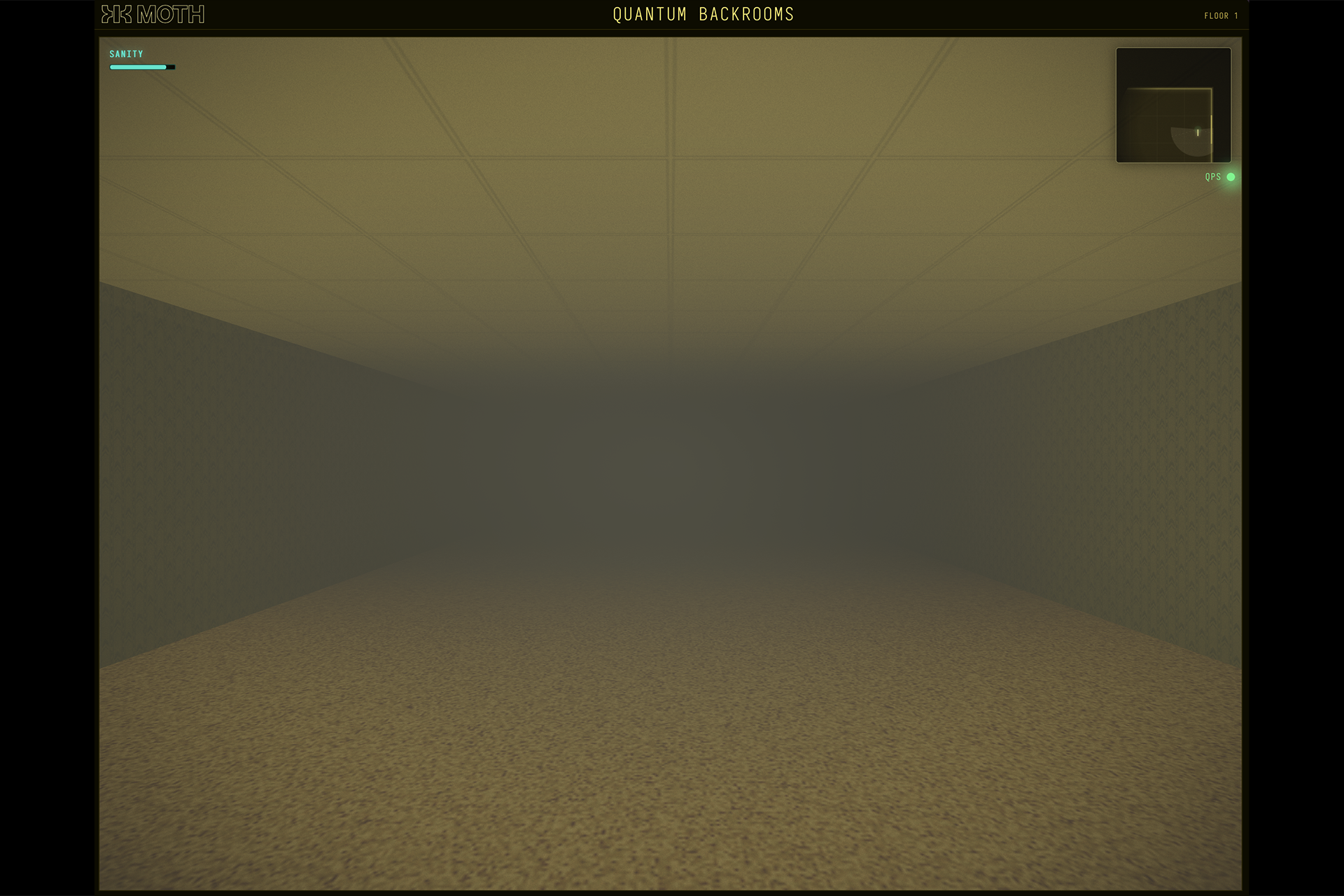
The game experience is reminiscent of old dungeon crawlers like Eye of the Beholder or Dungeon Master. Your character’s movement is constrained to a grid—quantized, in fact—so you can only move forward in discrete steps and turn at 90º angles. Unlike those games, however, the “dungeon” is in a constant state of flux, with the contents of each cell only becoming concrete when the player is facing it.
This reflects the idea that each cell is a representation of one of the quantum computer’s qubits. A classical computer’s bits are deterministic binary systems: each bit represents either a 1 or a 0, and will return the value it’s been assigned every time you look at it. A qubit’s state, by contrast, is probabilistic: it exists in a superposition of possible outcomes, each with a given probability of being observed when the system’s state is measured.
In the game, this means that, for example, the cell at 0,0, on a level grid might have a 75% chance of being in state 0 (which might correspond to being empty), and a 25% chance of being in state 1 (which might mean that it contains the stairs to the next level). Whether the stairs are in that cell will only be determined when your player turns to face the cell—and the result may well change if your character moves away and then returns.
The same thing is true of the walls between cells. If the parity of the cell you’re in and the cell you’re facing match up—i.e. if they’re both in their respective state 0 or 1—then you’ll be able to move forward. If not, a wall will block your path. And again, if you turn or move away and return, what once was a passage might become a wall, or vice versa. This is a cute idea, and it makes for an effective representation of how strange and counterintuitive quantum systems seem when compared to the macroscopic world in which we live.
Moth’s FAQ sheet about Quantum Backrooms explains that the game “is powered by quantum hardware… levels are generated by running circuits on a real quantum processing units (QPUs), not simulated or approximated on classical hardware.” It also points to some other interesting ways in which the intricacies of quantum computing map to aspects of the game experience: the imperfections of qubit systems, for instance, mean that “the hardware’s limitations become part of the game’s character … rooms and corridors generated by high-fidelity qubits will be well-defined, [while] regions with noisier qubits will produce more irregular or degraded results.”
The company seems very eager to use the game as a way to push the idea that quantum computing is beginning a “transition into [being] a mainstream consumer technology.” The press release about the game proclaims that it represents “quantum computing approaching its ChatGPT moment” and spends a lot of time talking about how quantum computing is the new AI: “Moth’s message is simple: quantum computing is now entering the same kind of trajectory that carried artificial intelligence from research curiosity to mainstream products such as ChatGPT and Claude.”
If this is true—and for all that Quantum Backrooms is undeniably fascinating, it’s not clear that quantum computing is anywhere near ready for mainstream adoption—we can only hope that the trajectory it follows doesn’t follow that of LLMs too closely. For now, the technology remains in a superposition of “viable” and “not viable”, with the associated probabilities still unclear—but whichever way the wave function falls, at least we’ve gotten a cool game out of the whole thing.