As greenhouse gas emissions push Earth’s temperature to new heights, polar ice sheets are rapidly melting away. Numerous studies have sought to estimate ice loss from Greenland and Antarctica, but one team of researchers may have just produced the most comprehensive analysis to date.
A study published today in the journal Scientific Data presents the longest satellite record of polar ice loss ever assembled. The findings reveal that the Greenland and Antarctic ice sheets have lost an enormous amount of mass over the last 50 years and have become key drivers of sea level rise, and that’s just the tip of the iceberg.
“What’s really interesting is that we can see that there’s a long-term trend that glaciers are flowing faster, and so you have more and more ice discharge,” lead author Inès Otosaka, an assistant professor at Northumbria University who also works at the U.K. Centre for Polar Observation and Monitoring, told Gizmodo.
11 trillion tons of ice lost
There are dozens of satellites that observe Greenland and Antarctica, and scientists around the world use these observations to track polar ice loss. According to Otosaka, there are about 50 published estimates of mass loss from these two ice sheets, but they are based on different satellite datasets that have been processed in slightly different ways.
“What we really wanted to do is to produce a very comprehensive and robust estimate,” Otosaka said. “By combining all of those different independent estimates, we can then come up with one dataset and assessment of how the ice sheets have evolved over the past five decades.”
To that end, she and her colleagues compared and combined 42 independent estimates of ice sheet mass balance (the net difference between the total mass gained and the total mass lost) derived from satellite observations of ice sheet flow, volume, and gravitational attraction over time. This allowed them to estimate how much mass Greenland and Antarctica’s ice sheets have lost since the 1970s.
The researchers found that the two ice sheets lost a combined 11.3 trillion tons of ice between 1979 and 2023. “It is a huge number,” Otosaka said. “If you put that into context, it’s about enough ice to fill a cube that would be 23 kilometers [14 miles] in height.”
Her team estimates that this ice loss has raised global average sea levels by about 1 inch (3 centimeters). That may not sound like much, but it shows that Greenland and Antarctica have become key drivers of sea level rise in recent years, according to Otosaka. Early in the satellite record, the ice sheets contributed relatively little to sea level rise. Now, they are responsible for about one-quarter of the global average increase.
Discharge is the main driver
The mechanism behind this ice loss is perhaps even more surprising than the scale.
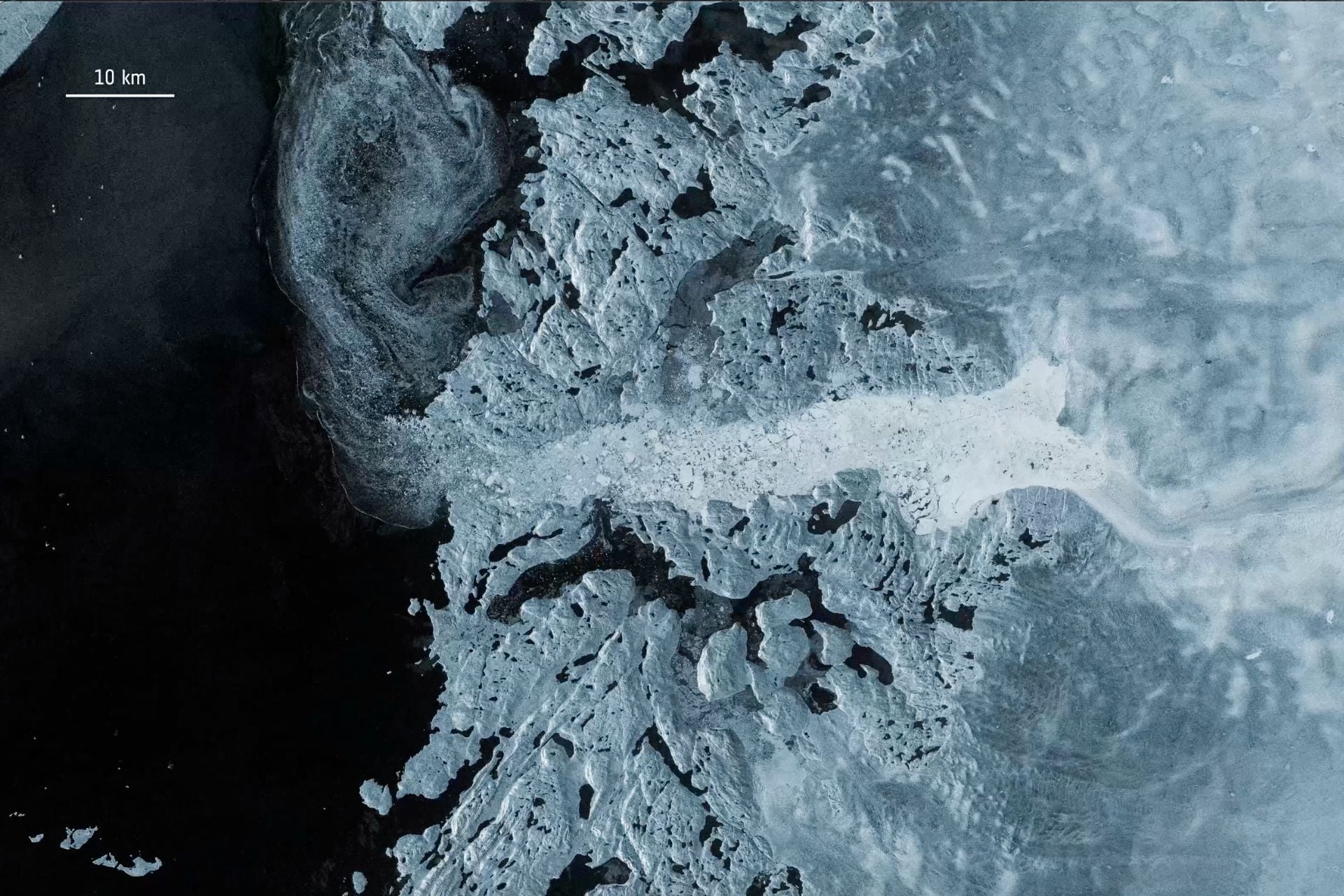
Ice sheets gain mass only through snowfall accumulation, but they can lose mass through two different processes: surface melting (driven by atmospheric temperatures) and outflow (driven by ocean temperatures). “Here we really found that the main cause of ice loss from the ice sheets is the latter, where you have glaciers that are flowing faster into the ocean,” Otosaka explained.
Indeed, she and her colleagues found that 84% of the combined ice loss from Greenland and Antarctica stemmed from glaciers pouring more ice into the ocean, with just 16% due to surface melting.
Looking at each ice sheet separately reveals some differences. Ice loss from both Greenland and Antarctica has accelerated significantly since the 1990s, but Greenland saw its biggest losses in the 2010s, when several extreme summer melt events occurred. Surface melting remains a major driver of Greenland’s ice loss, accounting for about one-third of the total. The remaining two-thirds comes from ice discharge, according to Otosaka.
Antarctica’s melt rate also surged in the 2010s, but its net mass loss was entirely due to ocean-driven melting of its outlet glaciers. In fact, the speed of outflow from West Antarctica, driven by Pine Island and Thwaites glaciers, has risen in every decade of the satellite record.
Between 2020 and 2023, record snowfall over East Antarctica and milder Greenland summers led to a temporary slowdown of mass loss from both ice sheets. Still, Otosaka emphasizes that the record shows a clear trend of glaciers flowing faster, so while snowfall and atmospheric temperatures can mitigate or exacerbate ice mass loss, discharge remains the long-term driver.
Overall, the findings highlight polar ice sheets as a growing contributor to global sea level rise and help scientists better understand what’s driving their mass loss. Next, Otosaka’s team plans to estimate Greenland and Antarctica’s ice loss on a regional scale, “because we know that some parts of the ice sheets are responding differently,” she said.