Sony’s decision to phase out physical media has prompted widespread concern among consumers, largely centered on the loss of control that comes with shifting from physical ownership to uncertain digital access. The news has also renewed discussions around exactly what it means—or doesn’t mean—to “own” software.
These are all perfectly valid concerns, but Sony’s decision also represents another nail in the coffin of physical objects being part of the experience of playing a game. In fairness, that particular casket was already pretty well-sealed—your average 21st-century PlayStation purchase from GameStop involved a DVD case, a disc, and perhaps, if you were lucky, a “booklet” that was a single folded sheet of paper. But it wasn’t always thus.
Back before digital distribution was a thing, games could only be purchased on physical media, and the way in which that media was packaged was an art in and of itself. If you’ll forgive a little nostalgia, there was something genuinely exciting about getting a new game home and tearing off the plastic wrapping to see what sort of manuals, maps, and other goodies the box might contain (in addition to a bunch of floppy discs, obviously.)
Sadly, my own examples of such items are currently in a sealed box just outside of Melbourne, left in the safe (?) hands of a man named Gary, whose career mullet is truly a thing of wonder. As such, it was a delight to stumble across a site called Big Box Collection yesterday, in the course of writing a piece on Tetris. The site is a digital catalogue of a truly impressive collection of boxes, manuals, and ancient media maintained by one Benjamin Wimmer, a confessed nerd who lives just outside of the Austrian capital, Vienna.
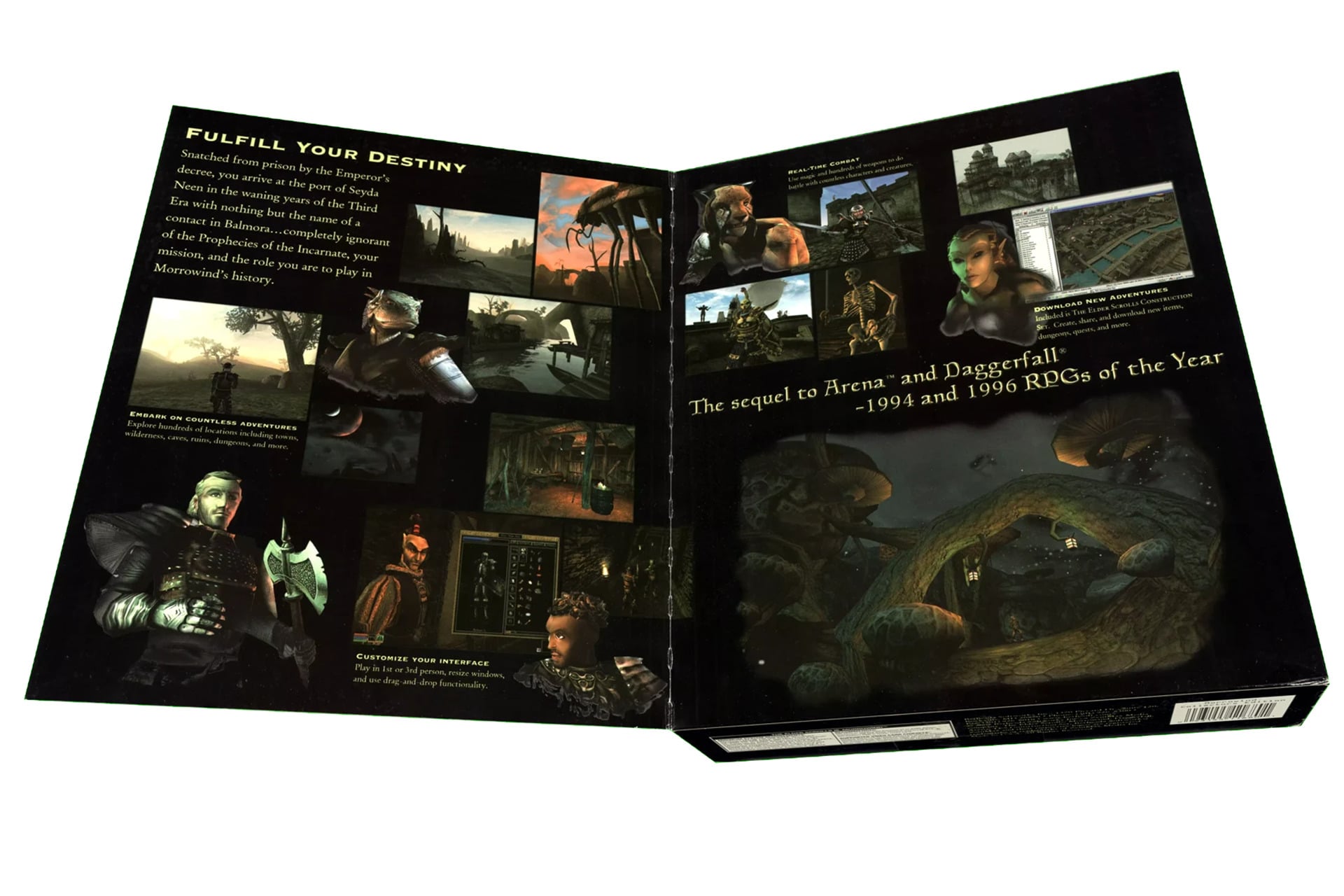
Big Box Collection is somewhat reminiscent of The Closet, the VR recreation of Criterion’s legendary closet that we covered a few weeks back. In Big Box Collection, Wimmer recreated his physical boxes as 3D models, projecting scans of the original box art onto their virtual surfaces. As someone who owns or owned several of the games here, I can attest to what a good job Wimmer has done—these are largely perfect recreations of the actual boxes I pulled off the shelves of Oz-E Software back in the 1980s and 1990s. There’s even a facility for opening gatefold boxes, as demonstrated by this box for a 2002 collector’s edition of Morrowind.
Still, for all that the boxes are impressive, I suspect that today’s gamers might be most impressed and/or surprised by their contents. Sadly, there are no Infocom games here—that company was justly famous for the quality of its so-called “feelies”, tangible objects that also served as a form of copy protection, because having access to them was required to solve in-game puzzles. But even so, there are many, many fascinating pieces of history.
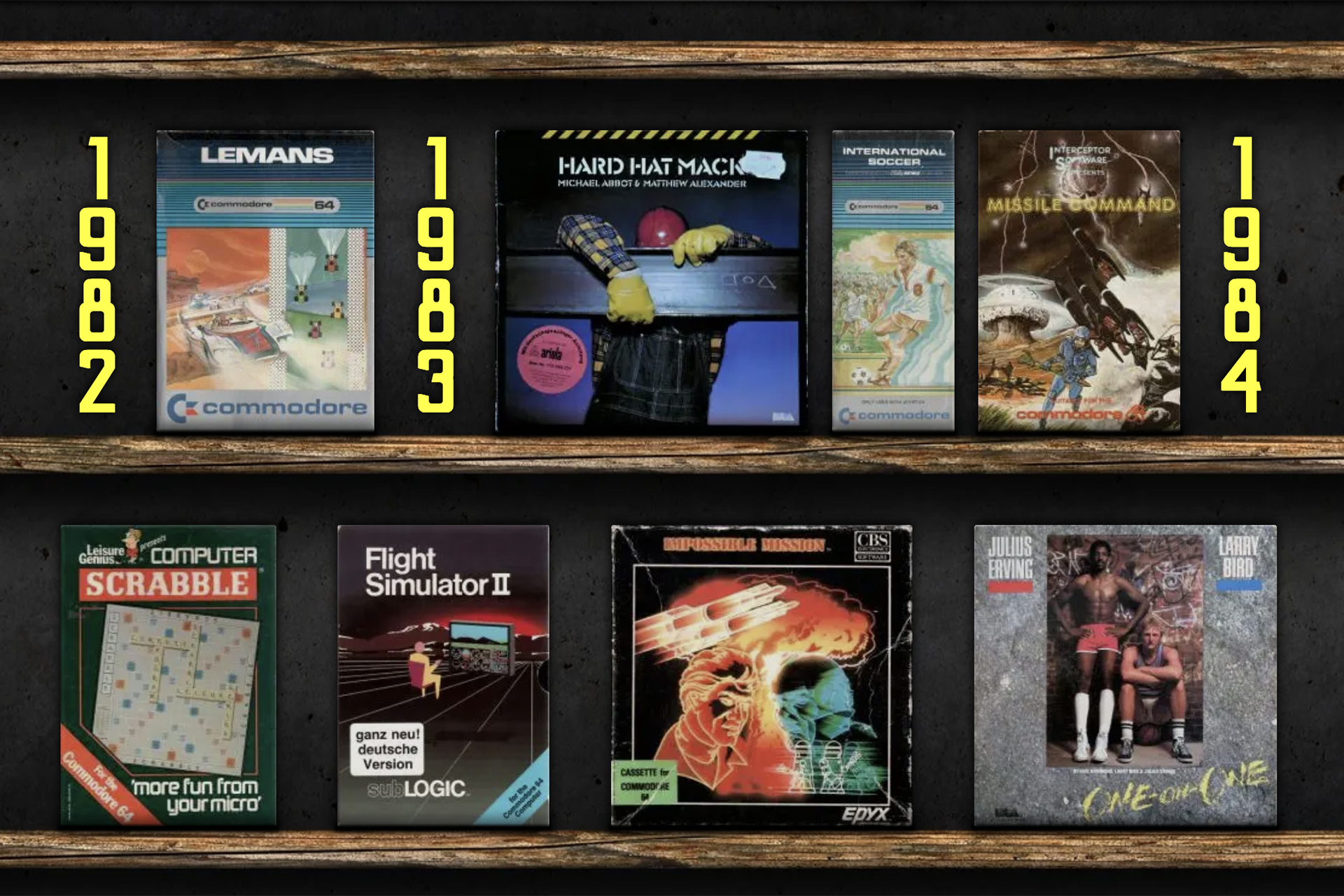
The various Ultima games, for instance, came with maps printed on pieces of cloth, rather than paper, for added longevity (Ultima IV also gave you a little ankh—the symbol of The Avatar, the game’s recurring protagonist). Another title from the same company, Wing Commander, came with impressively detailed schematics of the game’s various starfighters. And speaking of schematics: Flight Simulator II came with detailed maps of the New York and Boston region, presumably in the (forlorn) hope of encouraging you not to crash into the various landmarks.
Or: have you ever heard of something called Little Computer People? I hadn’t, so I clicked out of interest, to discover that the game was a sort of Tamagotchi-style simulation that involved literally taking care of a “little computer person.” It came on a single 3.5” floppy, accompanied by a cryptic photograph, a newspaper, a Deed of Ownership to your new virtual, um, friend, and a guide to communicating and taking care of him/her. Damn.
The site is also slick in its presentation of its contents. Click on a game, and you’ll be presented with a fully textured, rotating 3D box model. Scroll down, and you’ll find scans of its contents. As an example, here are the contents of the box of a personal favorite, The Bard’s Tale III.
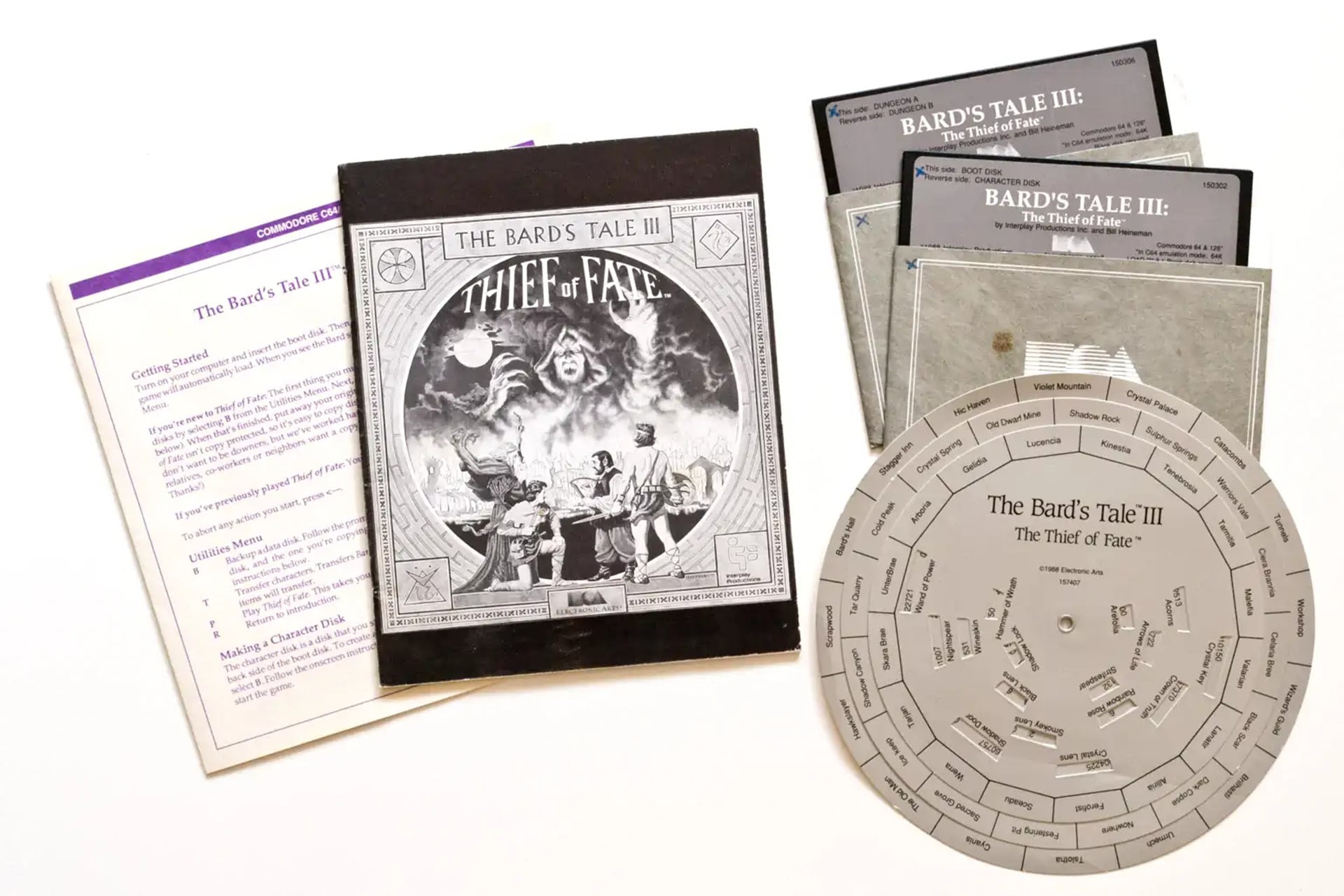
If you’re younger than me, you might be wondering what the circular contraption is. That, friends, is a code wheel! It was once a pretty common copy protection device. At some point, you get a copy protection challenge that provides three values, one for each of the concentric wheels. You align those values, and the wheel reveals a code. You punch that into the game, and you’re good to continue; otherwise, you get an admonition about the evils of copying software and get punted back out to DOS. (Also: pulling these wheels apart to photocopy each part was a huge pain in the ass. So I’m told.)
Anyway, the site also provides plenty of other information: links to other games in the series; information on publication dates, formats, and related blog posts, musings, photographs, etc. Perhaps most interestingly of all, there’s also whatever Wimmer has been able to find on the artists responsible for the box design, along with whatever’s available in the way of concept art, interviews, and links to other sites.
The whole thing is clearly a labor of love, and frankly, feels like something of a love letter to not one bygone age, but two—the first being those years when games came as physical objects, and the second being the equally fleeting era when the internet was first and foremost a place for people to express themselves and their interests, rather than a capitalist dystopia lorded over by very rich assholes and getting worse by the minute. Those were, indeed, the days.
READ MORE: When PC Game Packaging Was a Work of Art