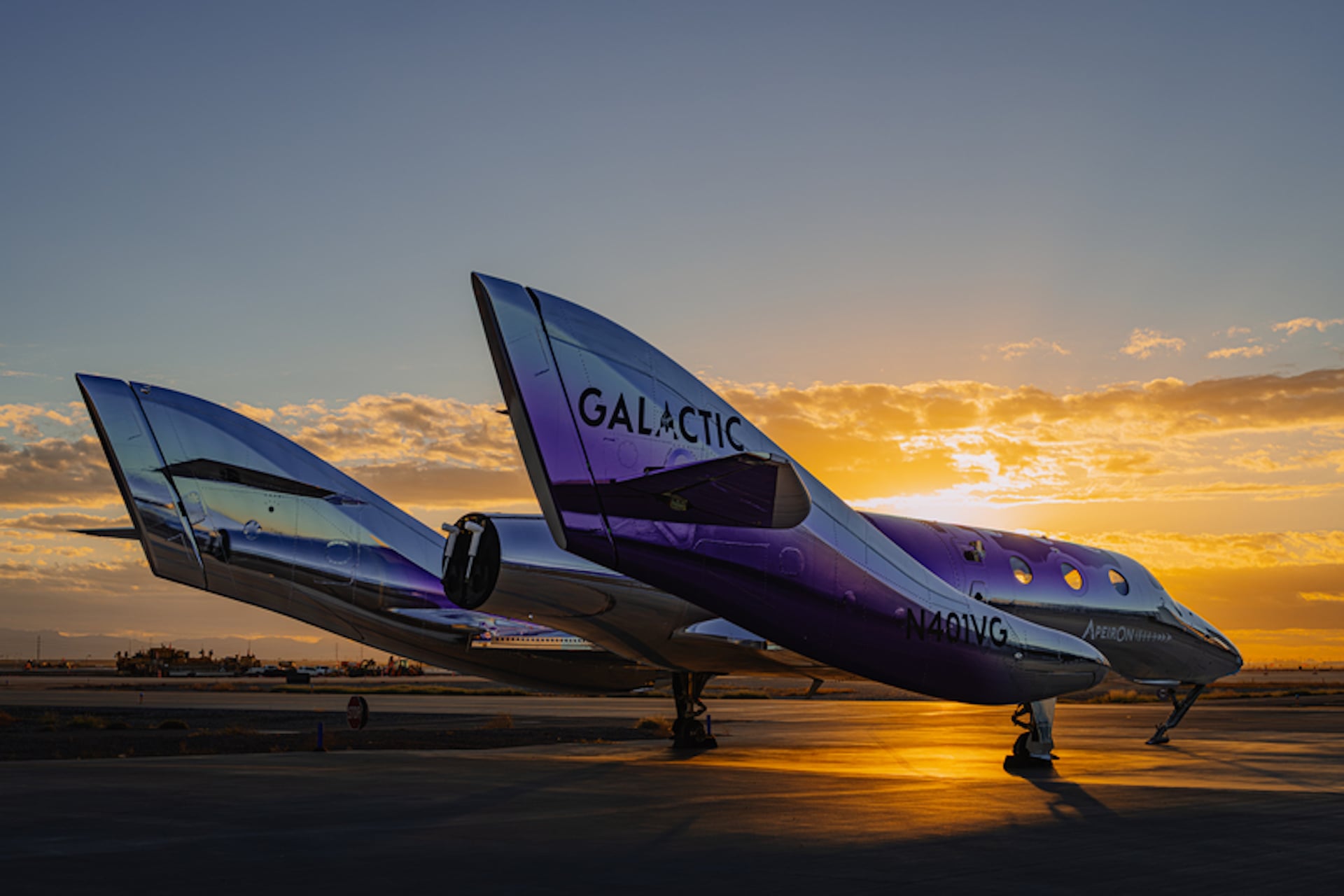
For those who have run out of ways to spend their money on Earth, Virgin Galactic has another option: a trip to the edge of space. The company’s new spaceplane is the latest addition to its ambitious space tourism venture, offering passengers brief moments of weightlessness and a spectacular view of Earth from above.
This week, Virgin Galactic unveiled its new spaceplane, named Apeiron, with plans to restart commercial space tourism flights in the second quarter of 2027. The vehicle was flown, attached beneath the company’s Eve mothership, from the company’s Spaceship Factory in Arizona to its base of operations in New Mexico, where it will undergo preparations before beginning a series of test flights.
Earlier this year, the company began selling a limited number of tickets for its 90-minute commercial flights, each priced at a whopping $750,000. With its next-generation vehicle at its new home, Virgin is now moving over 100 ticket holders into an initial phase of flight readiness, with more expected to follow on a rolling basis.
You can’t put a price on zero gravity
Virgin’s first Delta-class spaceship is meant to replace the company’s earlier model, VSS Unity, which flew passengers on seven suborbital trips between 2023 and 2024. After its final crew touched down in June 2024, the space venture halted flights in an effort to cut cost and focus on developing its next-generation spaceplane.
Compared to its predecessor, Apeiron is larger and able to carry six passengers rather than Unity’s four-person capacity. That gives Virgin two extra paying seats per trip. Another major difference is the frequency of suborbital flights. While Unity could only fly once a month, the company claims that the Delta vehicles will require less maintenance between flights. Apeiron is designed to support up to eight flights a month.
Apeiron will follow the same launch itinerary as its predecessor. Virgin’s mothership, the VMS Eve carrier, will take off while carrying the Apeiron spaceplane beneath its center wing before releasing it at an altitude of around 44,500 feet (13,500 meters) above the ground.
Once released, the spaceplane fires up its rocket engines, lifting off to a maximum altitude of 54.2 miles (87 kilometers), which is substantially shy of the internationally recognized boundary of space known as the Kármán Line, at 62 miles (100 kilometers). There, passengers enjoy brief, yet precious, moments of weightlessness, where they can unbuckle and float around the cabin for three to four minutes before the vehicle begins its descent.
Is space tourism still a thing?
Virgin Galactic anticipates that its new spaceplane will bring in more revenue as it is designed to fly more frequently and at a lower cost than its predecessor. The price for each seat on board the shiny new spaceplane is also significantly higher.
The first tickets for flights on board VSS Unity cost $200,000 per seat when the company began selling them in 2005. The price eventually climbed to $250,000, and when the company reopened sales in 2021, a seat aboard its spaceplane cost $450,000. By 2024, the price tag had once again climbed to $600,000 before Virgin announced its $750,000 ticket prices in late March.
The recent unveiling of Apeiron is meant to usher in a new era for its commercial flights at a time when suborbital space tourists have no other options for experiencing the thrill of floating around above Earth. In January, Blue Origin announced it was pausing its suborbital space tourism flights for at least two years to focus on developing lunar landers for NASA’s Artemis program.
This niche market never truly materialized as a profitable industry, considering the high cost of developing and maintaining reusable spacecraft, which leads to soaring ticket prices. Evidently, there are still a number of people willing to pay the price for a trip to (almost) space, considering Virgin’s backlog of eager ticket holders.