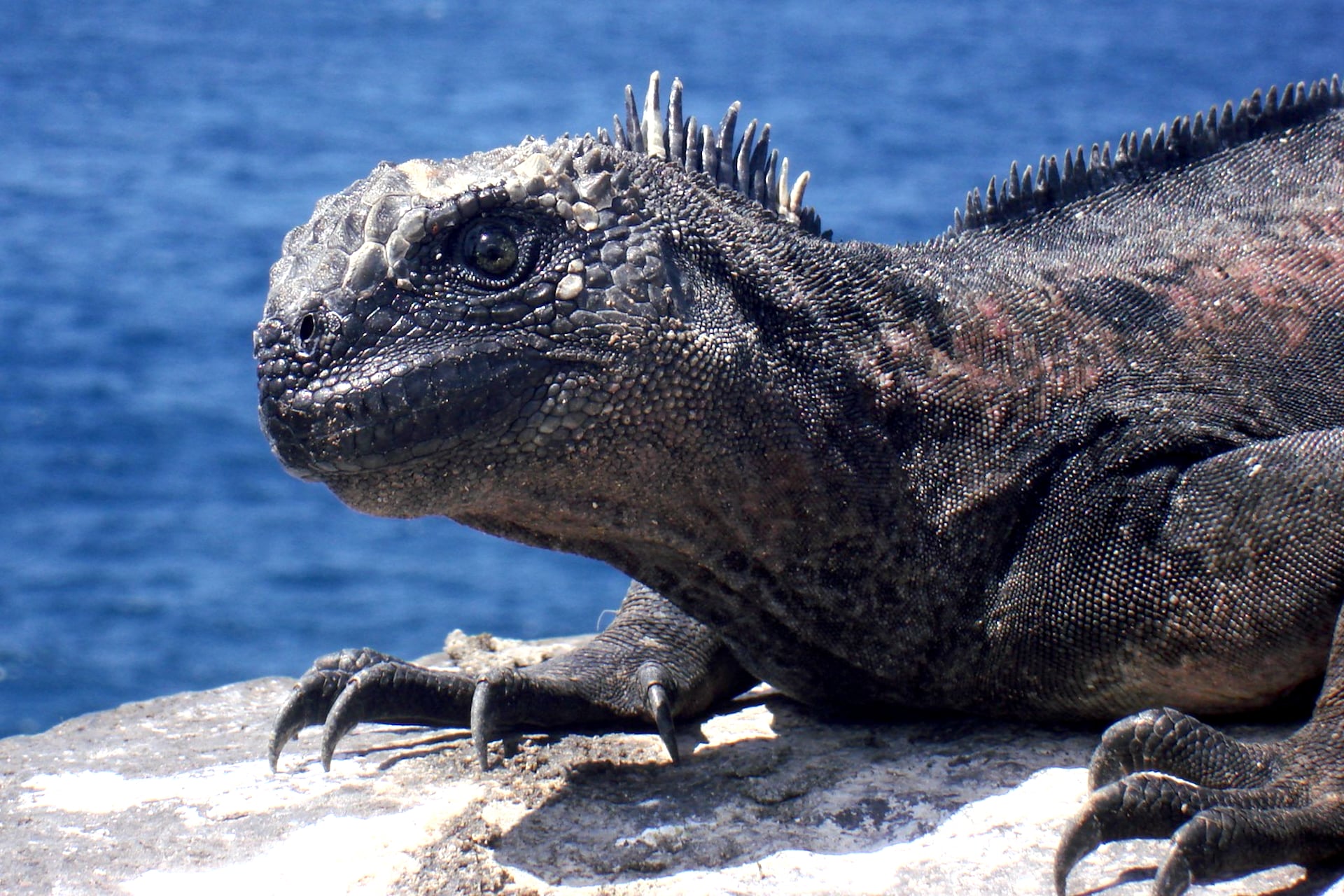
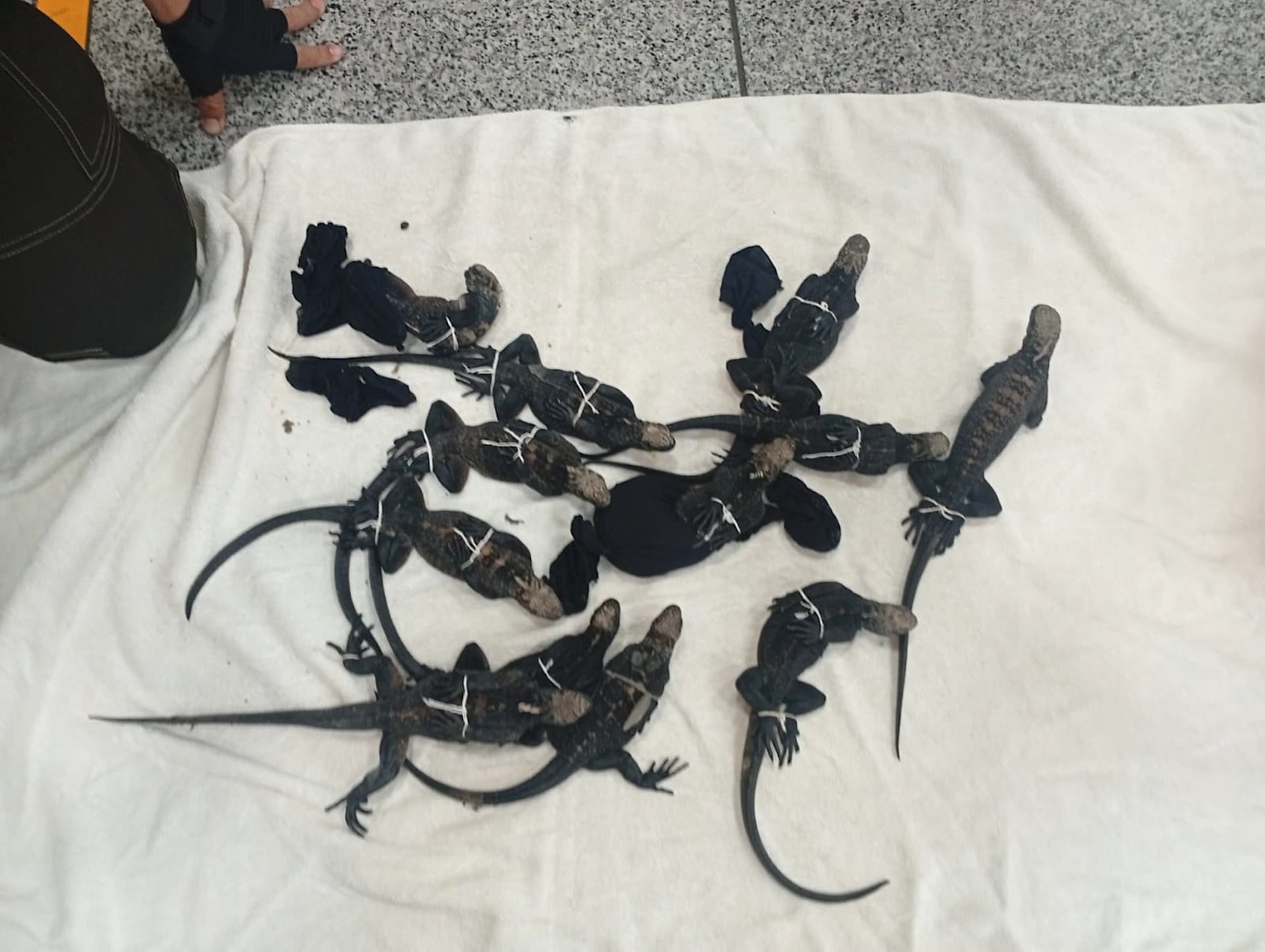
It started this May when Ecuadorian officials recovered four illicitly held Galápagos iguanas from a home near Guayaquil, the South American nation’s largest city. Before the month was through, Ecuadorian police would intercept over a dozen more protected Galápagos marine iguanas from the port city’s Joaquin de Olmedo Airport—stashed away by Thai smugglers in handbags and wrapped in nylon stockings, their little lizard limbs tied down.
Then another 32 specimens were discovered in the suitcase of a Russian national this August, leaving environmental scientists, criminologists, and conservationists worried that the escalation in trafficking might finally push this vulnerable species over the edge. Now, in a letter to the journal Science, marine eco-toxicologist Juan José Alava and his colleagues have warned that the twin burdens of heightened trafficking and the ecological toll of El Niño this year could seriously jeopardize this species’ survival.
“Marine iguana populations already face threats from chemical spills and plastics pollution,” Alava said in a statement put out by Simon Fraser University, where he teaches, “and now this strange uptick in trafficking to supply the exotic pet trade is happening at the same time the Super El Niño is wiping out intertidal macroalgae.”
“That macroalgae,” Alava added, “is the iguana’s primary food source.”
A macroscale problem
Scientists have known for at least a decade that an El Niño event of any strength can have an adverse impact on the Pacific Ocean’s aquatic plant life. Chlorophyll-a concentrations visible from space have confirmed the theory that El Niño’s hotter ocean surface temperatures can suppress the natural upflow of the colder, nutrient-rich seawater that ocean vegetation like intertidal macroalgae (AKA “seagrass”) and phytoplankton rely on for nourishment.
Under normal conditions, the marine iguanas of the Galápagos would be foraging between rocks along the coast’s shallow waters for seagrass to eat. While these iguanas can dive as much as 39.4 feet (12 meters) deep and hold their breath for up to an hour, the species simply “cannot swim long distances in the open sea to look for food” as Washington Tapia, the director of the Galapagos Conservancy, noted during 2023’s El Niño event.
“They are already shrinking in size and facing mass mortality, either by starvation or by trying to swim longer distances in search of food,” Alava noted. “This species is already very vulnerable to climate change. We wrote this letter to call attention to this added threat of trafficking.”
Cold-blooded criminals
Alava and his coauthors—which included criminal justice professor Gohar Petrossian, who researches wildlife crime at CUNY’s John Jay College of Criminal Justice in New York—focused their letter’s call to action on law enforcement whose efforts, they argue, contain critical gaps. Even though most locally recognized subspecies of the Galápagos marine iguana are protected under Ecuadorian law, the latest cases have shown that smugglers feeding the exotic pet trade are successfully evading ecological inspection checkpoints surrounding the Galápagos Marine Reserve.
And new problems emerge once international criminal actors manage to get these lizards out of the country, despite the strict ban on their trafficking enforced by the Convention on International Trade in Endangered Species of Wild Fauna and Flora (CITES).
“Traffickers launder marine iguana by using falsified documents and exploiting loopholes in the CITES permitting process in Uganda, Switzerland, Mali, and Japan,” Alva and his coauthors wrote in their letter to Science. “For example, in Mali or Uganda, wild-caught Galapagos iguanas have been falsely declared as ‘captive bred’ to obtain CITES permits.”
None of these four nations actually have a single authorized ‘captive breeding’ facility, the researchers noted.
Alava, Petrossian, and their coauthors added that they suspect global economic pressures have forced impoverished local fishing communities in Galápagos and coastal Ecuador into uneasy cooperation with international traffickers. So, to truly succeed, the nation’s policymakers, will have to “aggressively combat and litigate organized crime and provide financial support and sustainable alternative livelihoods to coastal citizens,” they wrote.