The Cambrian explosion brought exactly that to Earth—an “explosion” of life that kickstarted the evolution of animals as we know them. Scientists have come up with a myriad of theories to explain this phenomenon, such as a recent paper on a literal sh*t-ton of poop. And here’s now another odd idea: gigantic Antarctic mountains that eroded millions of years ago.
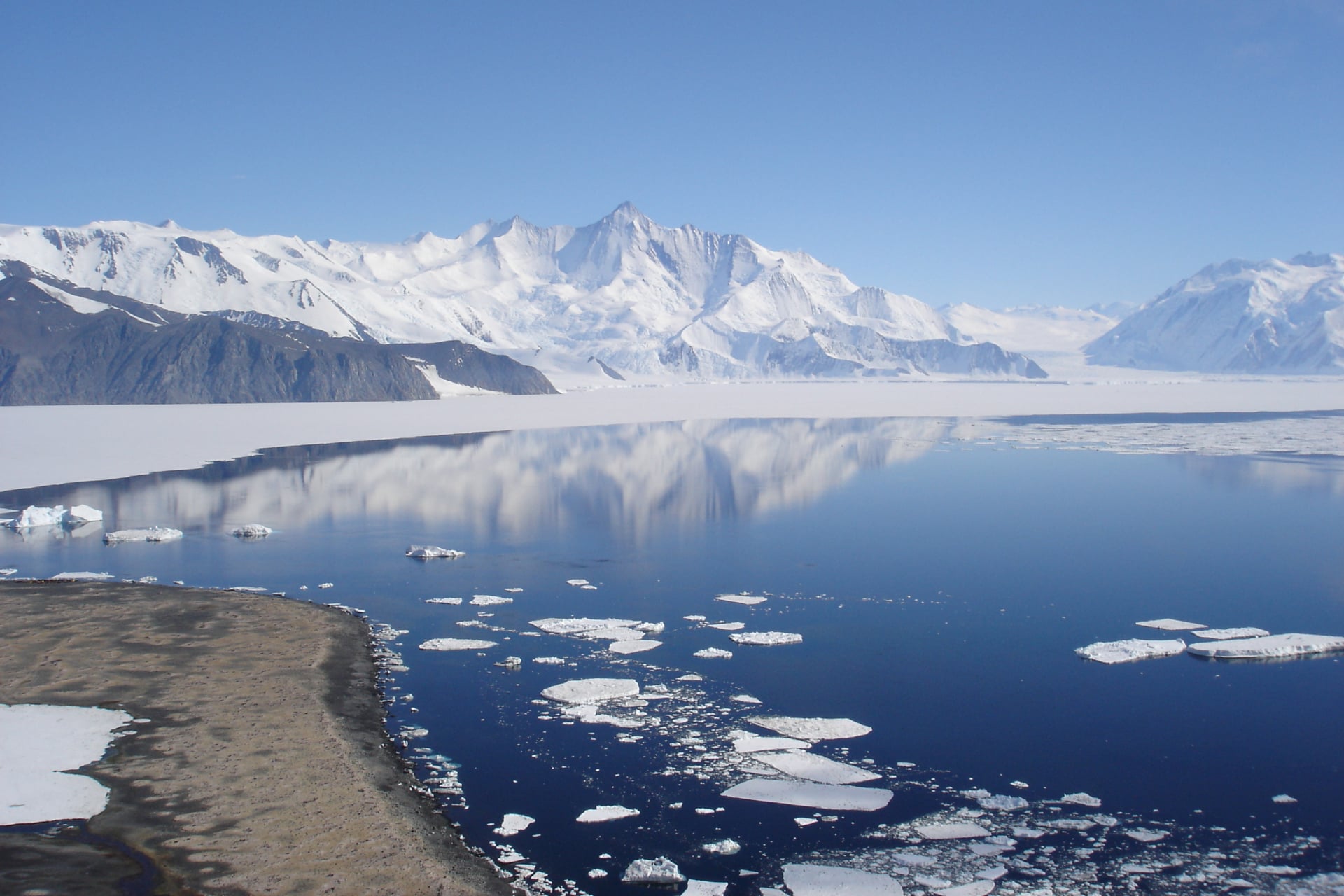
To be exact, a new analysis of zircon particles from Antarctica strongly suggests that the barren lands once hosted an enormous mountain range. As these ancient mountains eroded over the years, they would have shed nutrients that fed organisms at the very bottom of the food chain. Their photosynthesis sparked a huge leap in atmospheric oxygen, which was good news for more complex organisms—and the rest is history. Bei Chen and Ian Campbell, both Earth scientists at the Australian National University, published their findings in a recent paper for Earth and Planetary Science Letters.
“If rapid advances in evolution occur in response to favorable environmental change,” they wrote in the paper, “the dramatic evolutionary changes that occurred during the Cambrian should be matched by an environmental change of comparable importance.”
Moving literal mountains
And that dramatic environmental change was the erosion of Antarctica’s lost mountains, the team argued. For the study, the researchers collected 1,712 zircon grains from 12 different locations in Antarctica. Then, they dated the samples using uranium-lead dating, which helps determine the precise crystallization age of zircon. From these measurements, the team picked out four peaks in the distribution for the zircon particles’ age.
As it turned out, the highest peak, between 650 and 450 million years ago, matched nicely with the formation of the supercontinent Gondwana. According to the paper, the assembly of the supercontinent led to the collision of continent-sized pieces. When the conditions were right, these collisions would have produced giant mountain ranges, similar to how the Himalayas were formed.
The rise of supermountains
Here’s why the team believes the zircons point to a lost mountain range. First of all, previous research has shown that central Australia and the Antarctic section of Gondwana would have been moving rapidly enough toward each other to create that much force. Second, the geological deposits that the team studied share key traits with those traced back to Himalayan-style mountains, the researchers noted in the paper.
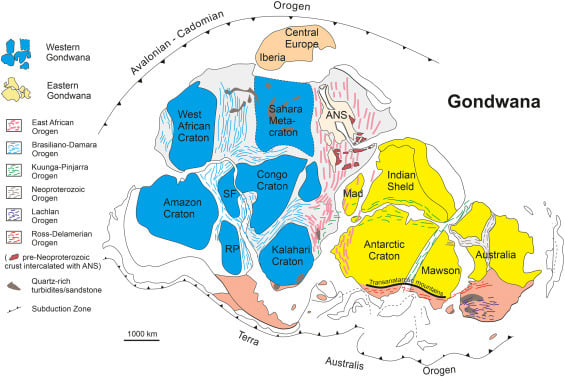
The resulting mountains would have been much larger than those we see today, they added, so it may be fitting to call these extinct features a “supermountain.” And if true, the disappearance of these supposed supermountains has significant implications for the Cambrian explosion. For one, the mountains would have included “essential nutrients for life,” such as phosphorus, iron, and carbonate molecules.
The miracle of life
As the team noted in the paper, this account is as “feasible” as any other theory on the Cambrian explosion, insofar as we’re aware that Earth’s systems are closely intertwined. That is, the right “answer” is likely a combination of various factors that provided the right conditions for the evolution of life. And these lost mountains may as well have been one of them.
“It is unlikely to be a coincidence that Earth’s most dramatic period of evolution correlates with the planet’s most important period of mountain building: the formation and erosion of the Gondwana Supermountains,” the researchers concluded.