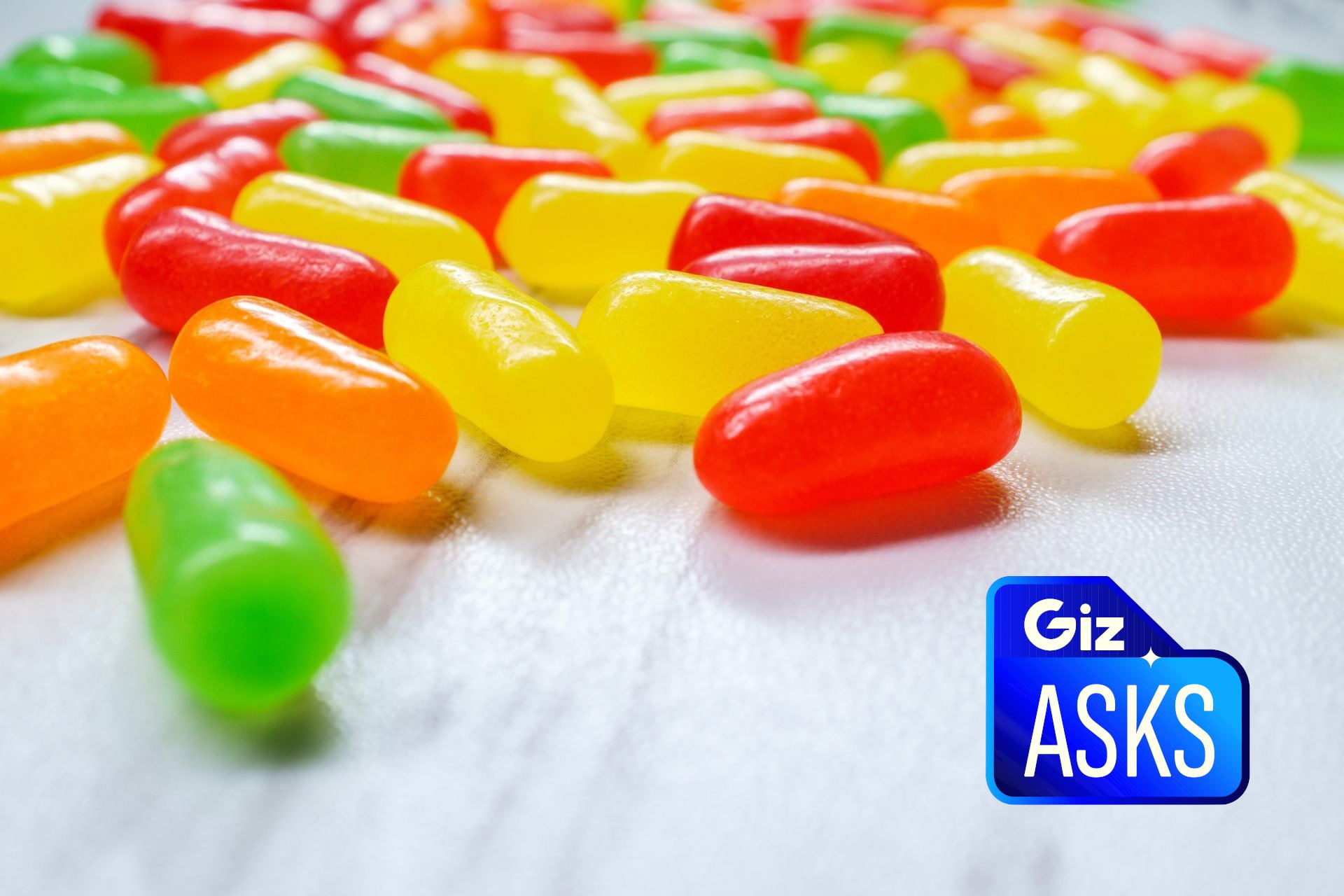
Growing up, few things in the supermarket excited me as much as a colorful bag of candy, a breakfast cereal box, or another sugary snack. And even today, though I try to keep my sweet tooth in check, I still occasionally fall for a brightly advertised treat at the checkout line.
These products often get their color via various dyes, many of which originate from synthetic sources. There’s long been a movement to reduce or even ban these artificial dyes from our food supply over potential health risks—one that’s now being championed by the highest levels of the U.S. government. In April 2025, the Department of Health and Human Services and the Food and Drug Administration announced a plan to phase out all petroleum-based synthetic dyes from our food.
A year later, progress on that front has been shaky. Though the FDA has moved to formally remove some dyes from the market recently, it’s largely relying on major food companies to willingly stop using the remaining six synthetic dyes on their own. A Reuters review in January 2026 found that only two of the 15 biggest food makers in the U.S. had agreed to phase out these dyes by the end of 2026—the FDA’s intended deadline—while seven have pledged to do so by the end of 2027. Some other makers, like Coca-Cola, have stated they are working on creating dye-free alternatives for their products.
Robert F. Kennedy Jr., the current head of HHS, has argued these artificial dyes are nothing less than “poisonous compounds” that are gravely endangering Americans, particularly developing children. Given Kennedy’s long history of spreading misinformation about vaccines and other health topics, it’d be reasonable for someone to be skeptical about this latest crusade. But some researchers have been worried about food dyes long before RFK Jr.’s ascension to the federal government, and other countries have been stricter than the U.S. about the coloring agents and other additives they allow into the food supply.
For this latest Giz Asks, we reached out to food science researchers, pharmacists, and other experts studying food dyes to get their thoughts. Does RFK Jr. actually have a good point (for once)? And will we be better off if and once these artificial dyes are no longer lining the supermarket aisle? The following responses may have been lightly edited for grammar and clarity.
Lorne Hofseth
A professor and associate dean for research at the University of South Carolina’s College of Pharmacy. Hofseth has published research looking into the possible health risks of several dyes.
The answer is nuanced. While many people consume foods containing synthetic dyes without obvious adverse effects, a growing body of evidence is showing that certain artificial food colorants may pose health risks for susceptible individuals. The challenge is that we do not yet know who is most vulnerable.
Short-term effects can include allergic reactions, skin rashes, gastrointestinal distress, headaches, and behavioral changes such as hyperactivity or attention difficulties in sensitive children. Emerging research also suggests that chronic exposure may contribute to inflammation, DNA damage, and gut microbiome disruption.
One reason food dyes are controversial is that they are xenobiotics (i.e. they are foreign to your body). Like other xenobiotics (e.g. viruses, bacteria), they interact with immune and metabolic pathways, causing a low-grade, simmering inflammation which is a recognized factor in obesity, cardiovascular disease, neurodegenerative disorders, and cancer.
Susceptibility likely varies according to genetics, age, immune function, underlying health conditions, and differences in the gut microbiome, with children potentially at greater risk because of their higher intake relative to body weight and ongoing development.
Many commonly used dyes (e.g. Red 40, Yellow 5, and Yellow 6) are azo dyes that can be metabolized by gut bacteria into aromatic amines capable of damaging DNA. So, the biological effects of these dyes may depend not only on the dye itself but also on how it is processed by an individual’s microbiome.
Supporting these concerns, the Southampton study reported increased hyperactivity in some children following consumption of mixtures containing synthetic food dyes (including Red 40, Yellow 5, and Yellow 6), prompting regulatory review and warning-label requirements in parts of Europe. But, not in the U.S. Additional laboratory studies have reported DNA damage, inflammatory signaling, and microbiome alterations associated with dyes such as Red 40, Yellow 5, and Blue 1.
Regulatory agencies continue to debate the significance of these findings. In January 2025, the United States banned Red 3 because of longstanding carcinogenicity concerns from rodent studies. A 1987 study our of the Medical College of Virginia showed that Red 3 causes thyroid cancer in male rats, which officially triggered the Delaney Clause (prohibits the FDA approval of any food additive found to cause cancer in humans or animals). However, other dyes remain approved due to insufficient evidence linking typical human exposures to disease. This reflects a central challenge in public health: the absence of definitive proof of widespread harm does not necessarily establish safety for every individual.
So, how worried should we be about the dyes in our food? While there is no need for panic, there is good reason for concern. Synthetic food dyes are petroleum-derived chemicals that provide no nutritional, therapeutic, or health benefit and are added primarily to enhance the appearance and marketability of processed foods. A growing body of scientific evidence suggests that these dyes contribute to low-grade chronic inflammation, DNA damage, behavioral effects, and other biological disruptions, particularly in children and individuals with underlying inflammatory conditions.
Although the science continues to evolve and not every question has been fully answered, the existing evidence raises legitimate public health concerns. Given that synthetic food dyes are not essential to food production and that safer alternatives are readily available, there is little justification for their continued widespread use in the food supply. Therefore, we should be concerned enough to support efforts to reduce or eliminate unnecessary exposure to synthetic food dyes, especially among vulnerable populations.
David Just
A professor in science and business at Cornell University’s Cornell SC Johnson College of Business. Just has studied the differences in food additive policy between the U.S. and the European Union.
While our food supply is generally safe, there is some reason to be concerned about artificial dyes in our foods, particularly if we eat a diet that leads to high levels of exposure. There are a number of food dyes that are restricted or banned in the EU that are allowed in the US. In general, the bans have arisen due to studies showing adverse effects in animals that range from lethal cancers to hyperactivity in children. The difference in regulation is usually a result of either weak or mixed evidence, or a difference in the threshold of consumption used to ensure safety.
The differences in potential harms are important to consider, but also the potential exposure. For example, Green 3 is banned in the EU and not in the U.S. due to evidence of increased incidence of tumors. However, Green 3 is used in a very small number of products – primarily candies and sports drinks—limiting exposure. On the other hand, Red 40 requires a warning label in the E.U. but not in the U.S. (also linked to increased incidence of tumors), and is included in almost 40,000 products. These include cereals, water enhancers, snack foods, and other foods that can be eaten relatively frequently. Without paying specific attention to the presence of Red 40 when you buy food one could end up being substantially exposed.
In general, each of these dyes is more prevalent in what are often referred to as ultra processed foods, and limiting your intake of these foods is likely to limit your exposure to said dyes. Some food categories are much more likely to expose you than others. For example, energy drinks and drink enhancers make relatively heavy use of dyes. Those who follow common sense nutrition advice are much less likely to face significant exposure in their diet, and perhaps have less reason to worry.
M. Monica Giusti
College of Food, Agricultural, and Environmental Sciences (CFAES) Distinguished Professor in the food science and technology department at The Ohio State University. Giusti has studied the development of natural alternatives to synthetic dyes.
I don’t really worry about the dyes in our food. Artificial dyes have been tested repeatedly for safety and have been shown safe for consumption at the levels typically used in foods. When eating regular foods, in a balanced diet, the amount of food dye consumed is far lower than any dose that could present any harm. To ingest enough dye to cause health concerns, you would need to eat so much that it is more likely that other ingredients could become more of a problem. For example, eating too much candy with artificial dyes will cause issues due to their high sugar content before causing any potential toxicity from their artificial colors. Still, like many other ingredients used in foods, such as eggs, or soy, or other generally safe ingredients, there are populations that are particularly sensitive to artificial dyes, and they should try to avoid them. Those populations and anyone interested in consuming more natural ingredients, should have easy-to-find alternatives free of those artificial ingredients. And more companies are now making foods that are free of artificial food colorants.
Yet, I am very excited about the potential benefits of incorporating more healthy compounds from fruits and vegetables into our diet. Nature is beautiful and colorful, and there are many wonderful nature-made pigments that can be used to produce plant-derived food colorants. When we replace artificial, petroleum-based colors with plant-derived colorants, we can replace empty colorants with health-promoting compounds, making food better. For decades, our laboratory has studied a group of plant pigments called anthocyanins. Anthocyanins are pigments that give blueberries, strawberries and many other fruits and vegetables their beautiful colors and they can be used to color other foods. Anthocyanins are also potent antioxidants whose consumption has been linked to many possible health benefits. Incorporating more of these antioxidants in the diet could show benefits to the overall health of the population without any major changes in dietary habits: a simple colorant replacement will suffice.
Replacing artificial colorants with more natural alternatives can however present many challenges. Foods may not look exactly the same, may go bad faster, and could even become more expensive. Possible changes in the appearance of our favorite foods could affect the way we enjoy them.
A question often posed is: couldn’t we just remove the colorants completely? Not that simple. As humans we eat for nutrition but also for joy and as a social experience. We are attracted to beautiful, colorful foods. The color of food informs us of their identity—helps us recognize them and their flavor and even helps us judge their quality. We need to provide healthy and affordable options for the population and not forget that people have different tastes and needs. No parent should be shamed into avoiding a more affordable food option that provides nutrients to their children just because the option contains an artificial colorant. Artificial colorants have been safely consumed for decades without health issues, and shifting to plant-based alternatives should be an excellent and welcomed opportunity to make food even better.
Renee Leber
Food science and technical services manager at the Institute of Food Technologists, an international, non-profit scientific society of professionals focused on topics related to food science and technology.
As of 2026 the regulatory landscape for FD&C colors in the United States is undergoing significant change, making it important to understand both domestic developments and the broader international context.
Globally, the regulatory framework for FD&C colors reflects a combination of converging regulation and regional divergence. The Codex Alimentarius utilizes safety assessments from the Joint FAO/WHO Expert Committee on Food Additives (JECFA) to provide guidance on acceptable daily intakes (ADIs) for the FD&C colors and maximum use levels across food categories. This creates a common reference point for global trade. Regional authorities then build on this foundation with their own risk assessments and policy decisions. The European Food Safety Authority (EFSA) has established ADIs for most FD&C colors while limiting Red #3 primarily to candied cherries and not permitting Green #3 in foods. Other markets, such as Canada and Australia/New Zealand, generally allow these colors with defined concentration limits or ADIs that vary by food category.
In the United States, FD&C colors have historically been permitted for use in foods under FDA regulation where FD&C colors are required to be batch approved and approved for maximum use levels across food categories. However, in 2025 the U.S. Department of Health and Human Services and FDA announced a national initiative to phase out FD&C color additives from the food supply. This includes FD&C Blue No. 1, FD&C Blue No. 2, FD&C Green No. 3, FD&C Red No. 40, FD&C Yellow No. 5, and FD&C Yellow No. 6, with a target timeline for removal by the end of 2027. In 2025 the FDA revoked authorization for FD&C Red No. 3 requiring manufacturers to reformulate to remove the food color by January 15, 2027.
U.S. food companies are actively working to reformulate products to remove FD&C colors while balancing a complex set of competing priorities. These efforts require manufacturers to meet evolving consumer expectations for color and transparency while managing cost implications and maintaining technical performance in finished products. It is also important to recognize that naturally derived color additives require approval for the maximum usage level specific to product category. The FDA is actively working to expand approvals for naturally derived colors to help support innovation and facilitate the transition away from FD&C color additives.
Reformulating from FD&C color additives to naturally derived alternatives is a complex, multi-variable process. While FD&C colors are manufactured to high purity and provide consistent and intense color performance, naturally derived color additives are typically less pure due to their origin from plant, mineral or animal sources and can therefore exhibit greater variability in composition and performance. As a result, successful reformulation requires careful consideration of factors such as pH sensitivity, shelf life, environmental stability, vibrancy, availability, and cost, as each of these variables can significantly influence the feasibility and outcome of replacing synthetic colors with naturally derived options.
At IFT we work to bring forward credible, science-based resources to help those in the science of food navigate evolving topics like food color regulation and reformulation. For those looking to learn more, IFT FIRST provides a valuable forum for professionals navigating these regulatory and technical shifts to identify practical solutions. Through scientific sessions, expert panels, and an extensive expo floor, attendees can engage directly with ingredient suppliers and product developers who are actively shaping the transition away from FD&C colors. Navigating Regulatory Shifts in Food Color Reformulation is also a helpful resource that can be consulted for those looking for a quick one pager.