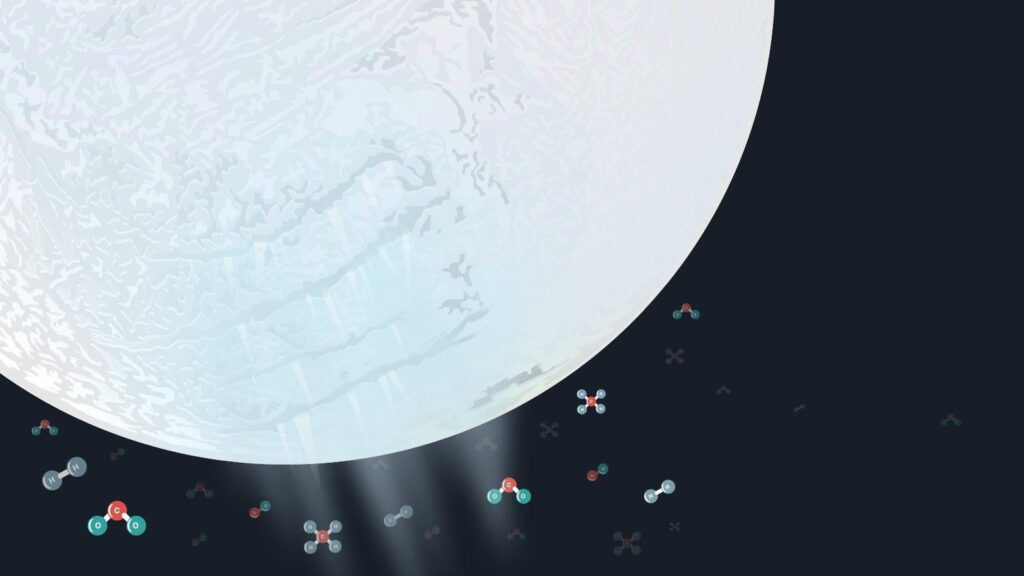
Enceladus and Europa are among the most promising places where alien life could exist in our solar system.
Plus: The deadly medieval disease that vanished from history, the solar storm threat has returned, and China's spaceplane is up to something.
An adjustment to the famous Drake Equation could radically refine estimates of intelligent civilizations in our galaxy.
Saturn's moon Enceladus is known for spewing jets of water-ice into space, with new research revealing a potential mechanism behind this phenomenon.
Underneath the parched sands of Atacama is a massive, diverse group of bacteria and a previously undetected biosphere, according to a new study.
While we go about our daily lives on Earth, a nuclear-powered robot the size of a small car is trundling around Mars looking for fossils.
How would the chaotic alien world from the series' virtual reality game look in real life? We spoke to the show's science advisor to find out.
The shift from a geocentric to a heliocentric worldview during the scientific revolution influenced our perception of life beyond Earth.
Green is a sign of life on Earth, but other habitable planets could be teeming with purple microbes that we should be able to detect with telescopes.
We may not need to bore through miles of ice to see life on extraterrestrial moons.
A new SETI technique, combining game theory, astronomy, and data analysis, aims to locate sites from which alien civilizations might transmit signals.
The next generation of world-exploring craft is being designed today.
If NASA ever manages to pry open the sample canister, that is.
The space agency received some online backlash for crushing people's dreams.
A challenge facing alien hunters is discerning natural from artificial signals, but new research suggests we're better equipped than we thought.
The carbon appears to have spilled out of the moon's subsurface oceans, rather than arriving via a meteorite or other outside source.
It was a banner week for NASA's Perseverance. Let's rove down memory lane to fully appreciate the rover's current moment.
It's not preserved matter from biological organisms, but the discovery is a boost to the rover's mission: finding signs of ancient life on Mars.
As the search for life elsewhere in our solar system intensifies, so does the need to keep space exploration safe and sustainable.
The Cassini spacecraft detected phosphorus—a building block of life—in the subsurface oceans of the icy moon Enceladus.