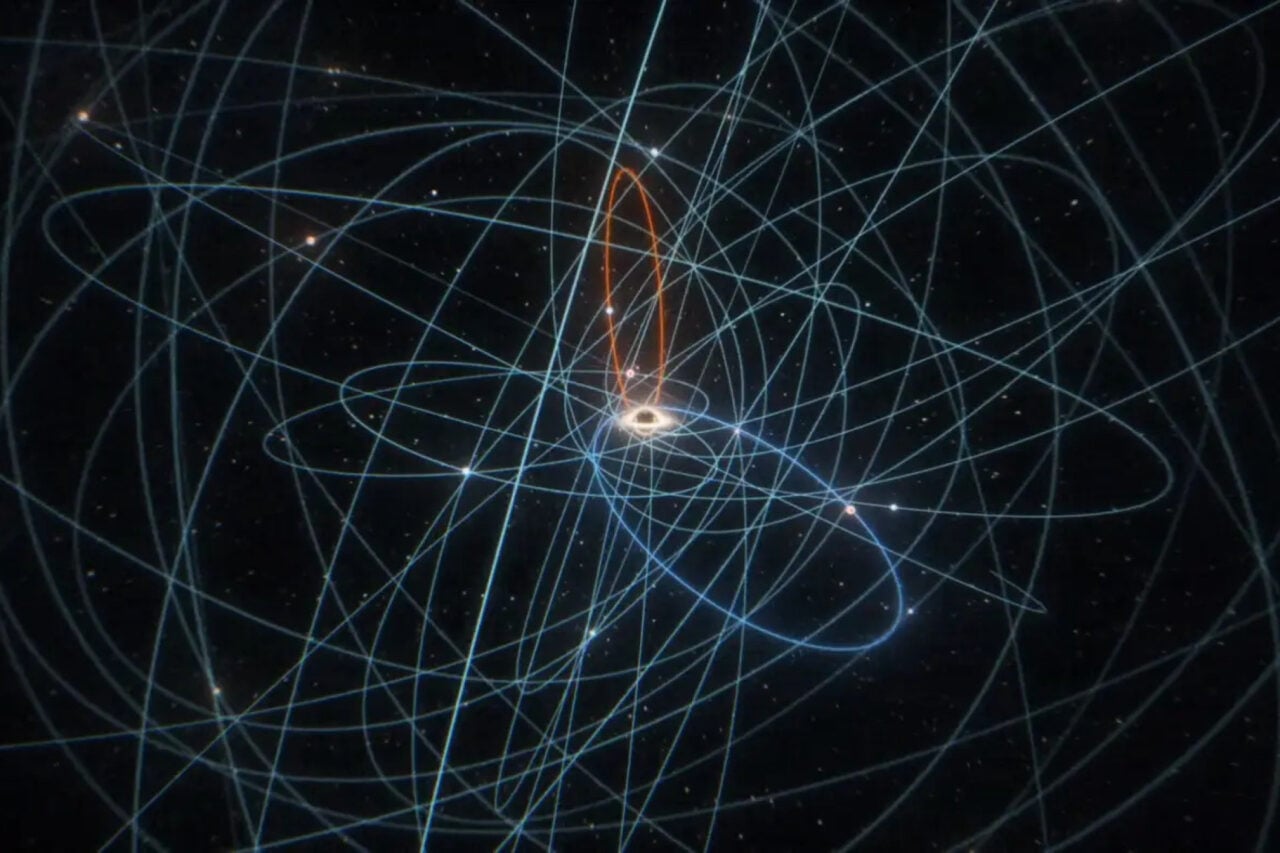
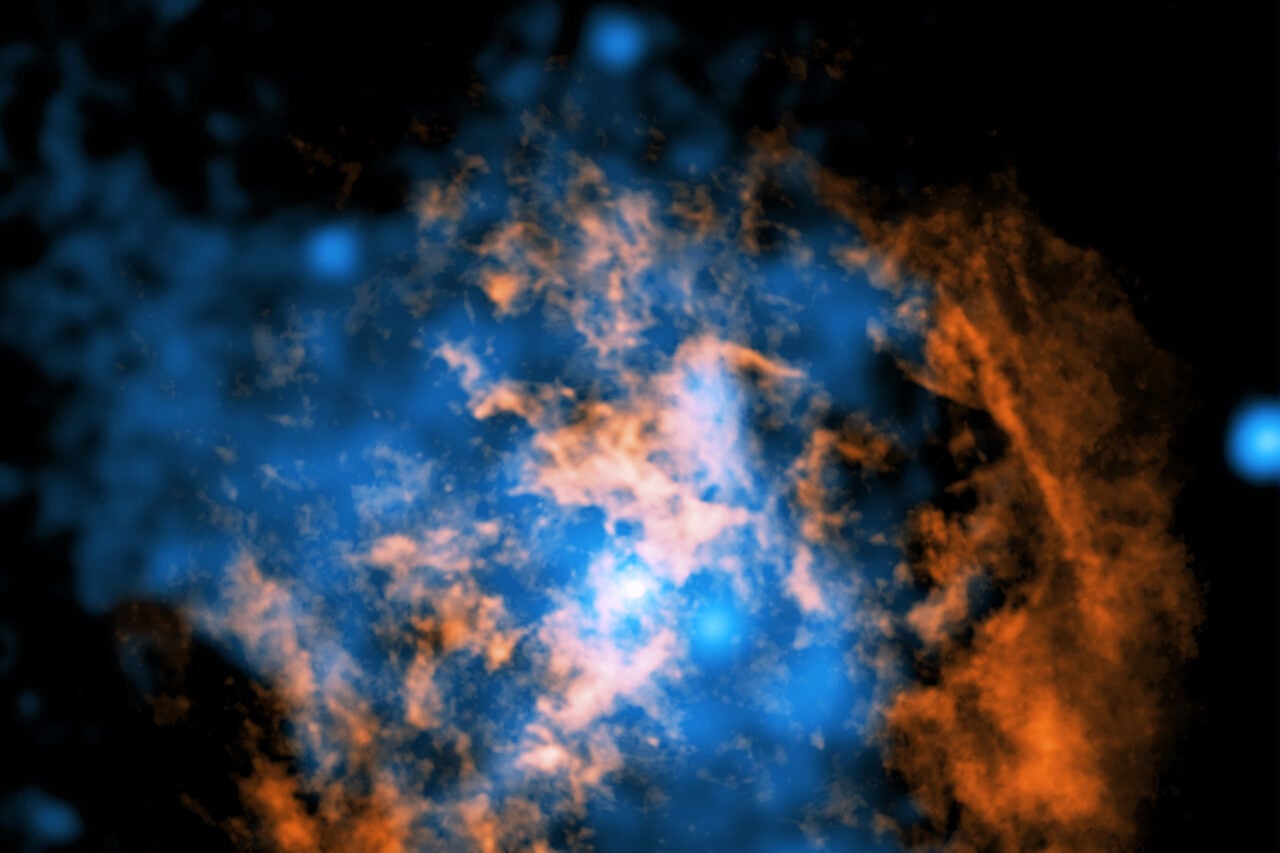
For 50 years, astronomers have been searching for evidence of winds emanating from the black hole Sagittarius A*. Now, they finally think they have an answer.
Using multiple wavelengths and some atmospheric jiu-jitsu, astronomers are changing how we see the universe.
NASA's flagship space telescope captured flares from the disk of superheated material around the black hole, revealing the dynamic—and explosive—physics at our galaxy's core.
The black hole lurks just 2,000 light-years away in the constellation Aquila.
The magnetic field lines of our galaxy's central black hole are answering some questions about black hole structure.
Forget magnetic north; now you can stay oriented on a galactic scale.
Using its near-infrared camera, the Webb telescope has revealed never-before seen features in the galactic center.
The black hole devoured an equivalent of three Earth masses during its nine observed bites of the star over several months in 2022.
The Event Horizon Explorer would build on the work of the Event Horizon Telescope, which famously visualized a black hole in 2019.
The distant object suddenly started feeding after a prolonged silence.
The PIGS survey sought out—and found—a group of metal-poor stars staying close to the galaxy’s core.
Light-years-long filaments perpendicular to those previously discovered are sprouting from the supermassive black hole Sagittarius A*.
A massive outburst rocked the cosmos nearly 8 billion years ago, but we're only just observing it.
They're not called "supermassive" black holes for nothing, as a video from NASA illustrates.
A higher-resolution view is helping scientists understand the physics behind the strangest objects in the universe.
Machine learning has boosted the resolution of an image produced by Event Horizon Telescope data captured six years ago.
A rare ‘ultramassive’ black hole, 30 billion times the mass of the Sun, is lurking in the cosmos.
The dense, dormant object is hiding in plain sight.
These are the IXPE mission’s first observations of a mass-accreting black hole.
The black hole ejected stellar material in 2021, three years after pulling a star into its orbit.