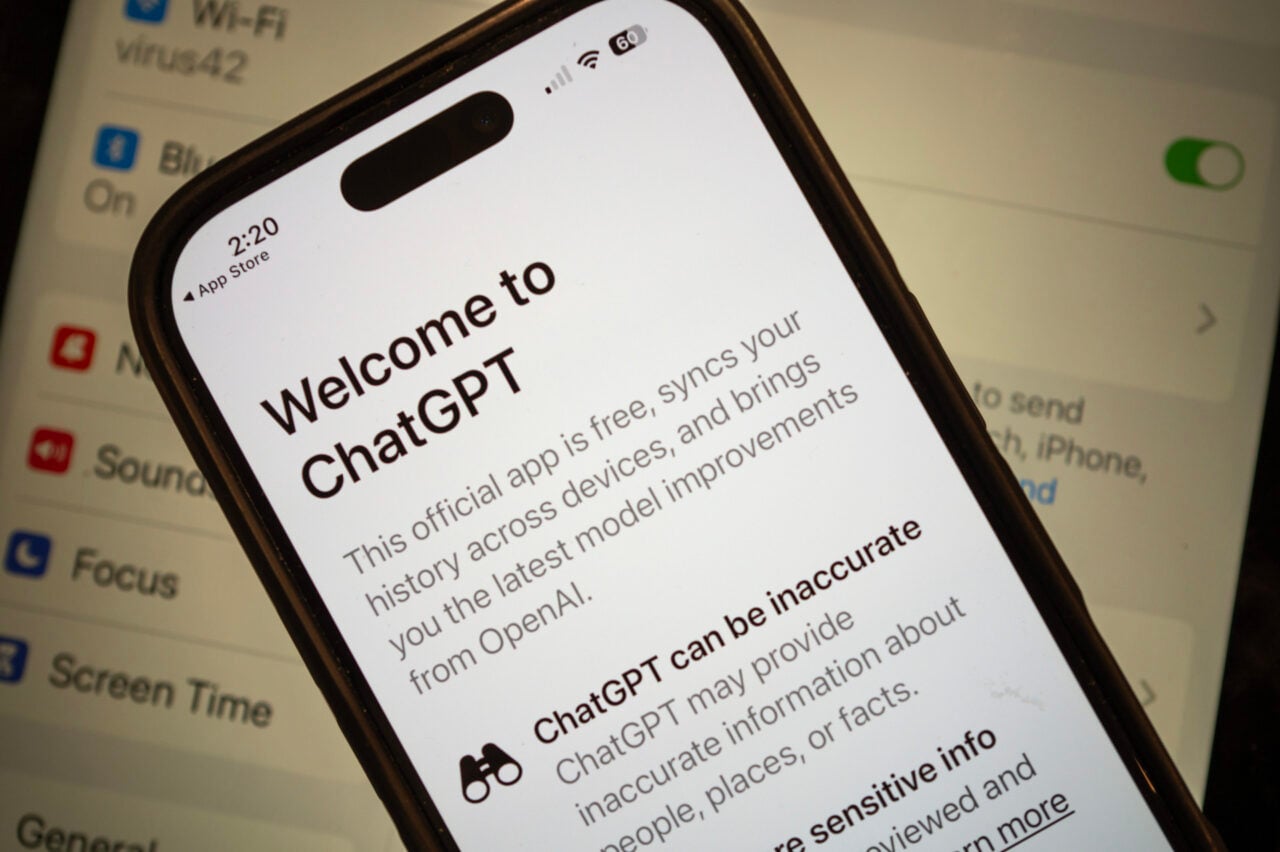
OpenAI just dropped a new AI model that’s designed to sound like an actual, human conversation partner—and the company says it marks progress towards building AGI.
For years, OpenAI has been investing in the development of AI tools that can speak in humanlike voices. That’s sometimes led to controversy, as when the company debuted a voice assistant that sounded suspiciously similar to Scarlett Johansson. The various shortcomings of AI assistants, meanwhile, such as their difficulty in understanding context, has become a fertile source of mockery on social media.
Now the company is hoping to turn the page on its AI voice assistant efforts—and, it hopes, bring the technology to a more mainstream audience—with the newly released GPT-Live-1, which it calls its “smartest voice model yet.”
Unveiled on Wednesday, the model is able to communicate in lifelike voices, sprinkled with subtle intricacies that inflect actual human speech, like sudden bursts of laughter and short intakes of breath before a sentence. But more importantly for OpenAI’s goal of boosting AI voice assistants’ appeal, GPT-Live-1 also knows when to keep quiet: It can be a passive fly on the wall, attentively following a conversation without chiming in every ten seconds. During these quiet periods it will sprinkle in the occasional “Right” or “Mmhmm,” to remind users that it’s listening.
GPT-Live-1 defers to GPT-5.5 for more complex requests, theoretically making it useful not just for idle conversations but also for tasks that require a deeper level of reasoning. It also comes with upgraded real-time web search and translation capabilities, which OpenAI is likewise underscoring in the hopes of boosting its appeal as a general-purpose assistant.
In short, OpenAI is hoping all these new features will add to users’ feeling that they’re interacting with something more than just a glorified search engine. “You can even forget you’re talking to an AI,” Yuchen Zhang, a research engineer at OpenAI, said in Chinese during a livestreamed demo on Wednesday, as GPT-Live-1 translated his words to English. “How should I put it? It’s a really, really amazing feeling.”
The company has gone to such great lengths to underscore the naturalness of GPT-Live-1’s conversational abilities that one almost gets the sense it’s positioning the new model as more of a companion than a traditional, question-answering chatbot. In a marketing video posted to its official X account on Wednesday, OpenAI showed three elderly women using the voice model for a variety of tasks, like getting a knitting tip, checking for public transit delays, and translating English to French. The decision to include a cast of elderly people rather than, say, hip-looking 20s-somethings could hint towards an effort from the company to promote voice assistants as being at least as much of a solution to loneliness as they are a quick means of getting a weekly weather forecast.
For the most part, though, OpenAI is pushing its new voice model towards a general audience, promoting it as a more useful and intuitive version of ChatGPT. “This model is one step closer to a truly accessible AGI, a world where talking to AI actually starts to feel like a real conversation,” Kundan Kumar, another OpenAI researcher, said during the livestream.
It’s worth remembering that AGI—short for artificial general intelligence—is a term that’s thrown around quite loosely these days as both a technical benchmark and a marketing buzzword. The industry lacks a clear, single definition for AGI, although there’s general agreement that such a system would need to perform a wide variety of intellectual tasks at least as well as the typical human brain. By dropping the term into its livestreamed demo, OpenAI could be trying to plant the idea the public’s mind that “true AGI,” whatever that means, depends on an ability to speak in humanlike voices.
OpenAI added in its announcement blog post that the new model has been built with safeguards to prevent some of the harms caused by earlier AI voice assistants. It will not imitate voices of actual people, for example, and if it detects users discussing dangerous subjects like self-harm or other kinds of violence, it will respond by surfacing information about health and safety resources and, in some cases, end the conversation.