A team from the University of Texas at Austin and its partners is a winner of the 2026 Gizmodo Science Fair for shedding new light on mysterious red dots, a newly discovered class of astronomical objects.
When the Webb space telescope first opened its eyes onto the early universe, it revealed something strange: luminous, red-tinted dots billions of light years away from Earth. And they were everywhere, appearing in almost every deep-field image. There was one problem, though: scientists had never seen those dots before and had no idea what they were. Their very existence, however, calls into question everything we knew about the distant cosmos.
The question
Can astronomers identify a new class of objects found in the early universe, and what do these findings suggest about the formation of the earliest galaxies and black holes?
The results
Vasily Kokorev, a researcher at the University of Texas, was first drawn to the little red dots for the mystery. “You don’t always get a chance to study something that people understand very little,” he told Gizmodo. “It’s very interesting and kind of refreshing…to speculate on the nature of these objects.”
Out of the hundreds of dots that showed up in Webb’s images, Kokorev and his team focused on just one lucky dot. The object, designated GLIMPSE-17775, appeared magnified due to gravitational lensing by a galaxy cluster. As a result, those 30 hours of telescope time gathered as much signal as nearly 80 hours of observation would have without the magnification.
Webb’s infrared sensitivity, combined with the cosmic magnifying glass, meant that astronomers got an extremely detailed look at GLIMPSE-17775. “We got the spectrum, and we were just kind of scrolling through them to see if anything cool popped up,” Kokorev said. “Then we see this spectrum of enormous complexity. Everything is very, very unique, and your imagination starts running wild.”
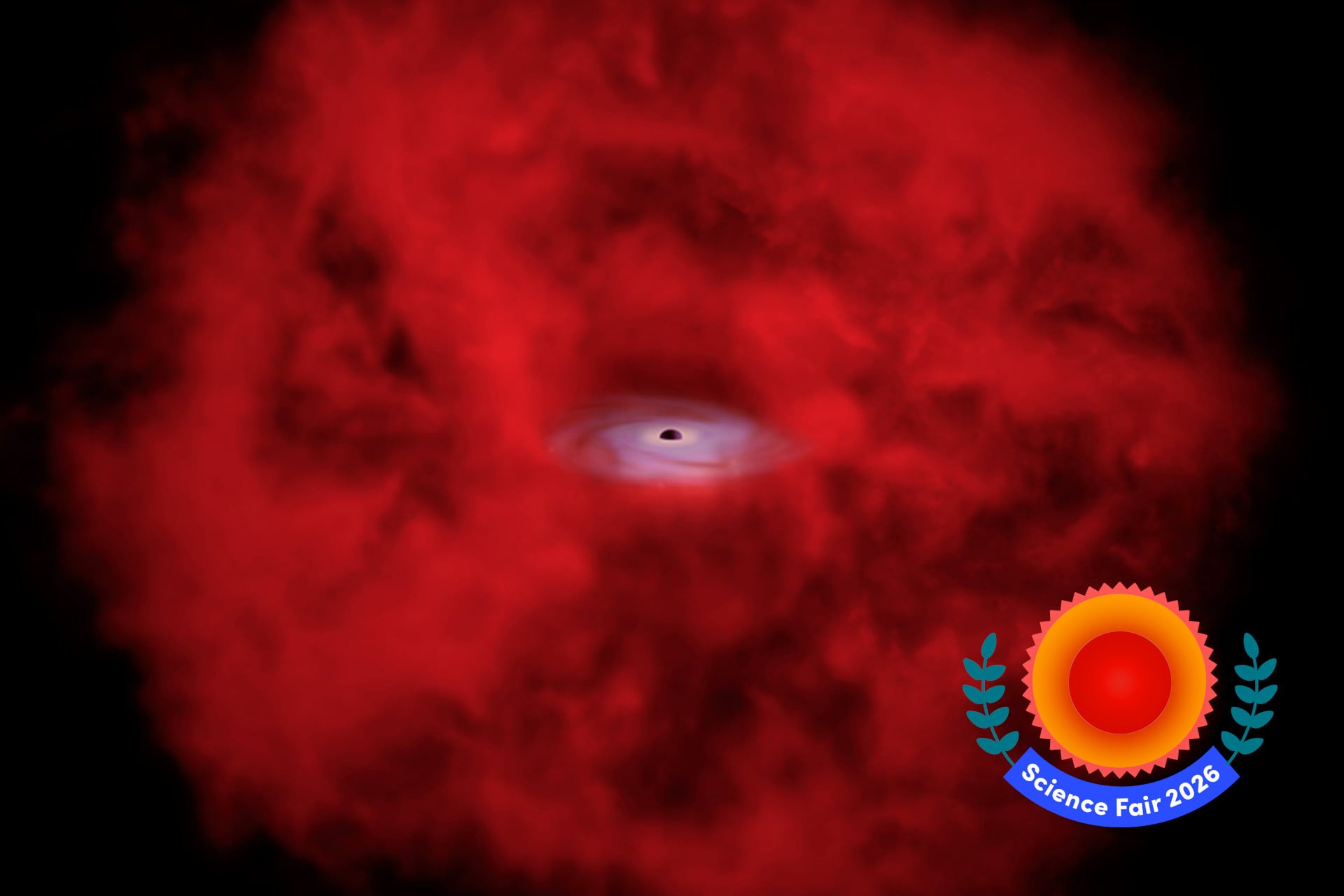
The team’s findings were published in The Astrophysical Journal earlier this year, providing unprecedented detailed analysis of the gas surrounding the little red dots. The data collected by Webb supported an earlier interpretation that this object is a black hole star, a rapidly growing black hole enveloped in a thick cocoon of gas.
The term ‘black hole star’ is meant to relay the complex nature of the little red dots, which lack many properties usually observed in accreting black holes while appearing more star-like.
“They show a lot of properties similar to stars, except that they cannot be normal stars because they’re way too luminous,” Jorryt Matthee, an observational astronomer at the Institute of Science and Technology in Austria, told Gizmodo. “They’re a million times more luminous than any star we had known before, and this really triggered my curiosity. Like, why does it look so much like a star, but it cannot really be a star?”
Matthee is a member of the team of researchers who coined the term “black hole star.” The newly proposed term is still debated, however, and not everyone is a fan, according to Matthee. “We initially also coined the term ‘little red dots,’ which is a much more interpretation-free term. That’s just how they look,” he said. “Black hole star carries some interpretation—that’s why there’s community resistance to that.”
More importantly than the name is what these objects suggest about the early universe. The little red dots ultimately suggest that black holes and galaxies grew at astonishingly fast rates between 500 million and 1.5 billion years after the Big Bang.
“It’s very clear that these black holes are forming in these dense gas environments and that they are either born very massive or they are growing faster than we thought black holes could grow,” Matthee said. “This is the big piece of this puzzle of solving why there are black holes in the first place.”
Why they did it
As part of his work, Matthee spent years simulating images of the early universe. Once the Webb images started coming in, everything looked as expected except for the little red dots. “Those were not in my simulation,” he said.
When Webb first discovered the little red dots, some researchers thought the universe was broken. Astronomers initially thought they were impossibly massive galaxies. They were unable to explain how an object could have become so big in a small amount of time after the Big Bang to account for their luminosity.
Once astronomers began collecting more data, the little red dots had some features normally associated with galaxies, some with black holes, and some with stars. “Nothing quite fits the data,” Anna de Graaff, a group leader at the Max Planck Institute for Astronomy in Heidelberg, told Gizmodo. “We had a lot of debates on who was right, and I think in the end everyone’s wrong to some degree.”
In March 2025, a team led by de Graaff published an analysis of the light emanating from one particular dot. The spectrum of the light showed the broad optical emission typical of a star, as well as bright emission lines characteristic of the superheated gas around an active black hole.
De Graaff reflects on the launch of the Webb space telescope. “It was built, of course, with a lot of science cases in mind, but secretly you hope to find something truly new, right?,” she said. “And so the fact that it delivered this puzzle has been really, really nice…it is extremely rare to come across a new type of object.”
Why they’re a winner
Having been given this cosmic puzzle, teams of astronomers approached it with curiosity, collaborating together across different disciplines to carefully put the pieces together. It isn’t about who gets to solve the mystery, but rather what it implies about their collective understanding of the universe.
“I don’t really subscribe to any idea just now. I don’t really care what they are. It’s whatever they are. They are what they are. There is an answer that exists. I don’t know if we’ll ever get to this answer, but I’m just curious to know,” Kokorev said. “It’s a really cool puzzle. I think that’s what science should be. Just cool, cool puzzles. We don’t need to argue about the answer.”
As the world of astronomy continues to be captured by these strange dots, de Graaff admits that it can be competitive at times, but for the most part, it’s also very fun. “It’s a very rapidly evolving field, and so you need to be on top of your game if you want to contribute,” she said. “That means a lot of hours. If you surround yourself with nice collaborators, it’s actually pretty fun.”
“I always say that you need to make sure to tell people how fun it actually is,” she added.
What’s next
In the coming year or so, the teams of astronomers plan on investing more time to stare deeply at these sources to really try and understand them in detail.
“There are two goals. On the one hand, figuring out in detail a small number of sources…understand the physics, and then the other side of it is trying to understand the population of these sources,” de Graaff said.
“This is a very different approach to science from what people sometimes are told in the textbook, where you have a theory and you perform an experiment to test the theory,” Matthee said. “This is something astronomy cannot do because we cannot do an experiment, and we cannot change the universe. We just have to rely on observing.”
Since their discovery, there have already been hundreds of papers published on the little red dots. Kokorev is hoping that, within the next couple of years, scientists will have a more concrete idea of what these things are. “I think we are moving in the right direction, in the next year or two we’ll know more,” he said.
The team
Vasily Kokorev, astronomer at the University of Texas; Rohan Naidu, assistant professor at the Institute for Astronomy at the University of Hawaiʻi; John Chisholm, assistant professor at the University of Texas; Jorryt Matthee, assistant professor at the Institute of Science and Technology Austria; Anna De Graaff, researcher at the Max Planck Institute for Astronomy in Heidelberg; Alberto Torralba, researcher at the Institute of Science and Technology Austria; Chris Ashall, assistant professor at the Institute for Astronomy, University of Hawaii; Luc Dessart, researcher at the Institut d’Astrophysique de Paris.
Click here to see all of the winners of the 2026 Gizmodo Science Fair.