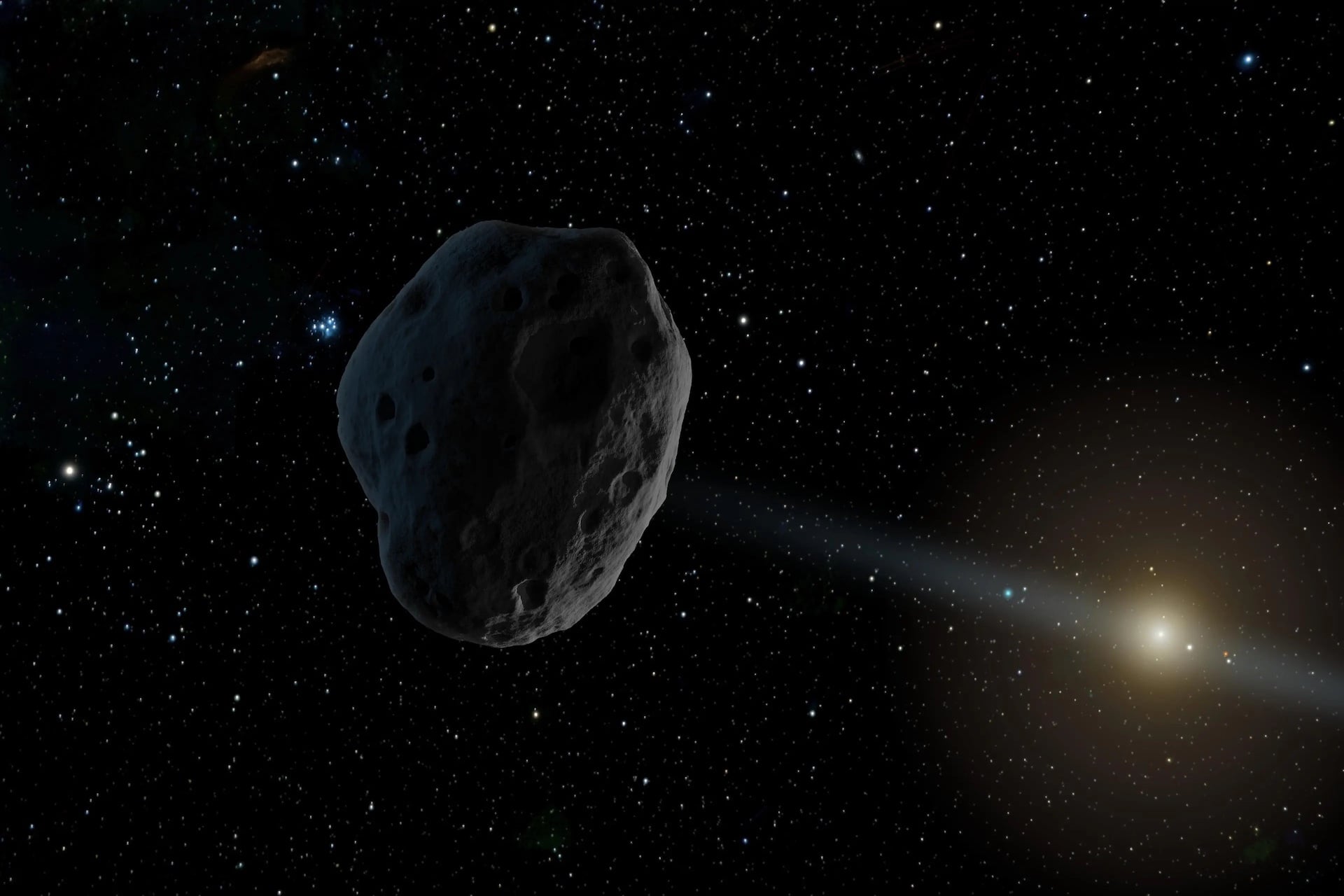
Earth has a new moon, but don’t get too attached. Our planet’s gravity pulled a small space rock into a temporary orbit. Although the object won’t stick around for long, its brief visit offers astronomers another opportunity to observe the small bodies drifting through our cosmic neighborhood.
The small near-Earth object, called 2026 QQ8, entered orbit around our planet in late April. Astronomers initially thought it was a piece of space debris, perhaps from a rocket or satellite, drifting through Earth orbit. It was only recently that the Minor Planet Center was able to confirm that the object was of natural origin, officially declaring it a temporary mini-moon.
The space rock is expected to stick around until December before it eventually escapes Earth’s gravitational grasp and continues its journey around the Sun.
Just stopping by
This mini-moon has earned its title, measuring only about 3 feet (1 meter) in size. Hungarian astronomer Krisztián Sárneczky, who has discovered hundreds of asteroids, first spotted 2026 QQ8 on August 20, according to EarthSky.
Astronomers then carried out follow-up observations of the object using the University of Hawaii 2.2-meter telescope and the Lowell Discovery Telescope. After observing it further, they were able to confirm that it was in fact a space rock and not an orbiting piece of hardware junk.
By analyzing its orbital data, astronomers were able to reconstruct the space rock’s trajectory around the Sun and its encounters with Earth. It turns out that 2026 QQ8 makes a relatively close approach to our planet roughly once every 10 years. The object passed near Earth in 1965, but not close enough to be captured by Earth’s gravity. It is expected to make another close approach in 2058, though it will once again remain too far away to become a temporary satellite.
During its previous encounters with Earth, the small space rock never crossed into what astronomers call our planet’s Hill sphere, the region around Earth where an object can remain gravitationally bound to our planet despite the Sun’s influence. That changed in April, when 2026 QQ8 crossed this boundary and became temporarily gravitationally bound to Earth, allowing it to orbit our planet as a mini-moon.
Capture and release
During its brief time as Earth’s mini-moon, the closest the space rock will come to our planet will be 0.0038 astronomical units (or about one and a half times the distance between Earth and our actual Moon).
The mini-moon follows a strange orbital path around Earth, forming a wide, kidney-shaped loop around our planet before escaping Earth’s gravitational grasp.
Is Sar2901 a mini-moon or space junk? Even the Minor Planet Center isn't sure. The astronomy community is divided. More observations in November should help settle the debate.🔭 #astro
— Tony Dunn (@tony873004.bsky.social) 2026-09-03T19:31:23.961Z
The object doesn’t pose a threat to Earth. In addition to there being no risk of collision with our planet, 2026 QQ8 is so tiny that it would be obliterated by its descent through Earth’s atmosphere.
This isn’t Earth’s first time grabbing a space rock for some cosmic quality time. The most notable examples include asteroids 2006 RH120 and 2020 CD3, which were both captured by our planet’s gravity and spent months orbiting Earth before escaping back into space. More recently, asteroid 2024 PT5 also became a temporary companion, although it never completed a full orbit around our planet.