It’s been just four months since the Vera C. Rubin Observatory officially began its decade-long survey of the cosmos, and it’s already exceeding expectations. Rubin’s latest find—an icy world orbiting the Sun at a distance farther than Pluto—may be our solar system’s sixth dwarf planet. What’s more, this candidate appears to be among the largest and brightest objects ever discovered in this region of our cosmic neighborhood.
“Finding an object this big, roughly 1,000 kilometers [621 miles] across, is something that happens maybe once in a generation,” Mario Jurić, a professor of astronomy at the University of Washington and leader of Rubin’s solar system team, said in a statement. “It’s the largest trans-Neptunian object found in about 20 years, and Rubin turned it up while we were still commissioning the telescope.”
This dwarf planet candidate has been provisionally named 2026 ED138, and Jurić presented the discovery alongside Matthew Holman, a senior astrophysicist at the Harvard & Smithsonian Center for Astrophysics, at a press conference on Tuesday.
Holman first spotted ED138 while running Rubin data through a search code he co-developed to compare billions of detections of moving objects and find those that correspond to the same object. This object immediately caught his attention, as its brightness and distance suggested it was unusually large.
“My first reaction was one of excited disbelief,” Holman said in the statement. “Objects like this are very rare, so I immediately started checking whether I or the code had done something wrong.”
Hidden among the stars
Rubin officially began its Legacy Survey of Space and Time in late June. Over the course of this 10-year science campaign, the observatory will capture a full view of the southern hemisphere sky every three days, producing a treasure trove of data that will help scientists unlock the secrets of the cosmos.
Equipped with the largest digital camera ever built for astronomy, Rubin’s images contain an unprecedented level of detail. This, in addition to its continuous monitoring and powerful algorithms that sift through billions of points of light to find moving objects, allowed Holman and his colleagues to spot ED138. This dwarf planet candidate was hiding like a needle in a haystack within a star-crowded region close to the plane of the Milky Way.
To confirm Holman’s initial discovery, Jurić searched through Rubin’s data catalogs and images and found 20 more observations of ED138 going back to March. The team also found the object in archival images from other surveys dating back to 2016. Having more than a decade of data allowed them to thoroughly study ED138’s orbit.
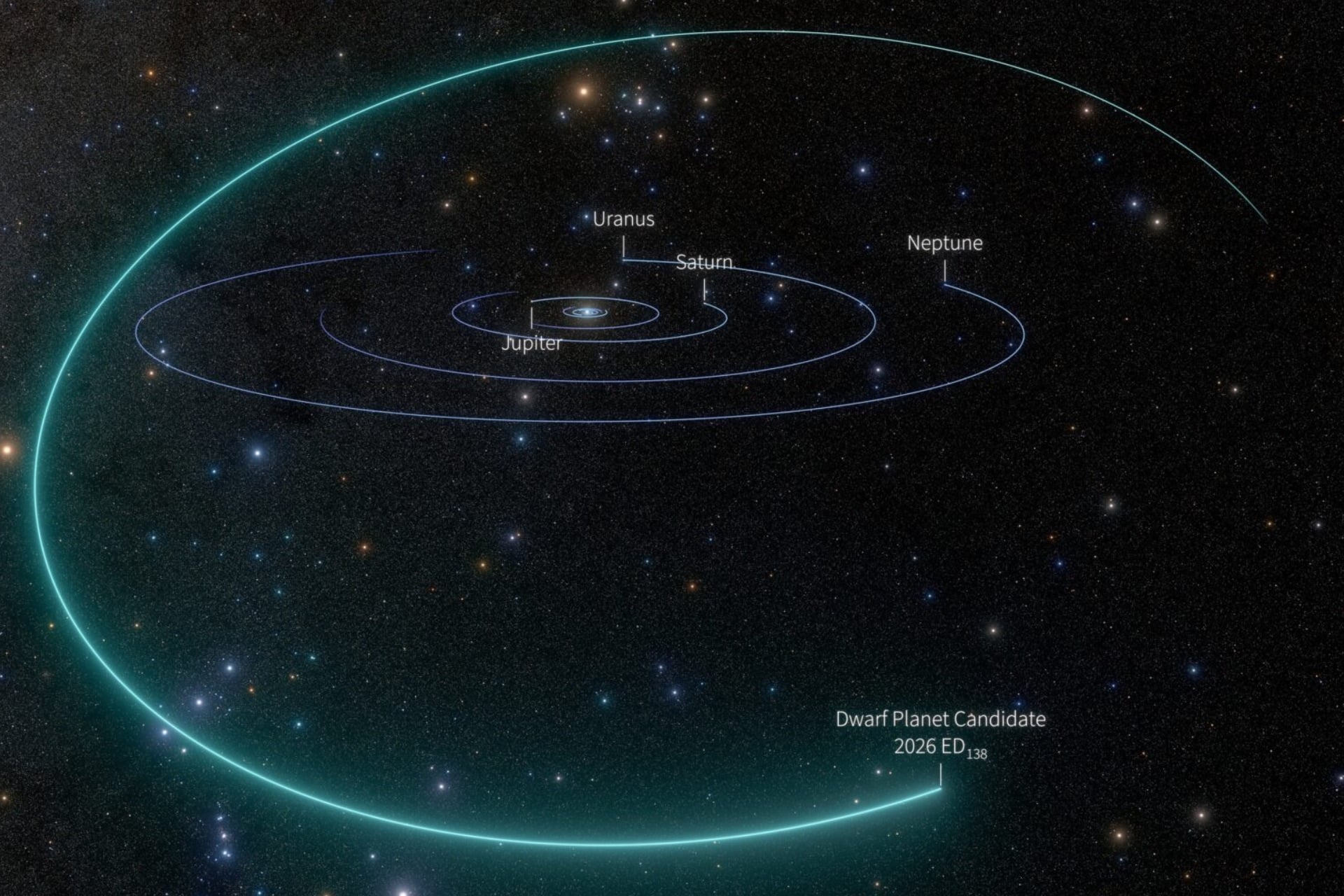
This far-off world is currently about 46 astronomical units (au) away, where 1 au is the average distance between the Earth and the Sun. That’s even farther than Pluto, which orbits at an average distance of 40 au. That classifies ED138 as a trans-Neptunian object: an object that orbits the Sun at an average distance greater than the orbit of Neptune.
Trans-Neptunian objects are among the best-preserved objects in the solar system, having changed very little since their formation. Researchers study them to learn about how the solar system formed and evolved to reach its current state, and ED138 will serve as an intriguing new window into the distant past.
Pretty big for a dwarf planet
Confirming whether this object is actually a dwarf planet will be another fascinating line of inquiry. Our solar system currently hosts five dwarf planets recognized by the International Astronomical Union: Ceres, Eris, Haumea, Makemake, and, of course, Pluto. ED138 could very well become the sixth.
To be considered a dwarf planet, an object needs to be massive enough to form a round shape under its own gravity. ED138’s distance, brightness, and estimated surface reflectivity suggest it is between 373 and 932 miles (600 and 1,500 kilometers) wide—large enough to be round. But constraining this size estimate will require further observations.
Regardless of its dwarf planet status, ED138’s discovery underscores the incredible power of the Rubin Observatory. As it continues to scan the sky over the next decade, there’s no telling what else this telescope will find.