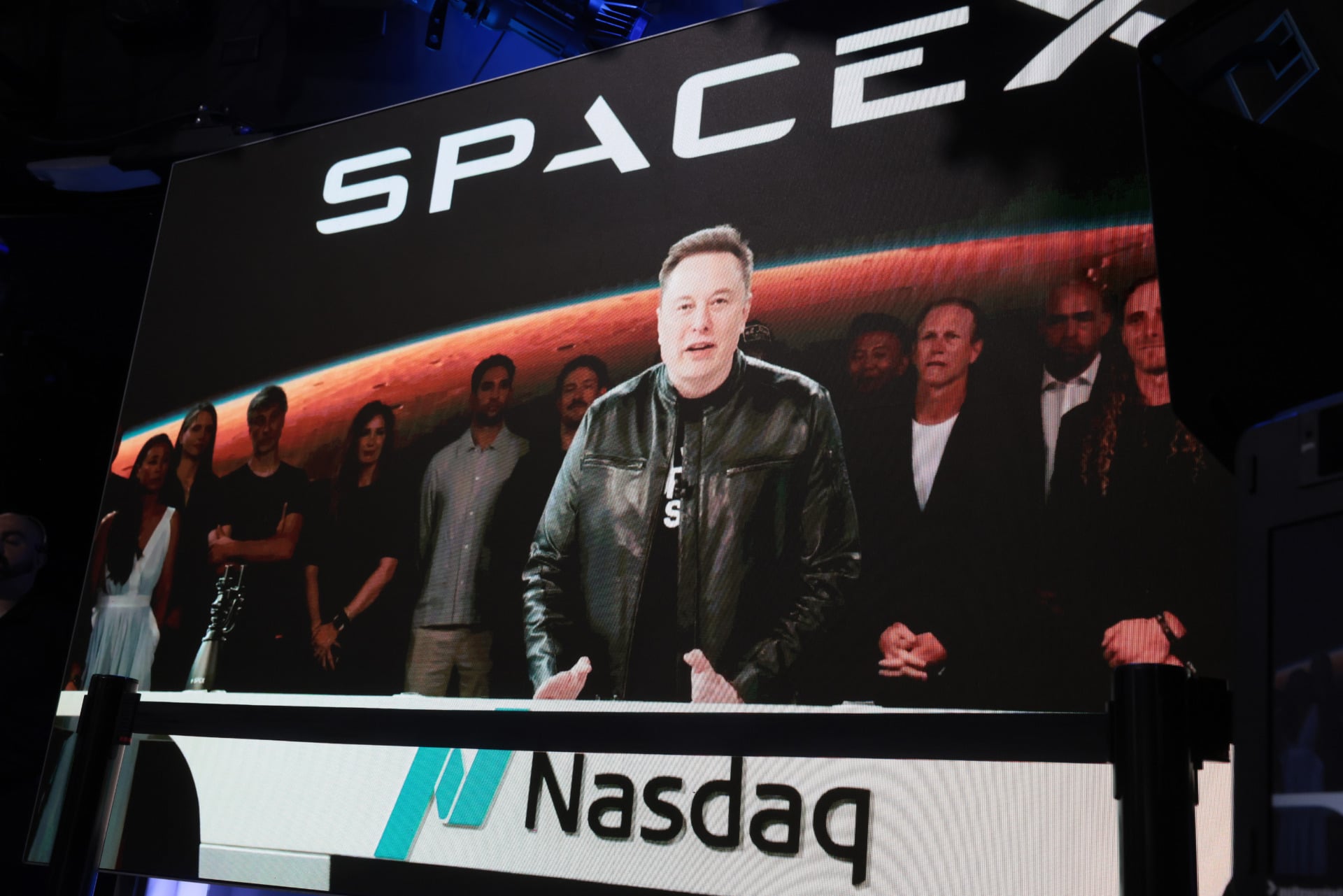
Elon Musk’s SpaceX spent an eye-watering $18.4 billion in its first quarter as a publicly traded company and warned investors to expect similarly high spending in the next two financial quarters, sending the stock price down more than 8% in late trading on Tuesday evening. A whopping $15.8 billion of that spending was to power its artificial intelligence efforts, a division that ended the quarter with a $1.3 billion net operating loss.
The figure comes from the company’s first earnings report since the record-setting initial public offering hit the market in mid-June. Although the IPO was surely an amazing day for Musk, who briefly became the world’s first trillionaire, things have not been all peachy since then, with the stock price currently well below its IPO price. As of last week, the company’s stock was so far down from its IPO highs that the value it shed was roughly equal to Musk’s other company, Tesla’s, market capitalization. Tuesday’s stock sales are unlikely to help that scenario, and neither is the fact that the company’s first lockup period ends on Thursday, meaning some company insiders will be able to sell more than $100 billion worth of stock for the first time since SpaceX went public.
To ease some of those worries, Musk promised dramatic AI advancements.
“Our rate of growth certainly is faster than anyone else, and our efficiency of compute deployment I think is also the highest,” Musk claimed. “So we expect to end this year with over two gigawatts of compute, and probably our cumulative compute online by the end of next year will be several times higher.”
Those compute plans are ambitious, but Musk struck a defiant tone against any doubters in the earnings call on Tuesday.
“The terrestrial data centers are a trivial problem compared to making gigantic reusable rockets which are launched frequently,” Musk said.
Musk said SpaceX’s data centers will be exclusively built on Nvidia chips. The two companies are also partnering to build Starmind AI satellites, a part of SpaceX’s even more ambitious plan to put a giant colony of up to a million AI data centers in Earth’s orbit. Some experts are hesitant that Musk and his company will be able to pull off the space-based data center colony plan, while many have also raised concerns about the environmental, economic, and social impact of such a huge launch program if it does pan out as promised.
On the call, Musk said that SpaceX would begin launching the Starmind AI satellites in 2027.
The company will also be unveiling Grok 5 before the end of the year, which Musk said would be trained on “all the data that SpaceX has ever produced,” making the chatbot “by far the best engineer.” Musk has previously claimed the yet-to-be-unveiled LLM will be AGI-level, aka a contested hypothetical AI that would theoretically equal or beat all human capabilities.
“We expect the cadence of AI development to improve dramatically,” Musk said. “I think, by the end of next year, it’s not clear to me that there’s anything digital at least that AI won’t be able to do based on the current rate of improvement.”
All of this comes with a huge, obvious caveat: Musk has long had a penchant for overpromising. His hefty promises extended beyond the AI sphere on Tuesday as well, with the CEO claiming that the company’s space business would be launching a rocket a day by next year and that there will be robots working in manufacturing operations on the literal Moon.
“I know this sounds totally nuts, but you can probably scale to a thousand times the economy of Earth in terms of intelligence launched to space, but probably maybe even a million times,” Musk claimed. “We’re going to build the factories on the Moon; the robots will be helpful with that.