Late last week, the federal government announced a decision set to affect the millions of Americans who use kratom and kratom-related products.
The Drug and Enforcement Administration, on the advice of the U.S. Department of Health & Human Services, is planning to revise its definitions of when a kratom-based product can be considered a schedule 1 controlled substance, with a particular focus on outlawing synthetic kratom derivatives. It’s the latest development in a long-running debate over the safety and potential benefits of kratom, one that has been marked by recent high-profile deaths and reports of injuries tied to these products.
After years of protests and legal battles, however, the government’s new plan might finally establish a safe middle ground for people who use kratom to help manage health problems like substance use disorders, some advocates hope.
“We are absolutely supportive of banning or scheduling these synthetics,” Mac Haddow, senior fellow on public policy for the American Kratom Association (AKA), told Gizmodo.
The rise of kratom
Kratom is the name given to the leaves of the tree Mitragyna speciosa. It’s a complex substance with dozens of different alkaloid compounds that can interact with the body in various ways. Some of these compounds can activate the same mu opioid receptors in our brain as classic opioids like morphine do, particularly at higher doses, while at lower doses, kratom provides more of a stimulant-like effect. The primary active ingredients in natural kratom are mitragynine and 7-hydroxymitragynine (7-OH), though the latter only accounts for around 2% of the total alkaloid content.
While people have used kratom as a herbal remedy for fatigue or other ailments since at least the 19th century, its popularity has significantly increased in the U.S. as of late. According to nationally representative survey data, an estimated 1.7 million Americans aged 12 and older used kratom in 2021. In a study earlier this May, researchers at the University of Michigan found that roughly five million Americans have used kratom at least once in their lifetime, including more than 100,000 children ages 12 to 17. Kratom use also seems to have continued rising since 2021.
Kratom proponents have argued that it can be used to safely manage chronic pain or as an alternative and more accessible treatment for substance use disorders, particularly for opioids. Mitragynine and 7-OH are partial agonists of the mu-opioid receptor, and there is evidence they can activate these receptors without causing the serious, potentially life-threatening side effects seen with classic opioids such as respiratory depression (slowed or stopped breathing).
Because of this, many people are using kratom as a form of replacement therapy to wean off other drugs that have a high potential for abuse. According to the May study, roughly 53% of recent kratom users reported having a substance use disorder in the past year, while roughly a third had experienced serious psychological distress.
Not everyone agrees that kratom is necessarily a safe remedy for these issues, though.
“The FDA has not approved kratom as a safe or effective treatment for any condition,” Sean McCabe, lead author of the May study and the director of the Center for the Study of Drugs, Alcohol, Smoking and Health at the University of Michigan, told Gizmodo. “There are other much more effective proven medications to treat addiction that have been tested.”
Whatever your stance on the value of kratom is, people on both sides agree that its risks have been amplified in recent years by the rapid proliferation of synthetic kratom-based products. These products typically have much higher concentrations of 7-OH or other opioid-related compounds than are present in natural kratom. As such, they have a higher risk of producing the worrying side effects seen with potentially addictive opioids, including fatal overdoses. Adding to the danger, these products can be widely found over-the-counter, often with no clear labeling that they’re any different from natural kratom.
As these products have become more popular, reports of kratom-related poisonings and even deaths have increased. Last year, for instance, at least six people died in Los Angeles from overdoses tied to synthetic kratom between September and October 2025; the following month, the city announced a sweeping ban of synthetic 7-OH and kratom products in general from stores. Last month, two University of Mississippi students died after taking synthetic kratom, and federal prosecutors are now pursuing criminal charges against the store clerks who sold the products to them.
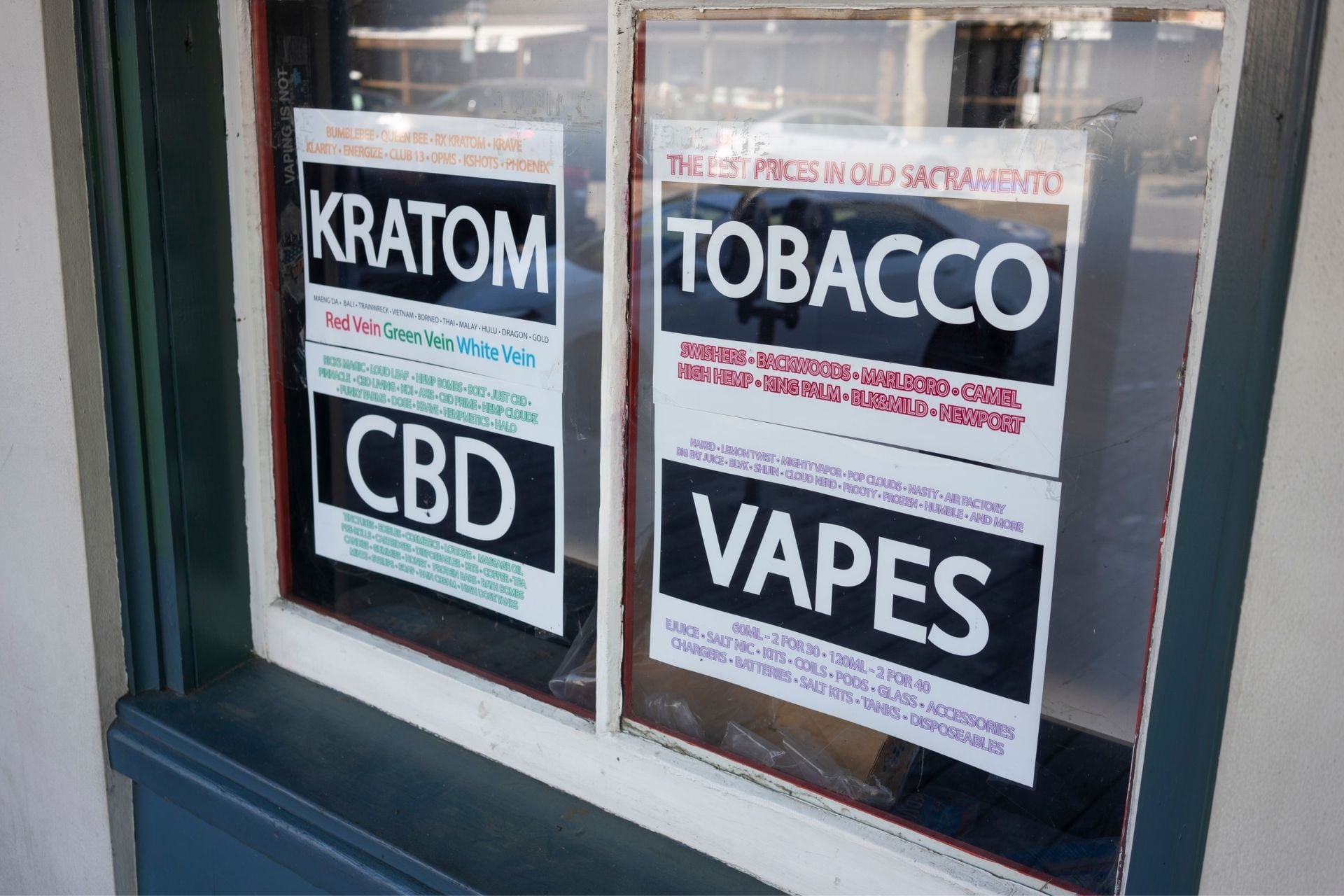
“I come into contact with thousands of people in recovery from substance use disorders and often warn them about kratom and 7-OH tablets, gummies, and drinks, which are frequently sold at gas stations and smoke shops,” McCabe said. “I have seen too many people in recovery get taken out by using these products they thought would help them get more energy or improve their focus. These products quickly turn on them and soon these individuals are spending $200 to $300 per day living in a miserable cycle of addiction.”
A potential middle ground?
The AKA and other advocates agree that synthetic kratom is a real danger, but they’ve pushed back against laws and policies that they argue are trying to completely eliminate people’s access to kratom.
The federal government has made it clear for years that it hasn’t really been a fan of natural kratom either. The DEA even tried to list kratom and its main ingredients as schedule I controlled substances in 2016 (an effort that generated so much pushback that it was ultimately abandoned). But the DEA’s new proposed regulations are rooted in more nuance.
Specifically, the DEA will only try to schedule kratom products that contain a certain threshold of 7-OH and mitragynine pseudoindoxyl (a byproduct derived from 7-OH). The agency originally called for a lower threshold of 7-OH in July, which it is now raising with this latest revision. It’s still maintaining the same proposed threshold on two other substances related to 7-OH, MGM-15 and MGM-16.
The AKA sued the federal government earlier this summer over its proposed regulations for mitragynine pseudoindoxyl, MGM-15 and MGM-16, arguing that it needed to clarify whether these regulations could potentially target natural kratom products. But the organization is now supportive of the current planned regulations, stating that they will sufficiently single out synthetics.
The future of kratom
The DEA’s scheduling of kratom products, which is expected to go into effect next month, is temporary for now. As such, the government could change its mind again in the future, but even assuming these changes stay intact, the AKA is still pushing for further regulation of the synthetic kratom industry.
“We think that Congress needs to enact an even tougher standard. The DEA’s limitation right now is that they can only identify a product that’s already on the market,” Haddow explained. “Congress has to really tighten this noose further and and just preemptively ban any product that’s derivative of any of the alkaloids in the natural kratom plant that are enhanced and synthesized in a way that would harm people.”
Haddow would also like to see a sort of amnesty for people who have used 7-OH or other synthetics, given the widespread marketing of these products as kratom, one that would protect users from federal prosecution. And the AKA continues to fight for other policies outlined in the Kratom Consumer Protection Act (KCPA), a proposed list of reforms backed by the AKA and other advocacy groups. Some of these include an age limit for buying kratom, mandated third-party testing for contaminants and impurities, and the clear labeling of ingredients and their concentrations.
A federal law would clean up the messy patchwork of state and local regulations on kratom. While some places have enacted or are trying to pass their own versions of the KCPA, others have passed wholesale bans of any kratom products, synthetic or not.
There are more thorny issues besides synthetics surrounding kratom. The drug remains woefully understudied compared to many other drugs. And it’s still possible for people who only use natural kratom to develop an unhealthy dependence to it, which can then lead to withdrawal symptoms (though these symptoms may be milder on average than those seen with classic opioids and other drugs). Fatal overdoses of natural kratom do appear to be very rare, and often involve the use of other drugs.
That said, McCabe says wife, Vita McCabe (who is also a co-author on his recent study), has seen increasing reports of people with severe addiction to both synthetic and natural kratom in her work as an addiction psychiatrist. He also argues that the growing popularity of kratom reflects deeper, systematic flaws in how we’re handling the overall problem of drug abuse in the U.S.
“Many of the concerns and issues regarding kratom highlights the lack of funding for evidence-based substance use treatment in our country,” he said. “There are simply not enough addiction psychiatrists, addiction medicine trained doctors, nurses, social workers among other trained professionals currently in the field to meet the demand in our states or country.”
At the same time, McCabe does believe it’s possible to reach a compromise with natural kratom advocates. “One middle ground solution could be to ban all kratom and 7-OH products with high addiction potential and tax natural leaf kratom with low addiction potential so these funds can be used to fund evidence-based addiction care,” he said.
Haddow acknowledges that just because a kratom product is natural, that doesn’t mean it’s safe. And that’s why the AKA wants to hold manufacturers to uniform standards for the ingredients included in their products.
“The bottom line is that the natural plant has limitations in terms of what its effects can be, and we want to make sure that those are maintained and not have this arms race within the industry to find ways to tweak the product so that it has a greater effect,” he said.
In the meantime, Haddow advises that people who are currently using kratom should be especially vigilant about the products they buy.
“Don’t trust something that’s new on the market until they’ve actually done the investigation, because there are a lot of bad actors out there, and we want to clean this marketplace up,” he said.