Here’s a terrifying fact: If there was a nuclear weapon in orbit, we would have no idea. The Outer Space Treaty—established in 1967 and signed by 118 countries to date—bans the placement of nuclear weapons in space, but there is currently no way for militaries to verify that a satellite isn’t carrying one.
That’s a big problem. As nations rapidly expand their space launch capabilities and strengthen their presence in orbit, some experts believe it’s only a matter of time until geopolitical conflicts spill off-planet. The growing threat of space-based warfare demands enhanced weapons reconnaissance to ensure that all signing nations abide by the terms of the Outer Space Treaty, but devising a way to detect nuclear weapons in space is an engineering conundrum.
Areg Danagoulian, an associate professor of nuclear science and engineering at the Massachusetts Institute of Technology, put himself up to the challenge. In a proof-of-concept study published today in the journal Nature, he proposes a satellite-based sensor system that could orbit near a suspect spacecraft and detect neutrons generated by high-energy protons colliding with radioactive material—a signature of a thermonuclear weapon.
The challenge of space-based weapons detection
In 1962, when the U.S. detonated the Starfish Prime nuclear test about 250 miles (400 kilometers) above the Pacific Ocean, roughly one-third of the satellites in low Earth orbit were damaged or destroyed.
Radiation was the primary culprit. The explosion injected an enormous amount of charged electrons into the inner Van Allen belt, one of two donut-shaped belts of radiation that surround Earth. This increased its electron population by several orders of magnitude, according to Danagoulian. As satellites passed through the belt, their electronics and solar panels were significantly degraded.
Today, there are thousands more satellites in space, and our modern lives depend on them. While detonating a space-based nuke wouldn’t result in any direct casualties, it could disable or destroy satellites that underpin communications, GPS navigation, weather forecasting, surveillance, and missile warning systems. Both the U.S. military and civilian infrastructure rely heavily on satellites, meaning a single explosion could trigger widespread disruptions and weaken defense capabilities.
Despite this risk, the only safeguard against nuclear detonation in space is the Outer Space Treaty. “Although the OST is almost 60 years old, it has always lacked robust means of verification for space-based nuclear threats,” Danagoulian writes in his report. This is partly because devising a verification method is technically challenging: low Earth orbit is a harsh radiation environment, so traditional nuclear detection methods would be encumbered by the bombardment of protons and electrons trapped in the inner Van Allen belt, he explains.
But the inner Van Allen belt could also help reveal hidden thermonuclear weapons, according to Danagoulian. If a satellite carrying one passes through this proton- and electron-rich zone, it is going to emit a ton of neutrons as a result of proton-induced spallation. This is when high-energy protons slam into heavy elements like uranium—the radioactive material used in most thermonuclear weapons—and knock neutrons and other particles loose.
Based on reasonable assumptions about the amount and size of uranium, he estimates that a thermonuclear weapon could emit as many as 40 million neutrons per second when it encounters the high-energy protons in the Van Allen belt, producing a detectable signal.
“But just because there’s a signal doesn’t mean you’re going to be able to see it,” Danagoulian told Gizmodo. To actually detect a warhead, he needed to devise a device that can sort through all the particle noise in low Earth orbit. “You have to be able to differentiate between protons that are coming from outside and neutrons that are coming from the satellite,” he said.
An important first step
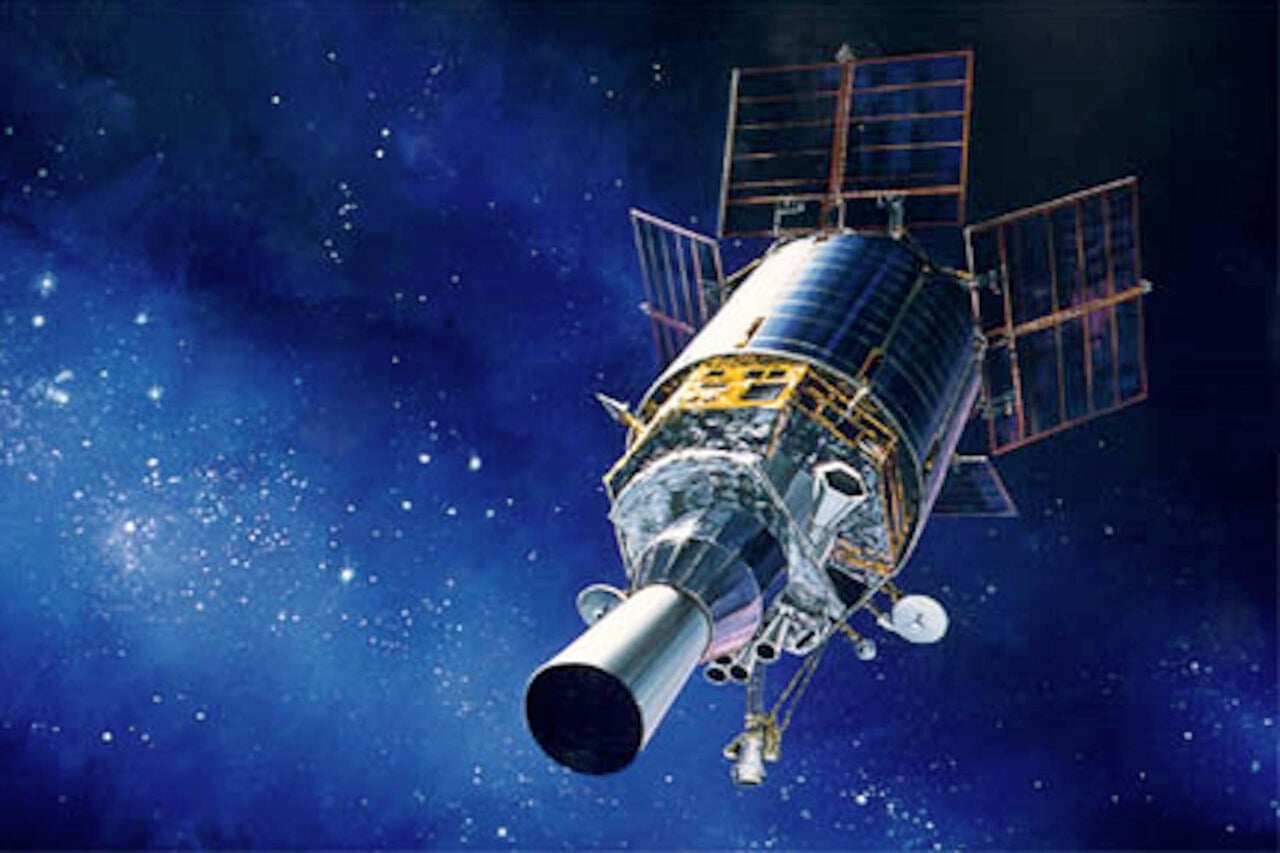
Danagoulian’s “inspector” satellite is designed to orbit below the suspect satellite, passing through the Van Allen belt alongside it. As both the inspector and the suspect encounter the belt’s charged particles, the sensor would need to distinguish neutrons emitted by the suspect satellite from the constant barrage of protons striking the detector itself.
To do that, Danagoulian devised a sensor that filters out incoming protons, leaving behind the telltale neutron signal that could indicate the presence of uranium. But there’s another problem.
“There is a huge flux of neutrons, also referred to as albedo neutrons, that are coming from Earth,” he explained. These neutrons are produced by cosmic rays hitting the atmosphere, creating another background signal that could interfere with warhead detection. Danagoulian’s sensor system would overcome this by using directional detection to determine whether a neutron came from the satellite above or the Earth below. That’s why the inspector needs to orbit beneath the suspect.
To validate his design, Danagoulian modeled a scenario where a satellite carrying a thermonuclear weapon is passing through the inner Van Allen belt at the same time as his inspector satellite, positioned roughly 2.5 miles (4 km) apart. The results showed that the inspector could filter out the noise and detect neutrons emitted by the warhead, effectively sniffing it out.
While his study shows that his idea is theoretically feasible, Danagoulian hopes that other researchers will improve upon it. “I hope people will pick up this idea and start developing a prototype, and I hope they’ll come up with a simpler configuration,” he said. “Maybe the system that I propose is still complex.”
Still, this work marks an important first step toward developing a warhead verification system to help uphold the terms of the Outer Space Treaty. As the threat of space-based warfare grows, there is an urgent need to fill this gap.