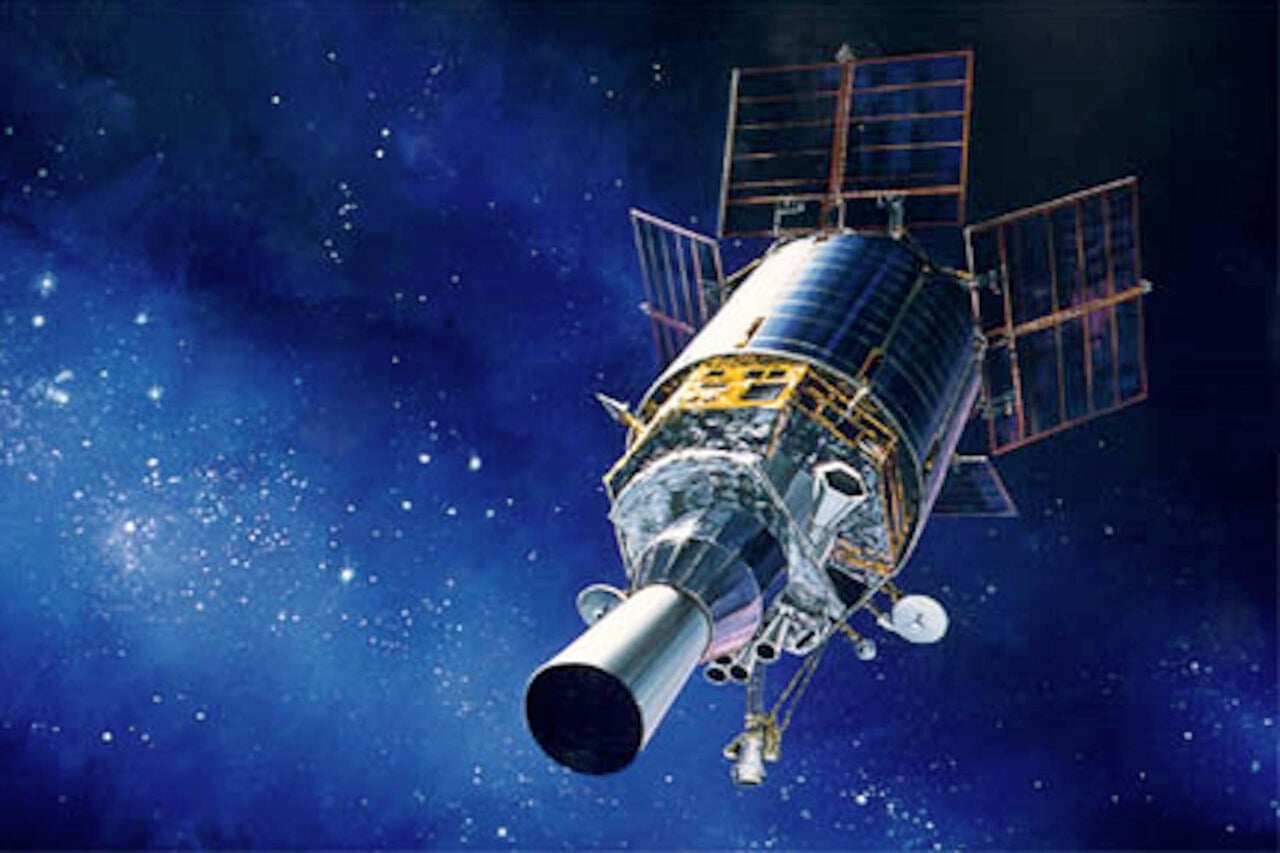
A spacecraft sent to rescue a NASA telescope from a fiery death had some issues of its own, and it looked like all hope was lost. That was until engineers figured out a way to save the spacecraft designed to save another spacecraft.
LINK, the servicing spacecraft developed by contractor Katalyst Space Technologies, experienced issues with attitude control in late July that caused it to spin uncontrollably. The loss of attitude control jeopardized the mission’s ability to capture NASA’s Neil Gehrels Swift Observatory and boost it to a higher orbit. Thankfully, the company may have found a fix.
Katalyst Space uploaded a flight software update for LINK, which is designed to stabilize the spacecraft so that it can continue its approach toward Swift, the space agency shared in an update. The team of engineers will continue to monitor the spacecraft’s performance as they begin a series of burns and maneuvers in the coming days to align LINK’s orbit with Swift.
Double rescue
LINK took off on July 3 onboard a converted Lockheed L-1011 aircraft from Kwajalein Atoll in the South Pacific. The spacecraft was then launched into space from an altitude of 7.6 miles (12.2 kilometers) using a Northrop Grumman Pegasus XL rocket.
The mission was going according to plan until two of LINK’s three reaction wheels experienced a failure. Reaction wheels control a spacecraft’s orientation and stabilize its rotation using electric motors to discharge momentum. While the spacecraft’s other systems remained healthy, the failure caused LINK to tumble while in orbit and resulted in sporadic communications.
Engineers at Katalyst raced against the clock to recover the spacecraft in time for its planned rendezvous with Swift. They first used LINK’s plasma engines to gradually slow its spin, pointing the thrusters in the opposite direction of the rotation rate, Ars Technica reported.
Once the spacecraft was in a more stable configuration, the engineers were able to upload a software update with new attitude control algorithms designed to maintain LINK’s stability using its remaining actuators, according to NASA.
Meanwhile, the team behind the Swift mission is also working to slow the observatory’s gradual decay through Earth’s atmosphere. Earlier this year, NASA suspended all scientific activity onboard Swift in the hopes of buying it more time until LINK is able to rendezvous with the aging satellite.
Hang in there, Swift
The LINK spacecraft is designed to nudge Swift to a more stable orbit. In doing so, NASA is hoping to avoid Swift being dragged down low enough to hit Earth’s atmosphere and burn up on reentry, thereby extending its lifespan.
The observatory launched toward low-Earth orbit on November 20, 2004, to study the most powerful explosions in the cosmos: gamma-ray bursts. Over the course of its mission, Swift gradually lost altitude due to atmospheric drag and has a 50% chance of an uncontrolled reentry by mid-2026.
Swift is currently at an altitude of about 216 miles (347 kilometers). The team is hoping to get to it before it falls below an average altitude of about 185 miles (300 kilometers), where an orbit-raising maneuver would become more difficult.