Currently, an estimated 17,776 satellites reside in low Earth orbit—a giant network supporting critical civilian and military infrastructure. Here’s a chilling thought experiment. What if someone threw a nuclear bomb in low Earth orbit?
That’s the premise behind new research by physicists at the University of Wisconsin-Madison and Princeton University. The paper, which has yet to be peer-reviewed and is currently available as a preprint on arXiv, considers a scenario in which a one-megaton nuclear detonation occurs at 311 miles (500 kilometers) above the South Atlantic. The team developed a framework based on multiple collision and debris models, as well as calculations on the spread of radioactive fission products.
A single nuclear explosion would disable roughly 98% of satellites within one week—at least according to the model. The loss of maneuverability would increase the risk of collisions, with around 20 expected within two years.
“The result would not be an immediate collapse of modern society, but rather a prolonged degradation of many services that we now take for granted,” Chantal Cappelletti, an aerospace engineer at the University of Nottingham, U.K., who wasn’t involved in the new paper, told New Scientist. “Recovery would likely require years of rebuilding orbital infrastructure while managing elevated radiation and debris hazards.”
The historical precedent
The U.S. actually tried something like this in 1962. The Starfish Prime test set off a 1.4-megaton nuclear detonation at an altitude of 250 miles (400 kilometers) above the Pacific Ocean. Data from the experiment was declassified in 2006, and scientists since then have characterized the physical properties of the explosion and its aftermath.
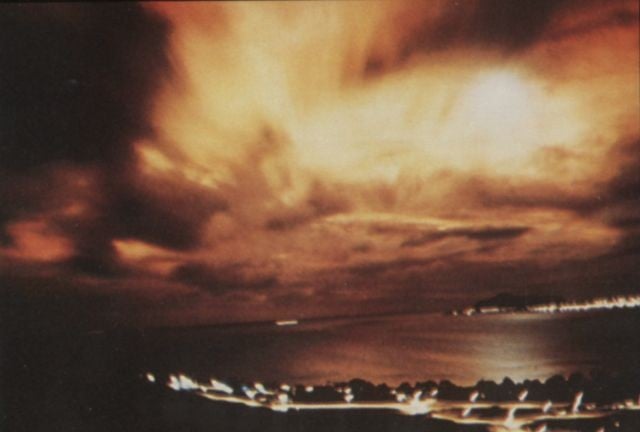
According to the paper, experts became aware of how the explosion left behind an artificial radiation belt, which, unlike the “prompt burst,” lurked in Earth’s magnetic field and repeatedly spewed radiation at spacecraft. Back then, there were far fewer satellites up there. A year later, the U.S. and the Soviet Union signed the Partial Nuclear Test Ban Treaty, which banned nuclear weapons tests on the surface, in the atmosphere, and in outer space, while allowing underground tests.
Live and learn, maybe
Decades later, in 2024, Russia vetoed a United Nations Security Council resolution reaffirming a nuclear weapons ban in Earth’s orbit. This has sparked concerns that a nuclear weapon “could be used against orbital infrastructure,” the team wrote in the paper. And unlike the 1960s, we have too many satellites that are too important for global communications and infrastructure—hence, the significance of the latest study.
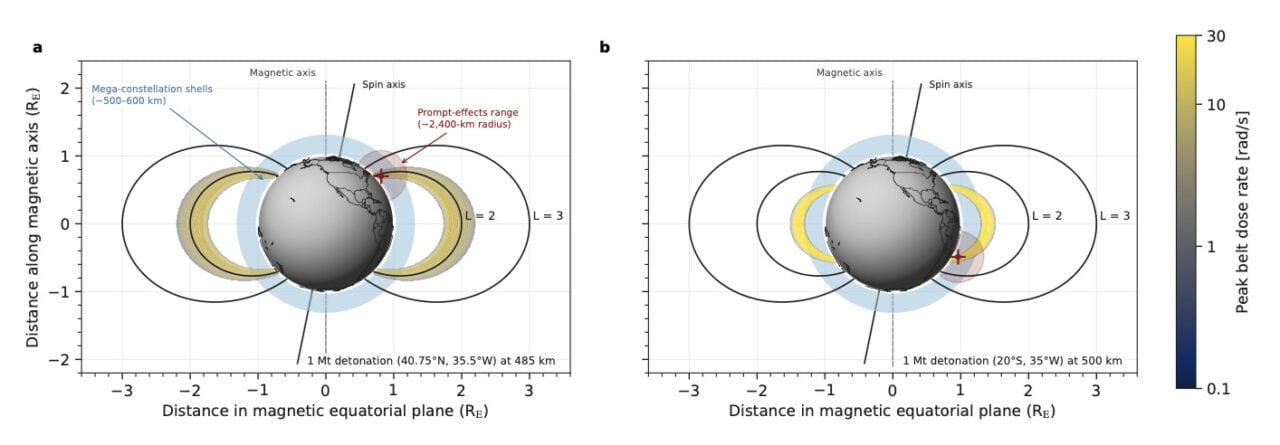
As expected, the team’s calculations found that the most damage came not from the X-rays released from the initial blast but from the electrons released by the fission products. When these electrons are trapped in Earth’s magnetic field, they effectively become an artificial radiation belt. The researchers even tried tripling radiation tolerance—perhaps better materials can withstand this—but still discovered that about 97% became disabled in two weeks.
Keep it as a thought experiment
Launching replacement satellites won’t really solve the issue, they added. For one, the loss of maneuverability “sharply increases” the risk of collisions, and we should expect around 20 collisions within two years of the blast. Most of them, about 19, would occur in the first year, compared to just about one without a detonation. The new satellites would also be jumping right into the artificial radiation belt, so they will not be safe from radiation exposure.
And remember, we’ll have to deal with this while juggling huge disruptions to civilian and military telecommunications infrastructure. To add to this happy thought, if the satellites come crashing down to Earth, it might push certain metallic elements far above natural background levels in the atmosphere—and that’s a whole separate assessment worth doing, according to the study.
So, the message seems rather clear. Let’s keep the scary thought experiment as a scary thought experiment.