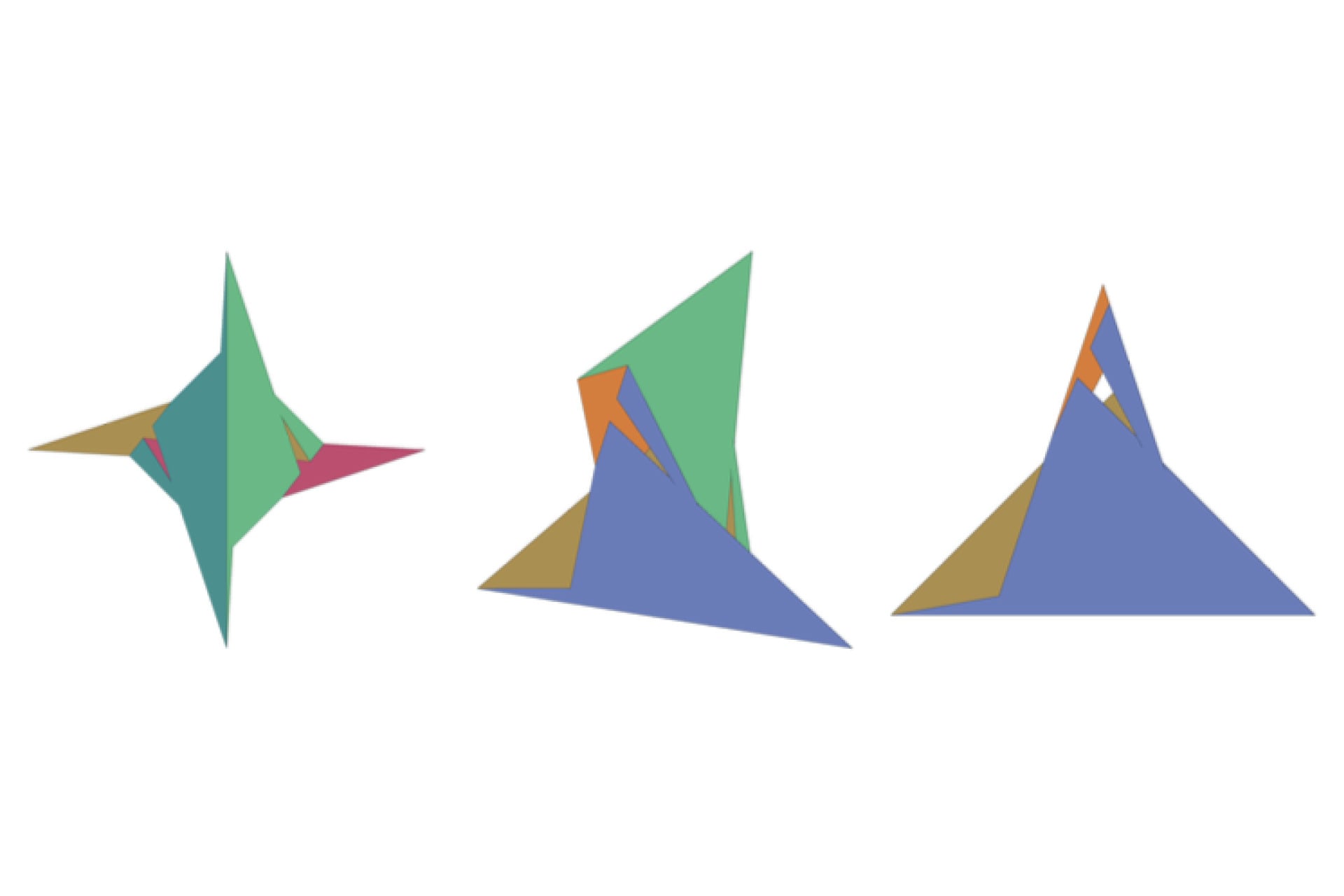
If you’ve ever tried 3D modeling (unsuccessfully, like me), you might have unintentionally added so many vertices that you end up with an irreparable mesh of spiky sides and lines. At first glance, that’s what the genus-3 polyhedron looks like—but unlike bad Blender experiments, this is an entirely new shape with big geometric significance.
Using a set of simple integer coordinates, independent mathematician Ruslan Mizhaev has found a way to create an 8-faced shape where every pair of faces shares at least one edge. Genus-3 polyhedron has 24 vertices and 26 edges, with 3 faces meeting at every vertex. 20 pairs of faces share 1 edge, whereas 8 pairs share 2. Mizhaev provides the data needed to reproduce the shape in a preprint yet to be peer-reviewed, currently available on arXiv.
Lars Schewe, a mathematician at the University of Edinburgh in the U.K., told New Scientist that while the new shape doesn’t overturn existing conjectures, it’s commendable, as “constructing these has always been a difficult task.”
The toroid iceberg
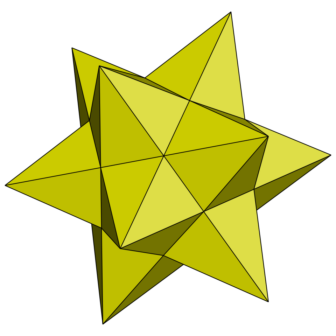
We’re all familiar with polyhedrons: three-dimensional figures with flat faces, straight edges, and sharp vertices. A cube or pyramid is a polyhedron. If you want to get fancier, some Christmas star decorations take the shape of a small stellated dodecahedron, a polyhedron with 12 faces in the shape of a 5-pointed pentagram, or a simple star. These polyhedrons are formations that we encounter easily in our daily lives.
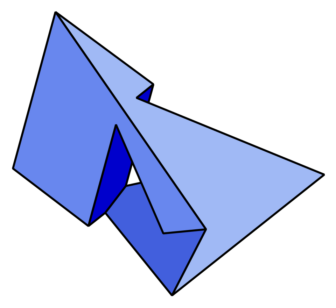
Now, for the real weirdo—the toroidal polytope. This refers to a polyhedron that’s also a torus, a surface of revolution with a hole in the middle. Famous examples of these shapes include the Császár polyhedron and its dual, the Szilassi polyhedron, which is also the closest existing structure to the genus-3 polyhedron.
The point of it all
Understandably, one may be confused as to why these things even exist. But as Mizhaev writes, these odd geometries actually are of significant importance in theoretical mathematics, particularly in studying the “interaction between combinatorial topology, graph theory, and three-dimensional geometry.”
Indeed, just coming up with the set of equations dictating the placement of every vertex, side, and face itself is a gargantuan task that requires a good understanding of those mathematical concepts. On a more practical level, it just so happens that non-mathematicians encounter new shapes in unexpected places. For example, in 2018 scientists found the “scutoid” while studying epithelial cells, realizing that these odd shapes were what allowed human skin cells to be so efficient at protecting our body.
Needless to say, describing the scutoid as a new shape warranted geometrical analysis. While it’s hard to say whether holey toroids exist in a similar context—if they exist at all in nature, that is—the work is definitely intriguing and shows how a trivial exercise really can reach for new models that don’t look like they should work, but do.