The future of hair loss treatment might be a bit more shocking than expected. Recent research showcases an experimental electrical comb that seems especially effective at combating baldness—at least in mice.
Scientists at Beihang University in China developed the contraption, which they’ve dubbed “Detangle.” Shaved mice treated with the comb experienced substantially more hair regrowth than mice given existing medications like minoxidil, the active ingredient in Rogaine, they found. Though more study is needed, the researchers are hopeful their device can be a valuable treatment for androgenetic alopecia, the most common form of baldness.
“[T]hese results demonstrate that electrostimulation via the Detangle system promotes hair growth and follicle regeneration in a safe and effective manner,” they wrote in their paper, published this month in the journal Nature Communications.
A detangled success
Minoxidil is an effective treatment for androgenetic alopecia, but it has its drawbacks. Many users hate the messy topical gels or creams typically used for application, for instance. Pill-based versions of minoxidil are easier to take but may cause unwanted hair growth elsewhere. And importantly, some people simply fail to respond to the drug or only experience modest regrowth.
Another limitation of topical agents like minoxidil is that very little of the drug actually manages to push through the skin and reach the hair follicles where it’s needed. That’s one limitation the researchers are aiming to address with their Detangle system—a name inspired by the 2010 Disney film retelling of Rapunzel, Tangled.
The Detangle comb has several components. It features two types of teeth with different lengths, with one type containing therapeutic molecules. As the comb is used, it delivers small pulses of electricity, while the differently-sized teeth are supposed to gently raise up the skin. These pulses and the skin-raising action are intended to generate a stronger electrical field than normally possible, which then makes it easier for the molecules to penetrate deeper into the skin.
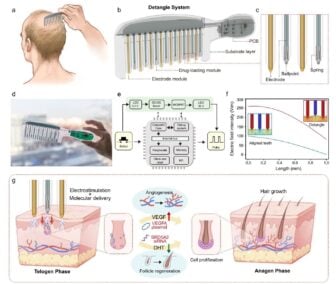
Androgenetic alopecia, also called pattern baldness, is caused by hair follicles that are overly sensitive to androgens, particularly the hormone dihydrotestosterone (DHT). In these latest experiments, the researchers relied on two molecules to stymie pattern baldness: a plasmid that encourages new blood vessel growth and SRD5A2 siRNA to suppress the production of DHT.
The researchers tested the comb on mice modeled to have the condition. This meant the mice had their backs shaved and were dosed with testosterone for 28 days. Afterward, some mice were given topical minoxidil or oral finasteride (another common hair loss treatment), while others were combed daily with Detangle.
Overall, the detangled mice saw much more hair return than mice given either conventional drug. By the end of the month, the mice on Detangle experienced nearly 100% hair regrowth on their shaved backs, compared to the roughly 70% hair regrowth seen in the minoxidil group. Tests also showed that the comb effectively delivered the molecules to the mice and that it didn’t cause any noticeable harm to their skin.
What comes next?
Obviously, this is only an early test in mice. Plenty more research will be needed, including studies in human volunteers, before we can know whether the Detangle comb will work well in people with pattern baldness.
Still, the researchers are optimistic that their system can eventually provide the roughly 1.5 billion people living with androgenetic alopecia another treatment option. And it may even have applications for other conditions that involve the skin.
“The Detangle system proves safe and effective for deep tissue delivery in dermatology,” they wrote.