Okay—and I don’t say this lightly—here’s a seriously weird one. Scientists managed to transmit a message through a brick wall using two unusual ingredients: an old elevator and gravity.
A study published yesterday in Science Advances asked what the team calls a “fundamental” question: “Can information be transmitted through an unblockable channel?” Modern wireless communication depends on electromagnetism, which is easily blocked. But gravitational fields can’t be shielded or weakened by any known material. It can also be measured using a gravimeter. Taking these ideas into account, the team designed an experiment to see whether a message encoded in gravity could bypass obstacles that would blot out electromagnetic signal. Turns out, yes. Yes, you can.
“Anyone who has lost phone reception in a tunnel or struggled with Wi-Fi through a solid wall will understand the appeal,” Charles Woffinden, a study co-author and a physicist at the University of Queensland in Australia, said in a statement. “While the present system is far from practical, it demonstrates the possibility of communicating using a method that ordinary physical barriers cannot block.”
Summoning Newton
That said, the team’s scheme might not be the strangest idea scientists have come up with. According to the paper, neutrinos, gravitational waves, and black holes have all been proposed as alternative, near-unblockable communication channels. However, these approaches have typically required giant detectors and a convoluted process to generate a measurable signal.
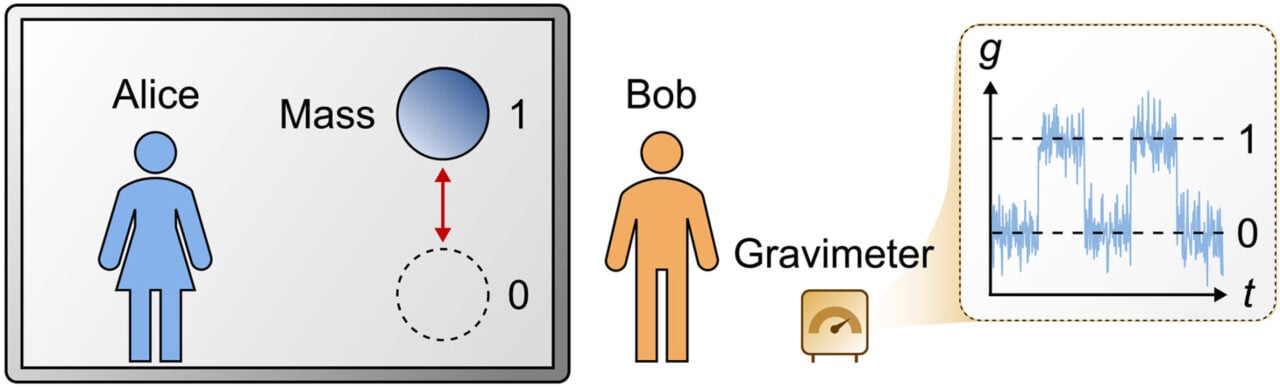
The latest proposal, on the other hand, is “purely classical,” the team wrote, and operates primarily on Newton’s law of gravitation. It only requires a handheld gravimeter, which detects tiny shifts in gravitational acceleration. The message sender encodes a binary message by moving a mass, and the receiver detects the signal with a gravimeter. Now that the researchers had a workable design, the next step was to actually try it out—and, luckily, the team’s university had a perfect location for the occasion.
Through the elevator
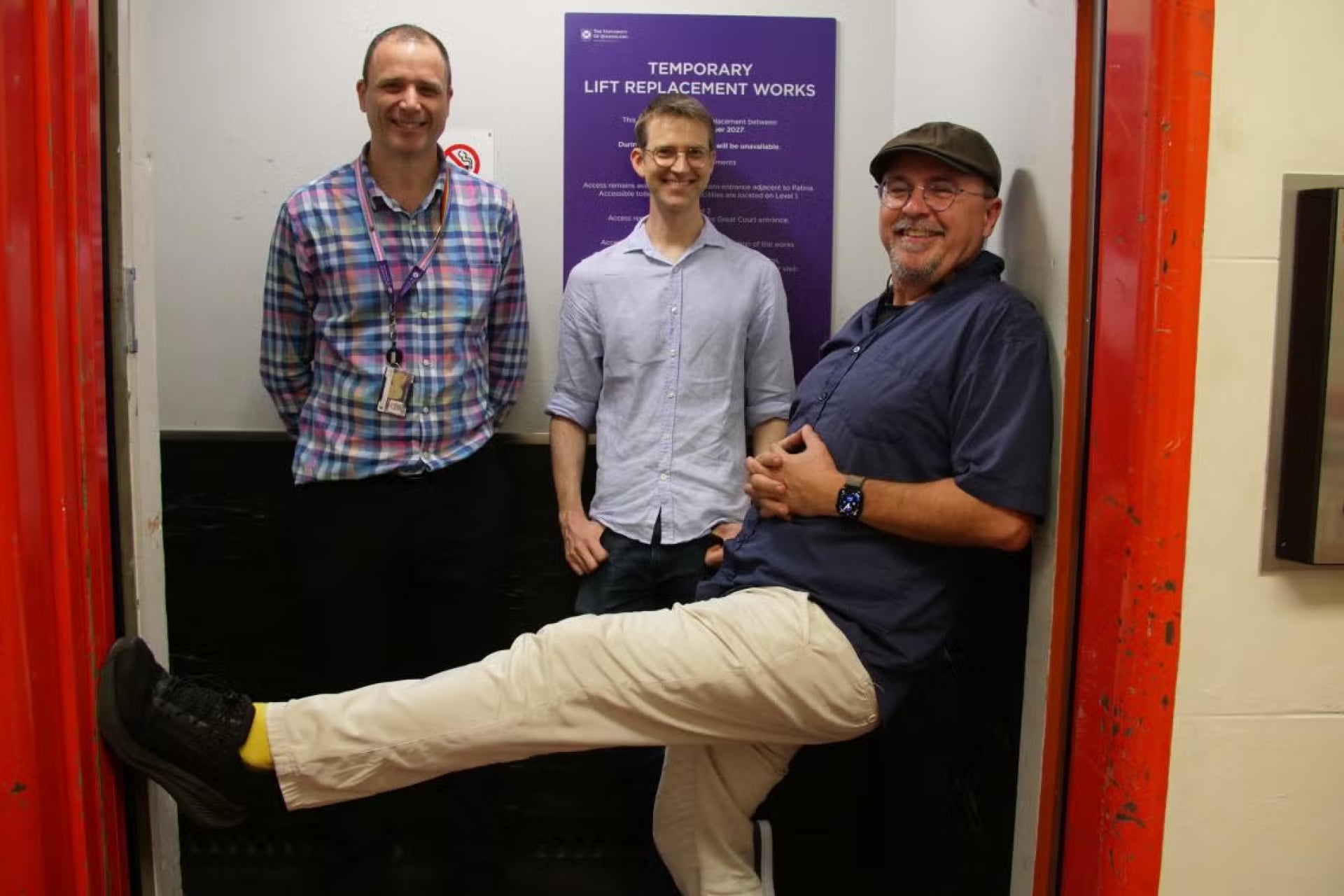
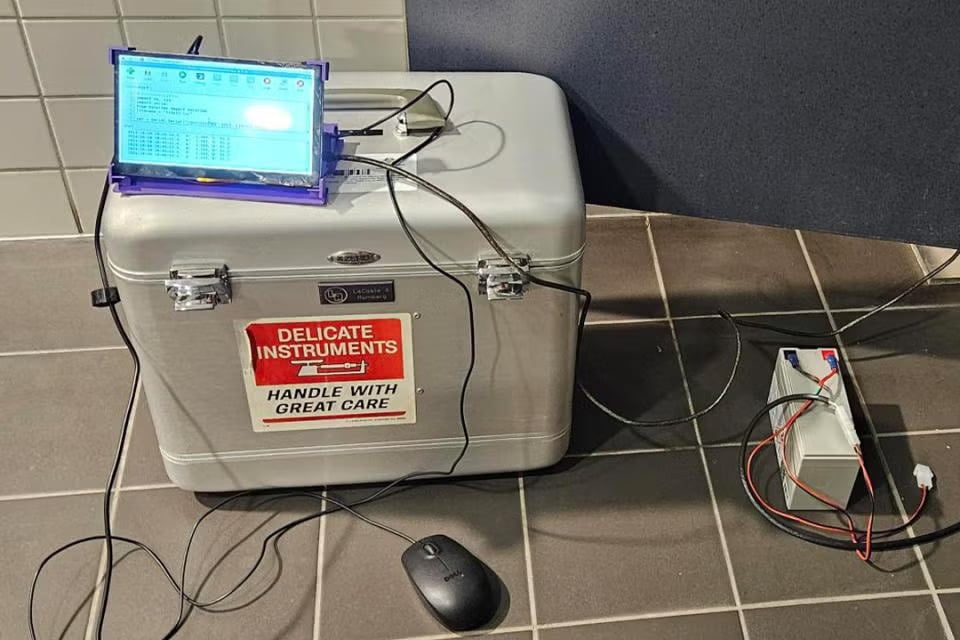
For the experiment, the team sent an elevator—from the 1950s—on campus back and forth between two levels, with its 1.9-ton counterweight between positions representing either 0 or 1. The gravimeter was placed in an adjacent bathroom. The experiment required some patience, however.
“Our lift was snail-paced—it’s from the 1950s—so our experiment transmitted just 1 bit per minute, meaning it took an hour to send a single word,” Andrew White, a study co-author and a quantum scientist at Queensland, said in the statement. “The speed of gravity communication would come down to how big the mass is, how fast you can move it, and the sensitivity of the detector.”
The future is gravity?
Albeit slowly, the gravity messenger worked as the team intended. And its first transmitted word: “Gravity.” The biggest limitation is speed, White said. But considering how it took over a century to go from the first telegraph to mobile phones, he said, it may be too early to wave this off as a quirky experiment.
Looking forward, the team’s modelling indicates that quantum sensors could ramp up the capabilities of this design. The important part is that the experiment showed it works, added Matthew Davis, the study’s corresponding author and a physicist at Queensland. An ambitious estimate indicates it’d be possible to transmit 15 bits per minute from a distance of up to 1,640 feet (500 meters).
“It’s not often that you get to demonstrate an entirely new way of communicating,” Davis said.