A Hulu subscription, a US banking app, and a Netflix profile check the country your connection comes from. Outside the US, the same services show a different catalog or block the session. A US IP address restores the American version, and we tested five of the best VPN services on US servers to see which ones deliver it.
4 Steps to a US IP Address in October 2026
- Sign up for NordVPN, our top pick for US servers, and download the app.
- Log in using the email and password from checkout.
- Search for United States and connect, or choose a specific city.
- Reload the US site that blocked you, and it will serve the American version.
Setting Up a US IP Address With a VPN
With a VPN, websites see the IP address of the server you connect to, across every app on the device. Subscribe to a VPN with US servers, then download its app. NordVPN leads our testing, covering 55 US cities with a 30-day money-back guarantee. Connect to the United States from the location list. Check the result by loading whatismyipaddress.com, and it should show a US location.
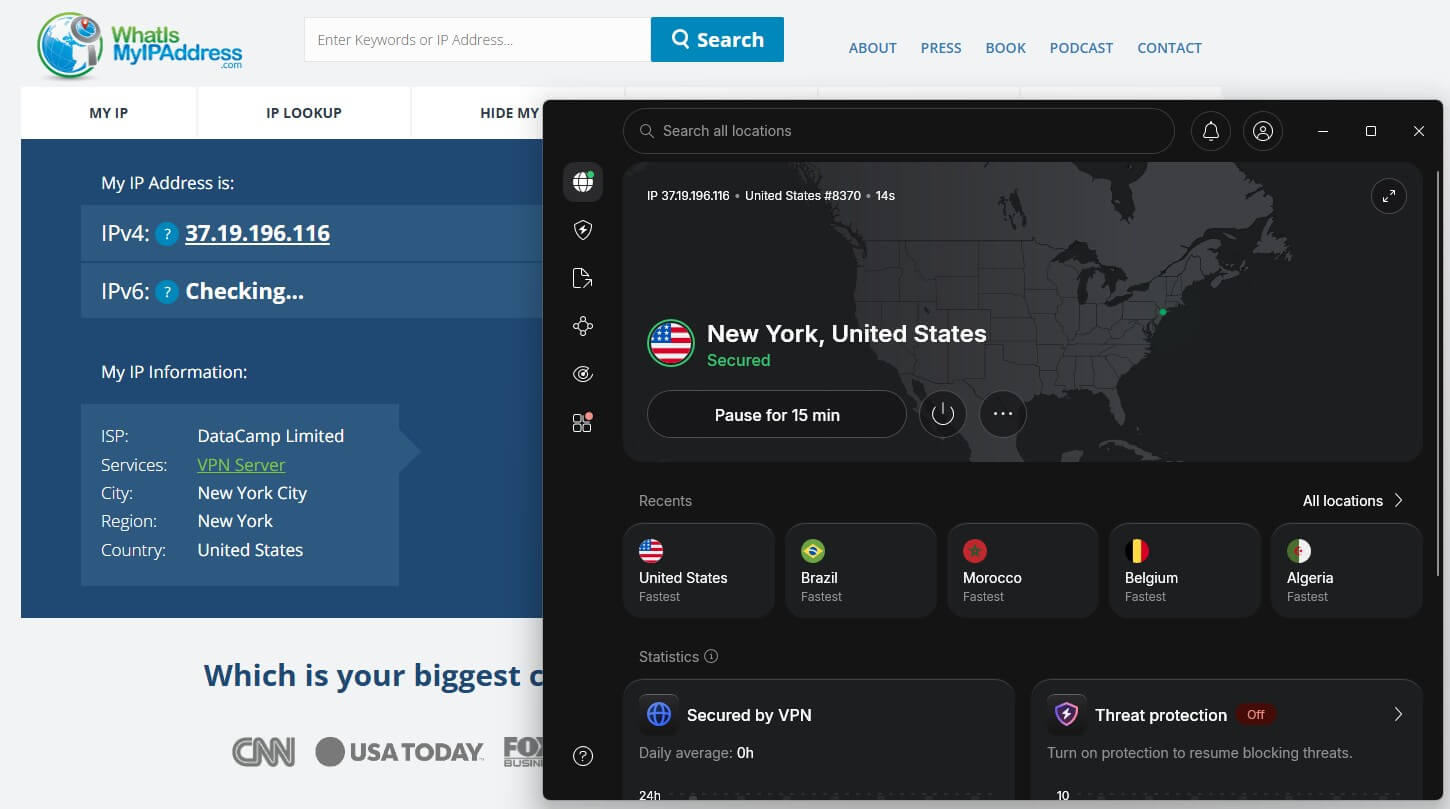
If a streaming service still shows the wrong catalog, clear its cookies and reload. The same check applies to ESPN+ and to Paramount+ outside the US. Changing your IP address is legal in most countries, and our VPN legality guide lists the exceptions.
Getting a US IP Address Without a VPN
- Tor Browser is free and routes traffic through three volunteer-run relays, with the final country chosen at random. Getting a US IP address means reconnecting until one appears or editing a configuration file, and many streaming services block Tor connections.
- A proxy server changes the IP address for the browser or the one app you configure, and most free proxies add no encryption. Netflix, Hulu, and Prime Video detect the shared data center IP addresses proxies use.
- Smart DNS leaves your IP address unchanged. It reroutes the requests a streaming service uses to check your location, so it works on supported services only and does nothing for a bank. NordVPN, ExpressVPN, and PIA include it for TVs that can’t install a VPN app.
A VPN switches the IP address for the whole device and encrypts the connection. Tor and a proxy cover a single app, and Smart DNS does neither.
VPN Speeds and US Coverage Compared
Each VPN’s US server, tested from a Windows 11 PC in Europe off a 190.36 Mbps baseline.
| VPN | US speed | Ping | US coverage | Netflix US | Hulu | Prime Video |
|---|---|---|---|---|---|---|
| NordVPN | 181.50 Mbps | 134 ms | 55 cities | Unblocked | Unblocked | Unblocked |
| Proton VPN | 173.68 Mbps | 135 ms | 18 states and DC | Unblocked | Blocked | Unblocked |
| ExpressVPN | 177.03 Mbps | 129 ms | All 50 states, 63 locations | Unblocked | Unblocked | Unblocked |
| PIA | 175.68 Mbps | 150 ms | All 50 states, 55 locations | Unblocked | Blocked | Blocked |
| Surfshark | 170.38 Mbps | 144 ms | 25 cities | Unblocked | Unblocked | Unblocked |
Five VPNs Tested on US Servers
1. NordVPN: Best for US Streaming Libraries
Pros
- Netflix US, Hulu, and Prime Video unblocked
- Fastest US download we measured
- 55 US cities to choose from
- Dedicated US IP address available
- Post-quantum encryption
- No-log record backed by audits
Cons
- Windows connection fails with other VPNs installed
- Prime Video detected it occasionally
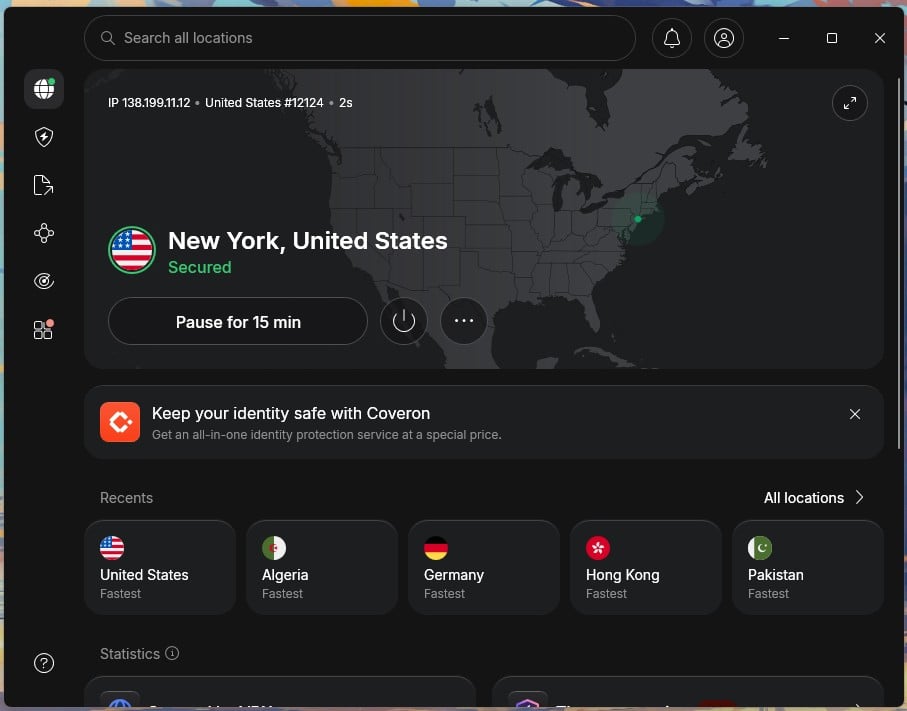
NordVPN measured 181.50 Mbps on its US server, a 4.7% drop from our baseline and the fastest US download we recorded, with ping at 134 ms. It unblocked Netflix US, Hulu, and Prime Video, with occasional detections on Prime Video, and our guide to US TV abroad covers the other channels. Its 55 US cities span both coasts, the Midwest, and the South. A dedicated US IP address adds $4.19 a month to a two-year plan, with 12 US cities on the list.
It keeps a bank from flagging a login that changes IP address every session. NordVPN also supports post-quantum encryption. Two years of NordVPN Basic average $3.49 a month and cover 10 devices. On Windows, NordVPN occasionally fails to connect while another VPN is installed and idle, ExpressVPN in particular.
2. Proton VPN: Best Outside US Jurisdiction
Pros
- Based outside the Five Eyes
- Netflix US and Prime Video unblocked
- US servers listed by state
- Apps open to public review
- Kill switch passed a cable-pull test
Cons
- Hulu blocked it
- Post-quantum encryption still missing
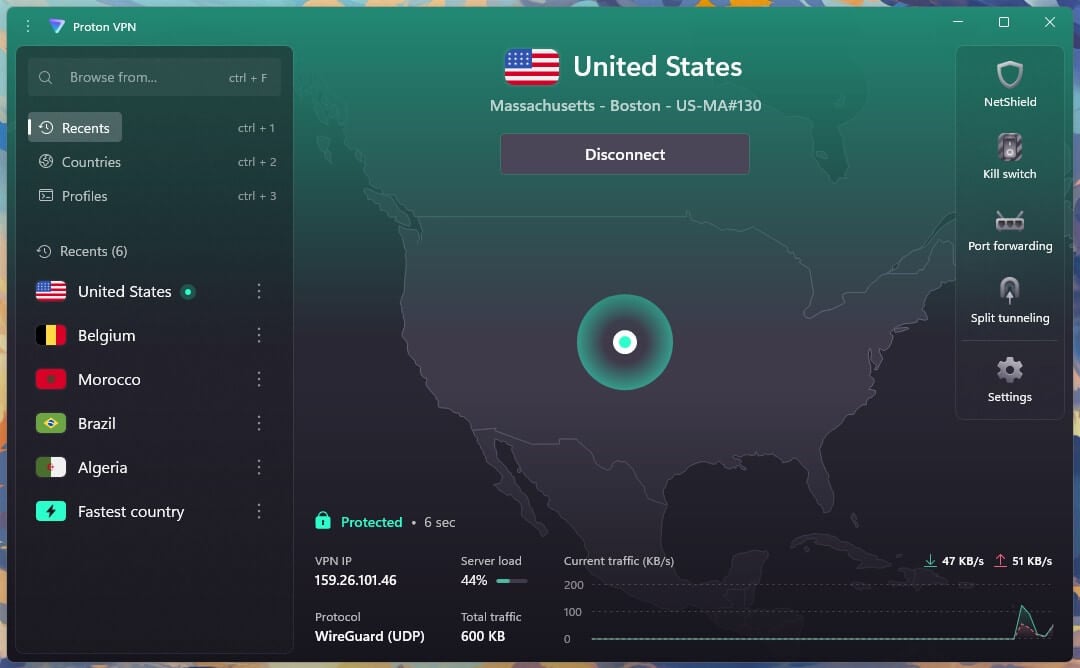
Swiss law governs Proton VPN, outside the Five Eyes intelligence group the US belongs to. That jurisdiction makes it the pick for a US IP address used on privacy grounds. It lists its US servers by state, 18 states plus Washington, DC, and measured 173.68 Mbps at 135 ms, an 8.8% loss. Hulu blocked it, the only US library it failed to unblock.
Proton VPN hasn’t added post-quantum encryption yet, which NordVPN, ExpressVPN, and Surfshark already offer. A two-year Proton VPN Plus subscription works out to $2.99 a month. Its 30-day refund covers only the unused part of the term, whereas NordVPN, Surfshark, and PIA return the full amount.
3. ExpressVPN: Most US Locations
Pros
- 63 US locations in the app
- Hulu and Netflix US unblocked
- Lowest US ping we recorded
- Post-quantum protection in Lightway
- Connects in about a second
Cons
- Settings moved under Profile
- No MultiHop option
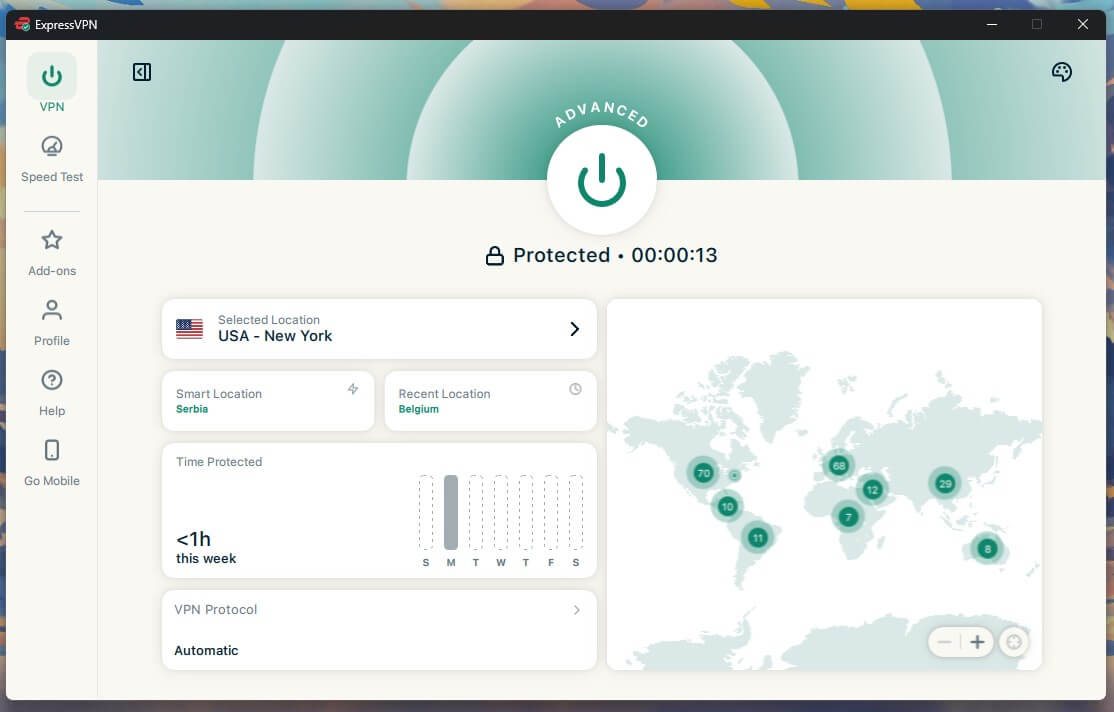
ExpressVPN lists 63 US locations covering all 50 states, the highest count we recorded. The company says some are virtual, routed through a nearby physical server. It measured 177.03 Mbps at 129 ms, a 7.0% loss with the lowest US ping we measured. Prime Video detected it now and then; it’s its only US streaming issue. Its connection came up in 1-2 seconds.
The early-2026 redesign removed the Settings menu, so protocol, kill switch, and split tunneling now appear under Profile, which takes some finding. A dedicated IP address is an add-on on the Basic and Advanced plans. ExpressVPN’s Basic plan, paid two years ahead, is $2.99 a month.
4. Private Internet Access: Every US State Covered
Pros
- Servers in all 50 states
- Dedicated IP from $2.50 a month
- Netflix US unblocked
- No-log policy tested in court
- Strongest ad blocker we tested
Cons
- Kill switch leaked on restart
- Hulu and Prime Video blocked it
- No port forwarding on US servers
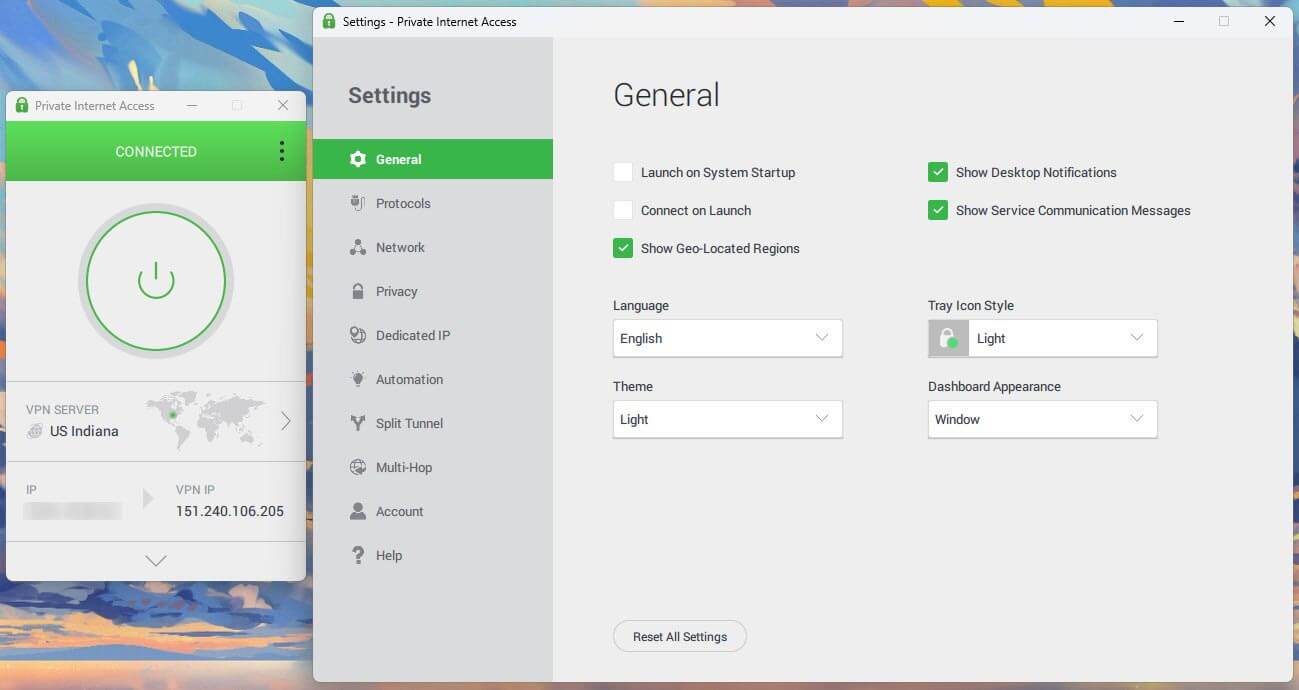
Private Internet Access covers all 50 US states across 55 US locations, which we counted in the app. When a local news site or a regional service expects a particular state, PIA always has one. It measured 175.68 Mbps at 150 ms, a 7.7% loss. Hulu and Prime Video blocked it. PIA is based in the US, a Five Eyes member, and that’s the usual objection. Its no-log policy answers it.
Independent audits back the claim, and court cases have confirmed PIA had no user logs to hand over. One result we didn’t expect from a VPN built on its privacy record: with the kill switch enabled, a PC restart let unencrypted traffic out before the connection came up. The Windows app also defaults to OpenVPN, so switch to WireGuard manually. PIA’s long plan comes to $1.99 a month, with dedicated IP addresses at $2.50 a month in 26 locations.
5. Surfshark: Best for Rotating US IP Addresses
Pros
- Prime Video unblocked without detection
- Rotating US IP addresses mid-session
- 25 US cities
- No device limit
Cons
- Slow to connect at times
- No Smart DNS anymore
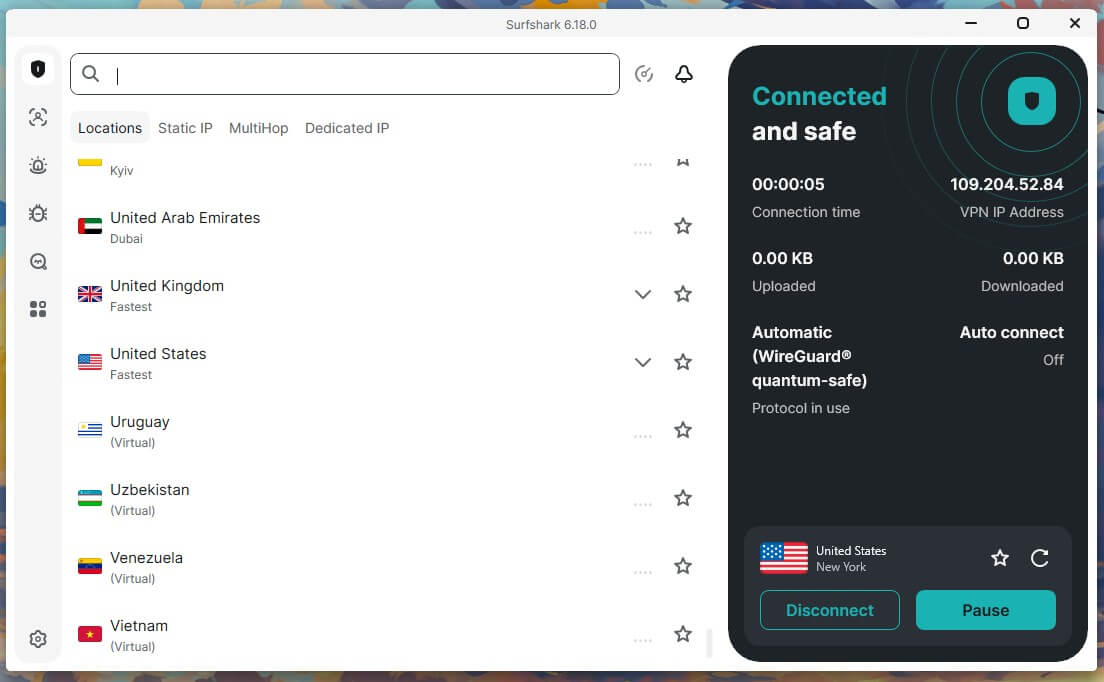
Surfshark kept pace with NordVPN and ExpressVPN on US streaming and passed every Prime Video session undetected. It ranks fifth on state coverage, where its 25 US cities can’t match PIA’s 50 states. Speed was 170.38 Mbps at 144 ms, a 10.5% loss. Rotating IP swaps your US IP address at intervals while the connection stays up, so sites find it harder to track browsing across visits.
Surfshark Starter comes to $2.49 a month with three free months on the first term, and one subscription covers any number of devices. A connection sometimes took 10 seconds to come up, and Surfshark no longer offers Smart DNS for TVs.
Choosing a Specific State or City
A US IP address at the country level covers most uses. A few require a region: local TV networks, sports blackouts, and banking portals that flag a login from a city far from the usual one. ExpressVPN and PIA cover all 50 states, and ExpressVPN spreads them across more locations.
A dedicated IP address goes a step further, reserving one US IP address for you alone, so a bank sees the same IP address at every login instead of a shared one that other users rotate through.
- NordVPN: $4.19 a month with a two-year subscription, 12 US cities
- PIA: $2.50 a month, 26 locations worldwide
- Surfshark: $3.75 a month, US locations in Dallas, Los Angeles, Denver, and San Jose
- ExpressVPN: $3.99 a month, an add-on on the Basic and Advanced plans
Free VPNs and a US IP Address
Free plans make a US IP address easy to find. Hide.me, Windscribe, and PrivadoVPN list US servers on their free tiers, and Proton VPN’s free plan assigns a country automatically, the US among them. Windscribe measured 160.59 Mbps and PrivadoVPN 164.55 Mbps on their free US servers. The limits show on streaming.
Windscribe and PrivadoVPN unblocked Netflix US and failed to unblock Hulu and Prime Video. A 10 GB monthly cap ends a session partway through a series, and the free VPN ranking has the full comparison.
Summary
The IP address itself is the simple part, since any VPN with US servers supplies one in seconds. The libraries it unblocks and how precisely you can pick a location decide which one to install. NordVPN comes first, with the quickest US connection in our testing, the three US libraries unblocked, and 55 cities.
ExpressVPN and PIA cover every state, with ExpressVPN having the most US locations. Proton VPN supplies a US IP address from a company under Swiss law, and Surfshark rotates yours mid-session. For a wider comparison on speed, privacy, and price, see our best VPN for the USA ranking.
Frequently Asked Questions
How do I get a US IP address?
Install a VPN, choose a US server, and connect. The new IP address takes effect the moment the connection completes, and websites then treat the visit as American.
Can I get a US IP address without a VPN?
Yes, through Tor Browser or a proxy server. Tor is slow and chooses countries at random, a proxy covers only the configured app, and major streaming services detect them.
Which VPN has servers in every US state?
ExpressVPN and Private Internet Access have a server in each of the 50 states. ExpressVPN spreads them across 63 US locations and PIA across 55, matching any state-specific service.
Is it legal to have a US IP address?
Yes, a US IP address is legal to use. Violating a platform's terms, such as a streaming region lock, can cost the account without breaking any law.
Can I choose a specific US city?
Yes, most VPNs list US servers by city. A dedicated IP address keeps the same US IP address on every connection, which banking portals treat as a returning login.
Can a free VPN provide a US IP address?
Yes, several free plans include US servers, Windscribe and PrivadoVPN among them. Their data is capped at 10 GB a month, and Hulu and Prime Video block them.