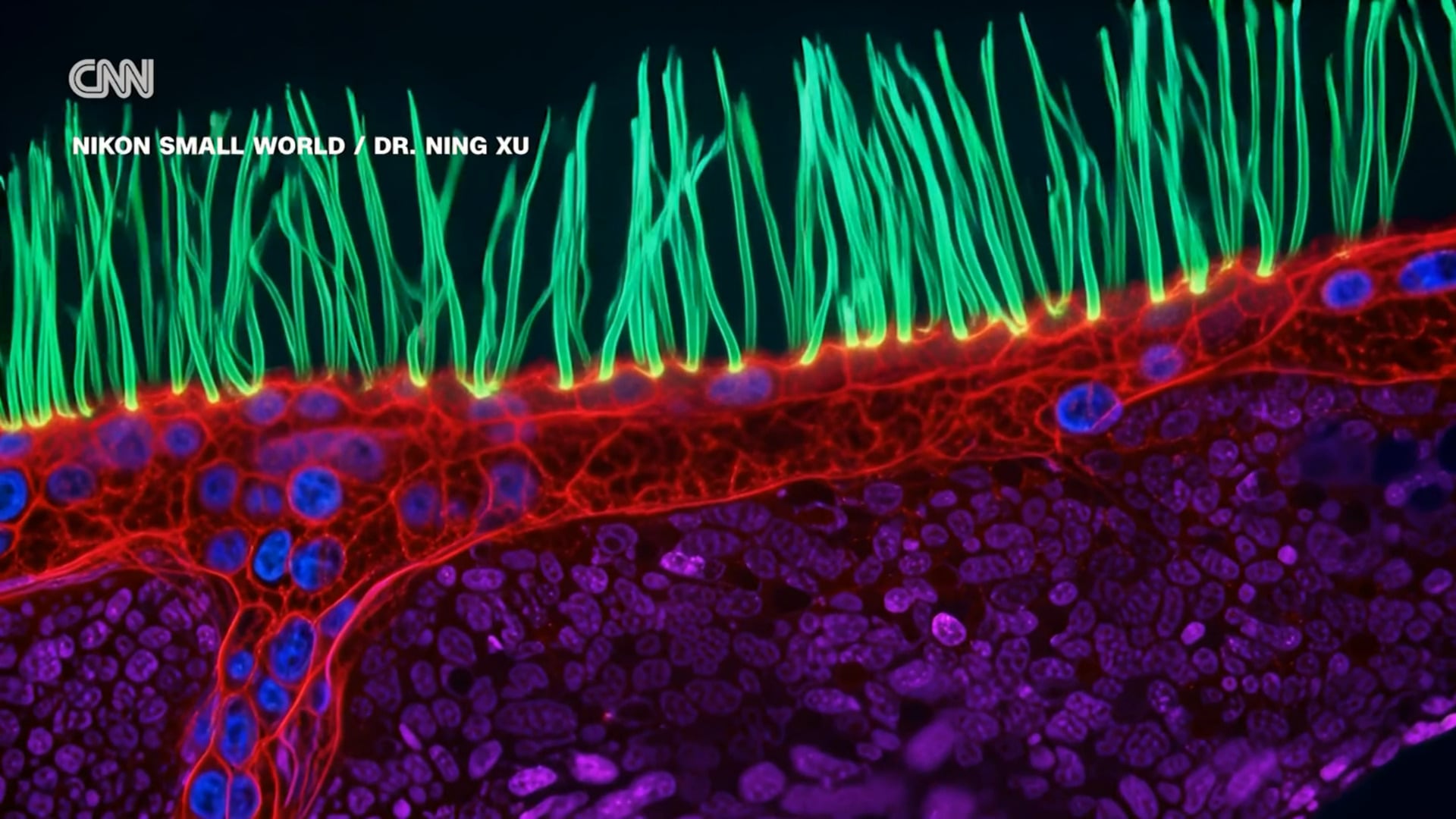
The organizers of Nikon’s Small World in Motion photomicrography contest have thrown out this year’s winning entry after determining it violated rules against generative AI.
“After thoroughly re-evaluating the video and supporting materials and consulting with members of our judging panel, Nikon has determined that the winning video did not comply with the competition rules regarding generative AI,” Remi Yuter, a spokesperson for the contest, told Gizmodo via email.
Controversy erupted over the last few weeks after experts noticed National University of Singapore optical engineer Ning Xu’s winning entry, a video of cilia in airway tissue samples taken from a child with primary ciliary dyskinesia (PCD), was full of structures that didn’t appear to exist in biology. It also had an AI-identifying SynthID watermark.
Xu clarified the video originated with actual research footage, but that he had used generative AI for “postprocessing.” Regardless of intent, the red, blue, and purple structures seen in the clip seem to have been altered beyond recognition or fabricated entirely.
“I have been diagnosing PCD for 20 years by examining their cilia waveform, length, cell size and shape,” University of Leicester scientist Robert Hirst told the BBC. Whatever is shown in the video “[looks] nothing like those from PCD patients,” Hirst said, adding the incident had a negative impact on PCD patients, doctors, and support networks worldwide.
“Nikon has adjusted the competition rankings to reflect this decision,” Yuter wrote, noting the decision was based entirely on eligibility rules and “should not be interpreted as a judgment of the entrant’s professional reputation, scientific contributions, or intent.”
The new winner is Nguyen Nam Nhat of Vietnam, who submitted a video of a roundworm and a single-celled organism called Dileptus. Xu’s entry no longer appears on the contest’s page of winners. Yuter added in the statement that Nikon Small World will “revisit rules and evaluation procedures for future competition entries.”
One widely cited set of scientific guidelines, which predates generative AI, argues that scientists should disclose when they color images. Generative AI is a difference of kind, not degree, because it fabricates pixels.
Fabricating pixels doesn’t really fly in science. Melanie White, a developmental biologist at the University of Queensland in Brisbane, Australia, previously told Nature that scientific images are data, and scientists “need to be able to trust that what we are seeing is grounded in the underlying measurement.”
Xu didn’t respond to a request for comment from Gizmodo, but we’ll update if we hear back.