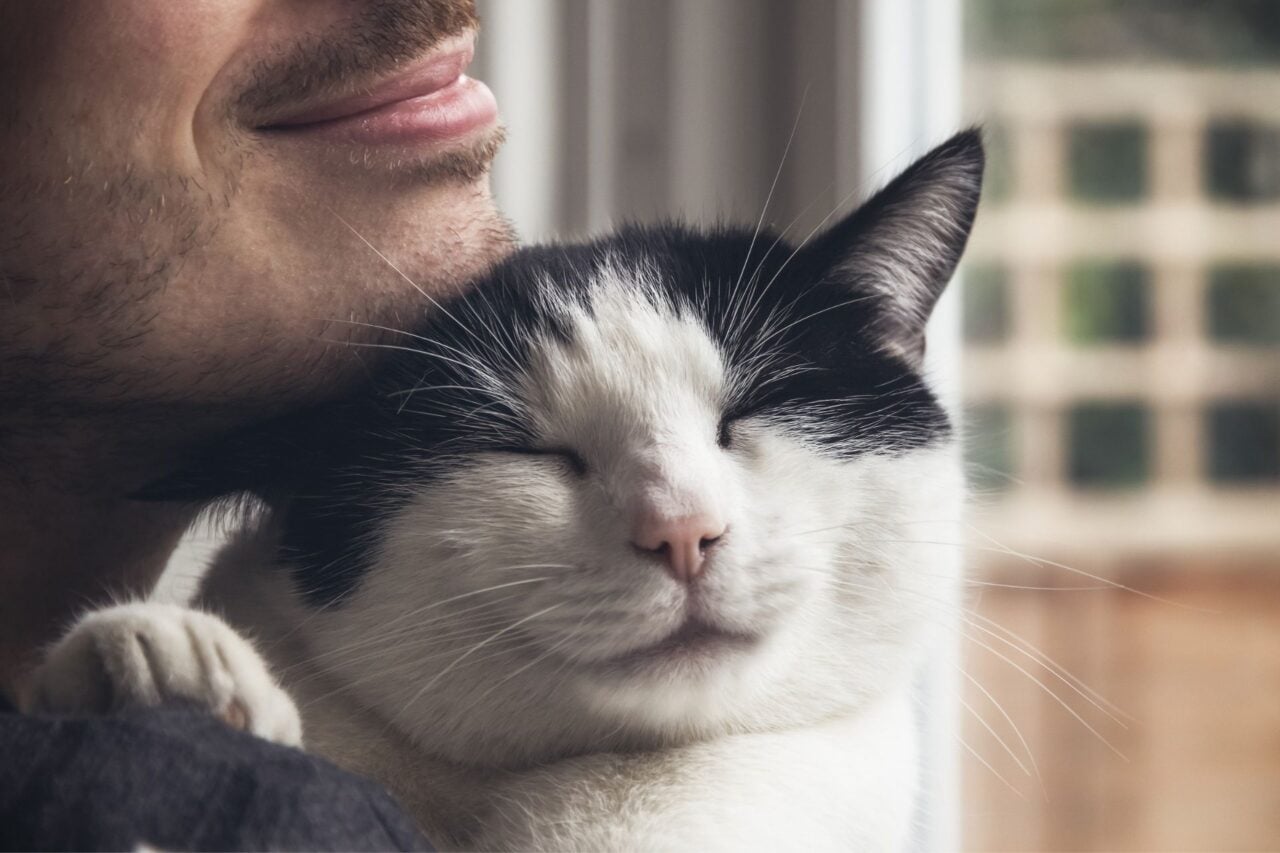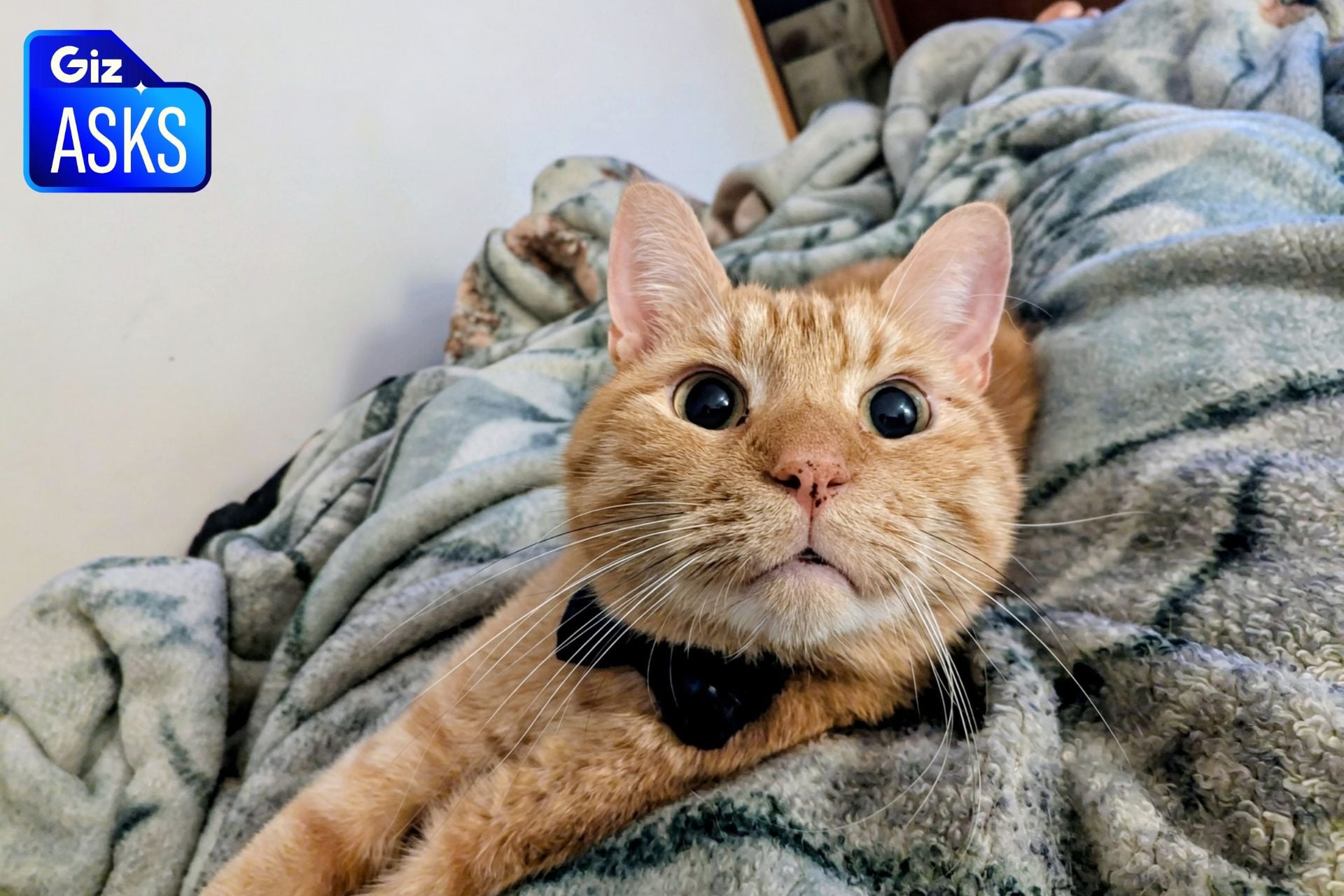
Occasionally, I’ll ask my cat Cheddar a question, particularly when he’s buried himself deep into the crevice between my neck and pillow while on the bed: “I love you, do you love me?” Cheddar will typically respond as only a cat can: either by remaining perfectly still—the sole sign of life his diesel-truck purring—or by ramming his head into mine, often making sure to rub his cheek all over my face, too.

For me, that’s more than a satisfactory response. Many people, including animal behavioral experts, say that headbutting (also called bunting) can be a sign of a cat showing trust and affection toward you. Bunting and cheek-rubbing also allows them to leave their scent on you, which can be used to communicate ownership or familiarity.
Cheddar has been a part of my life for almost a decade now. My friend found him abandoned and worm-ridden inside a carrier at a park in Queens, and I offered to take him to my local vet for a checkup. Over the course of the lengthy subway ride back to Brooklyn, his constant pitiful meowing melted my heart, and he would end the day at my apartment, which he’s called home ever since. He was only a few months old at the time and scared of anything he came across, myself very much included. These days, he’s still afraid of a lot of things, but not so much me. People familiar with cats might say that Cheddar chose me to be his person, and I have never regretted accepting the honor.
Still, cats are not people. And as someone who routinely reports on the intricacies of animal behavior, I try to be careful about over-anthropomorphizing Cheddar and other animals. To be clear, I’m not saying that cats don’t have complex cognitive processes or social behaviors. If anything, recent research shows that we’ve been underestimating just how capable many non-human animals are at such things. It’s more that humans are very good at wrongly assuming that other animals see or navigate the world the exact same way we do.

I don’t doubt that I mean something to Cheddar, nor do I doubt that many cats share a unique bond with their owners. But I have always wondered how that something differs from the something we feel toward cats. So for this Giz Asks, I reached out to feline behavior experts, both housecat and wild, to explore the nuances of the millennia-old relationship that modern-day humans have forged with the domestic cat (Felis catus). The following responses may have been lightly edited for clarity and grammar.
Carly Moody
Head of the Animal Welfare Epidemiology Lab at the University of California, Davis.
From a scientific perspective we don’t use the term “love” since it’s subjective and means different things to different people, but in animals we study the strength of the human-animal bond through things like affiliative interactions (e.g., rubbing), proximity seeking (e.g., time spent in close contact), social preference, vocal communication, and physiological responses, including hormone changes such as oxytocin release.
For example, research suggests that high oxytocin release can occur during cat-owner interactions, particularly in cats categorized as having a “secure attachment style” based on their behavior during a cat-owner separation and reunion test. Oxytocin release is involved in social bonding and affiliation across a variety of species, including humans, and similar oxytocin responses have been observed during positive social interactions between parents and their kids. So we have evidence that cats can form meaningful social relationships with people. That doesn’t necessarily allow us to say that a cat experiences “love” in the same way a human does, but an animal’s emotional experience doesn’t have to be identical to ours for the relationship to be meaningful.
One thing I think is particularly important when we’re talking about cats is individual variation in social behavior. Cats differ widely in how social they are, both towards people and other cats. Genetics, early socialization, previous experiences, management, and the living environment, as well as the behavior of the humans and animals they live with, can all influence these relationships. So there isn’t one single way that a strong cat-human bond should look.
Cats also have a really interesting domestication history, which differs a lot from dogs. The ancestor of the domestic cat was largely solitary, whereas dogs evolved from a highly social ancestor. Cat domestication also involved less intensive selection by humans than dogs. Cats have retained much more of the behavioral repertoire of their wild ancestors than many people realize, including very effective predatory hunting behavior. Many cats can survive with relatively little direct human intervention, although this doesn’t mean they necessarily thrive or have good welfare under those conditions. Cats show a large degree of social flexibility. They’re capable of forming social relationships with other cats, humans, and other animal species. Free-living cats can also form social groups when resources are sufficiently available.
Another important difference is that cats aren’t simply born knowing how to have a close relationship with humans. Early socialization with people is extremely important. Kittens that have little or no positive human contact during sensitive periods of development can have difficulty adapting to life in a human household and living in close contact with humans. The cat-human relationship is something that develops through positive experiences and interactions during kittenhood.
I would also push back on the idea that cats think of us as “large hairless cats.” Cats display some of the same affiliative behaviors with humans that they display towards other cats, but that doesn’t mean they mistake us for cats. We know that cats modify aspects of their behavior and communication depending on whether they’re interacting with humans or cats. I think it’s more useful to consider cat-human relationships as their own type of social relationship.
Overall, we know that cats and their owners can form very strong attachments and deep social bonds. Those relationships don’t have to look like human-human relationships or even dog-human relationships; the important thing is that they’re meaningful to the cat and human involved.
Kristyn Vitale
A certified applied animal behaviorist and founder of Maueyes Cat Science & Education. Vitale has conducted research into the attachment bonds cats form with humans.
Love is a complex emotion. At its core, it’s a desire to be close to someone, feel emotionally connected, and genuinely care about their wellbeing. Love is difficult to study, even in humans, and even more challenging to investigate in non-human animals. Without words, researchers must look to animals’ behavior for clues.
Because love is multifaceted, we can study components individually. One key element of love is attachment, a close, enduring bond most observed between parents and offspring in animals such as humans, dogs, and cats. In attachment, seeking closeness and contact is balanced with seeking independent exploration. For instance, a separated kitten’s distress vocalizations help its mother locate and reunite with the kitten. Once reunited, the pair maintains closeness through following, contact, and affectionate behaviors, while the kitten periodically ventures away again to explore its surroundings. All of this helps protect the kitten and support its development into adulthood.
Our research has investigated whether cats display these same attachment behaviors toward humans. Most cats tested demonstrated a secure attachment toward their caregiver. These cats became distressed when their person left, greeted them upon return, and used them as a secure base, or someone they used for reassurance before heading off to explore again. In this way, cats’ attachment relationships with humans resemble the relationships kittens have with their mothers.
This doesn’t mean cats see humans as large, hairless cats. Socialization to humans and other cats occurs independently, so a cat may be comfortable with humans but not with other cats, or vice versa. This suggests that while there are similarities, the relationships cats have with humans are distinct from those they form with other cats in the home.
Understanding the human-cat relationship requires examining how cats behave toward humans specifically and what those behaviors might reveal about their emotional lives. To understand whether cats experience love, we need to consider a range of behaviors. Do they seek our presence, share our space, approach us for contact or play, show distress when separated, or comfort us when we’re upset?
So, do cats really love us? It’s a complex question with many aspects left to explore. The human-cat relationship shows some hallmarks of love. Cats seek closeness with humans and their caregiver’s presence can help reduce a cat’s emotional distress. Although we cannot know whether cats experience love exactly as we do, the evidence suggests that their bonds with humans are strong and meaningful, and worthy of further study.
Natalia Borrego
A postdoctoral researcher with the Max Planck Institute of Animal Behavior in the Department for the Ecology of Animal Societies and a project leader in the Center for the Advanced Study of Collective Behavior at the University of Konstanz. Borrego has focused on African lions in particular.
The internet is full of stories about the “cat distribution system”: a cat appears, someone (usually a dad) insists he does not want a cat. Six months later, dad is spooning kitty on the sofa while still grumbling that the cat is “not mine.” Cats have become beloved companions despite a reputation for being aloof, mysterious, and silently judging us. So do they actually love us, or are we just large, hairless idiots who control the can opener?
The most scientifically defensible answer is: probably yes, if by “love” we mean an enduring social bond, but we have to be careful about what we are claiming. We cannot ask a cat what it feels, so researchers look for measurable signs: Does it recognize familiar individuals, seek them out, respond to separation and reunion, or use them as a source of security? By those measures, humans clearly matter to cats. Cats distinguish familiar voices and use many cat-to-cat affiliative behaviors with us, including rubbing and tail-up greetings. Recent work has also found hormonal responses during owner-cat interactions. When cats were allowed to initiate and end contact, oxytocin increased and cortisol decreased, while forced interaction produced the opposite pattern. That is not biochemical proof of love, but it tells us these interactions matter to the cat.
One especially interesting test comes from secure attachment, a concept first developed in human children and later applied to dogs. A securely attached child uses a caregiver as a home base: they may become distressed when that person leaves, seek them out when they return, and then go back to exploring. Dogs show remarkably similar attachment patterns. When researchers tested cats, they also found a familiar pattern. Roughly two-thirds were classified as securely attached, a proportion on par with studies in children and dogs. But the jury is still out. In the strict psychological sense, an attachment figure should be a unique source of safety and security, but studies directly comparing owners with strangers have not consistently found that effect in cats. Cats clearly form social bonds with us. Whether those bonds work exactly like attachment in children or dogs remains an open question.
So, do cats love us? I think there is good evidence that they form enduring, emotionally meaningful relationships with us. Whether those relationships work exactly like human love, or even dog love, is probably the wrong standard. Cats came to us on very different evolutionary terms. Early cats appear to have moved into human settlements as stored grain attracted rodents, giving cats easy hunting opportunities and humans useful pest control. Cats did not begin their relationship with us by depending on us or working alongside us, which may help explain why their social bonds look different from those of dogs. Different does not mean less meaningful, just harder for us to interpret. Science may eventually tell us more. Until then, perhaps the cat distribution system knows something we don’t.
Margaret Gruen
A veterinary behaviorist and an associate professor of behavioral medicine at North Carolina State University.
We all want to believe that our feline friends love us. Indeed, we know it in our whiskered hearts! However, this question continues to plague people as cartoons and articles describe cats as aloof, asocial, or uncaring about their people’s plights. The good news is that science backs up what feline lovers believe—cats do seem to return our affection.
While it may be fair to argue that “love” is a human emotion, and isn’t something we can directly measure, cats show clear evidence of attachment to their people, in ways that are similar to other species where love is less frequently questioned (I’m looking at you, dogs). Classic psychology experiments designed to evaluate bonds between parents and babies have been performed with cats, and they show that many cats have secure attachments with their caregivers, and respond to them as though they are a safe base from which to explore new environments. And while cats are not always right on top of you, there is also evidence that they seek proximity to their people, will follow routines of behavior, and “appear” in spaces where their people are spending time. Cats also direct other social behaviors toward their caregivers, including “bunting” with their head and cheeks (which marks someone as familiar) and directing vocalizations, like meows, toward them. They also respond differently to their caregiver’s voice, compared to a stranger’s.
There are many factors that may play into a cat’s display of affectionate behaviors, however. Kittens who are not socialized during their critical early period of life may have a more difficult time forming bonds with humans, and social tendencies will vary by individual.
If the question is, “Can cats love us?” then strictly speaking, the evidence supports that they can and do form strong social bonds with their people that have many similarities to bonds between humans and babies, and that these exist even when food is not involved. Is this love? I choose to say, Meow.
Hao-Yu Shih and Lena Provoost
Shih is a veterinary behavioral medicine resident at the University of Pennsylvania’s School of Veterinary Medicine (Penn Vet). Provoost is an assistant professor of small animal behavior at Penn Vet. Shih provided the primary text, while Provoost provided minor reviews and edits.
Scientists have spent years studying whether cats form social bonds with people. Some studies have found that many cats seek out their owners and prefer to spend time around them. Cats may also explore their surroundings more when their owner is present, and some cats even show signs of distress when separated from their owners. Cats may even become more affectionate and initiate more social contact when reunited with their caretakers after being apart for long periods of time. These behaviors suggest that cats do form social bonds and attachments to their owners; it just may look different from how we perceive relationships with dogs or other humans. Keep in mind that cats communicate through body language and vocalization, and proximity alone can convey affiliative behavior.
However, scientific evidence is not entirely consistent. In one study, cats behaved similarly toward their owner and toward an unfamiliar person, showing little evidence of a strong preference for their owner. Other studies observed that cats vocalized more when their owner left the room but failed to find attachment patterns beyond that.
Researchers have also examined what happens inside a cat’s body during interactions with humans. Studies have shown that human-cat interactions can influence hormones associated with stress and social bonding in both parties, such as cortisol and oxytocin. However, these physiological findings remain inconclusive, and they do not yet provide a definitive answer about the nature of the relationship between cats and their owners.
So, what can we conclude from the current research? The evidence suggests that many cats will form social bonds and attachments to their human caregivers that are maintained well into adulthood. Thus, they will notice when your schedule or behavior changes or if you haven’t made it to the kitchen to feed them on time. What we still do not fully understand are the factors that contribute to such social attachments.
And then of course, there is the age-old question of what is love? There is currently not enough evidence to say whether a cat’s bond with its owner is rooted in “deep affection” or if they simply become attached because we fulfill many of their health, physical, and emotional needs. In other words, your cat likely sees you as their go-to person and is attached to you, but they may not care—or know how to care—for you when you stub your toe. How cats develop and experience that connection remains an open question.

Giz Asks is a recurring Gizmodo series in which experts answer big questions in their own words, offering a range of perspectives on the ideas, discoveries, and debates that affect our lives and shape our understanding of the world.