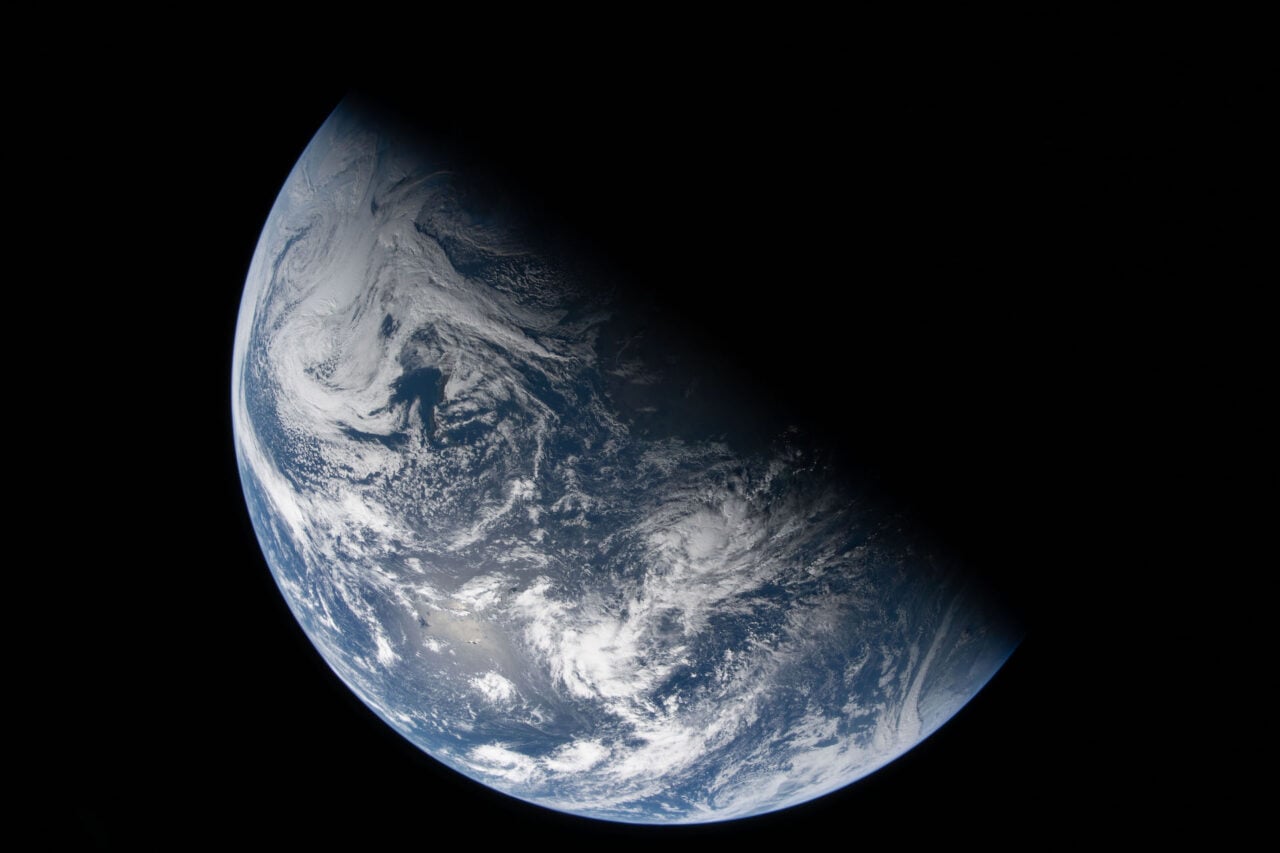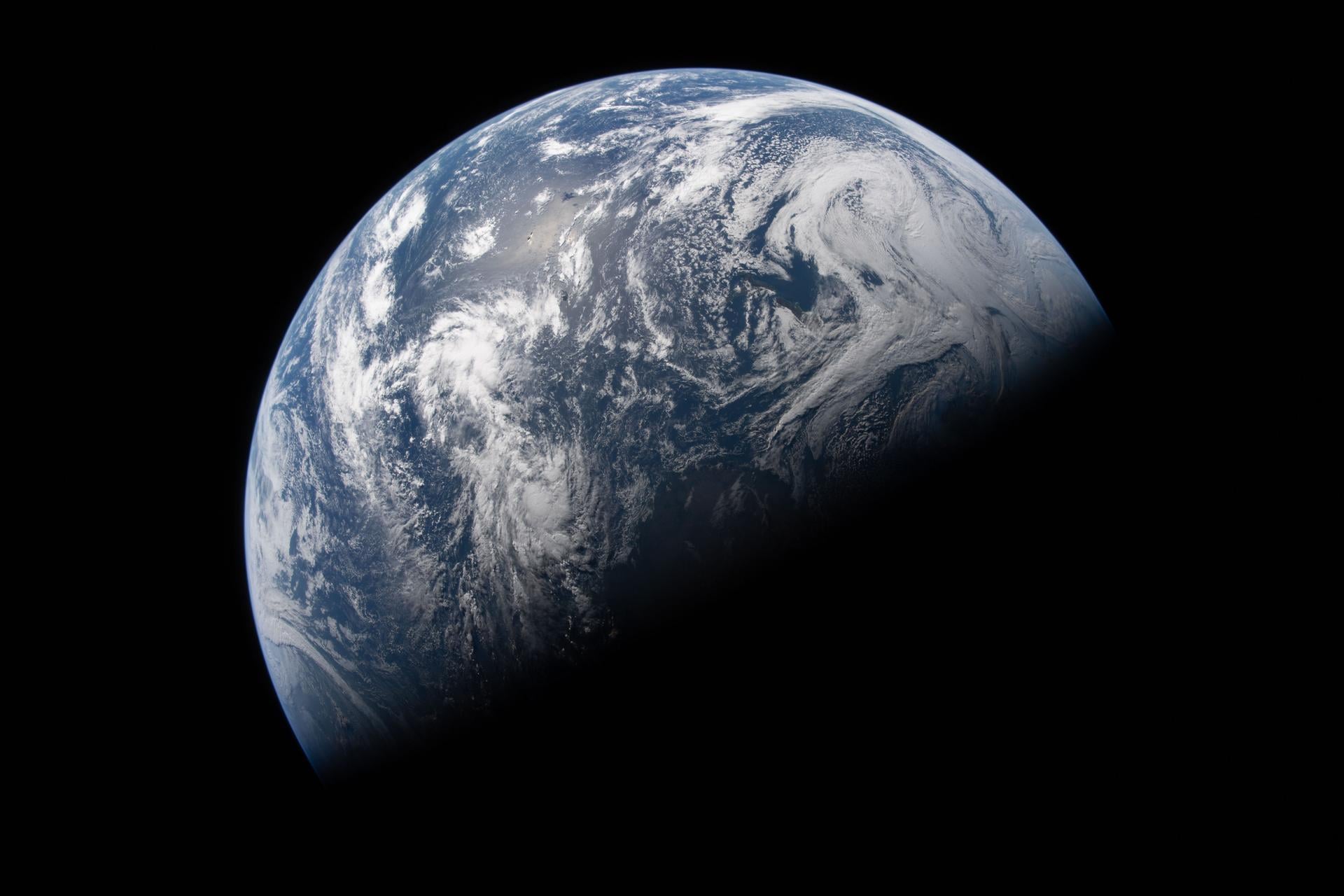
Earth is definitely not flat, but it’s not perfectly spherical, either. Due to its constant rotation, our Earth is closer to a squashed elliptoid. What this also means is that occasionally, the geographic locations of Earth’s north and south poles will wander across the planet’s surface as the solid Earth slowly rotates relative to its spin axis, so it appears as if the Earth tips over on its side. And this phenomenon may have had a greater impact on our planet’s environment than scientists thought.
This wandering phenomenon is called true polar wander. According to a study published today in Science, some believed that true polar wander was “negligible or persistently slow.” However, the team behind the new work found that sizeable shifts in sea level patterns tended to align with suspected episodes of rapid true polar wander, namely during the Jurassic and Cretaceous periods. The researchers arrived at this conclusion via a new method to study true polar wander using ancient sea-level changes, which highlights the underappreciated influence of this phenomenon on the global environment. Although “rapid” true polar wander episodes still played out over millions of years, their impact on Earth’s environment may be more significant than previously believed, according to the paper.
The findings “highlight the need to consider true polar wander as an episodic control on sea level change and likely other global environmental and biological dynamics,” the team, which includes Mathew Domeier, a geoscientist at the University of Oslo in Norway, wrote in the paper. “They further imply that similar episodes of fast true polar wander are likely to have punctuated earlier intervals of Earth history.”
Keeping things stable
Earth tries to keep itself balanced while rotating on its axis. Because our planet isn’t a perfect sphere, changes to mass distribution—typically due to surface or mantle dynamics—end up messing up this balanced axis, and the “entire solid Earth reorients to restore this alignment,” according to the paper. But the core and climate belts remain fixed, which led scientists to theorize that true polar wander brings “profound” impacts on climate, the biosphere, and the geodynamo (the convective flow of Earth’s outer core that generates its magnetic field), the researchers explained.
That said, Earth’s surface is continuously shifting from tectonic motions that aren’t always easy to distinguish from suspected episodes of true polar wander, they added. As a result, scientists mostly relied on paleomagnetic records to trace back candidates for polar wander “hotspots” from hundreds of millions of years ago. Needless to say, this has “yielded divergent interpretations” of true polar wander, particularly during the dinosaur ages, including those that characterized the phenomenon as “substantial but persistently slow.”
When the Earth moves
For the new study, the team took a “fundamentally different approach” to detecting true polar wander, using extensive records of continental flooding maps to study what Earth was like as far back as 320 million years ago. The idea is that the misalignment of Earth’s innards during true polar wander events disrupts both the lithosphere and the hydrosphere. However, the effects of this change would be relatively milder on the lithosphere, held together by the mantle’s viscocity.
On the other hand, we’d see more notable changes in the hydrosphere, namely shifts in the distribution of exposed and inundated land, the team explained. From their assessment, the researchers studied signals pointing to these major shifts at 10 million-year intervals. As a result, they identified four intervals with strong signals pointing to rapid true polar wander events.
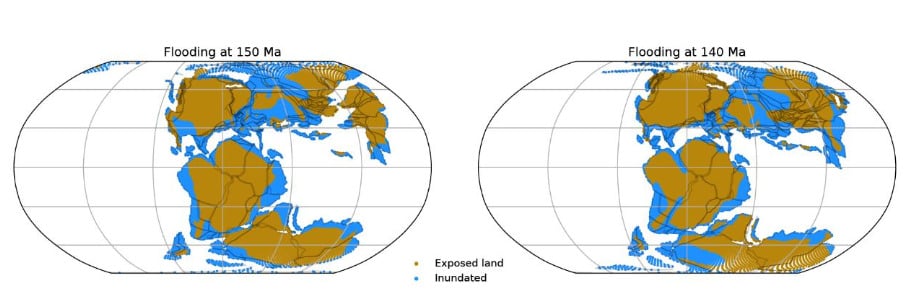
These include the mid-Cretaceous (100–90 million years ago), the Late Jurassic to Early Cretaceous (150–140 million years ago), the Early Jurassic (200–190 million years ago), and most recently, during the Oligocene to Miocene (30–20 million years ago). Globally, rapid true polar wander events brought the most sea level changes in areas furthest from two axes of rotation: one along the rotational equator and the other perpendicular to the first.
Surviving the dino age
The findings are consistent with the estimated axis positions during the mid-to-late Cretaceous period using other statistical methods, they added. The signal from the Jurassic in particular also aligns with previous investigations that used the traditional approach in paleomagnetics, but further scrutiny is warranted, according to the paper.
The study doesn’t get too detailed about how these episodes would have affected Earth’s biological systems. If the findings are correct, however, it suggests that an underappreciated process was reshaping coastlines across the globe during the age of the dinosaurs.