Hubris threatens doctors in the same ways it does many of society’s other technically daunting, well-paid professions: It’s a hard club to get into, and if you’re in there, well, you must be pretty smart. (This latent tendency likely played a role in Jurassic Park author Michael Crichton going from completing an MD at Harvard Medical School at age 27 to preaching climate change denial by the end of his life.)
Now a stern warning is coming down from a team of medical researchers who have pored over 93 peer-reviewed studies investigating the real-world behavior of millions of healthcare professionals who regularly prescribe medication to their patients. Contrary to what most doctors might tell themselves, free lunches, paid trips, complimentary new drug samples, and other perks from major pharmaceutical companies display a concrete, measurable impact on how frequently a given medical provider then prescribes a drugmaker’s wares.
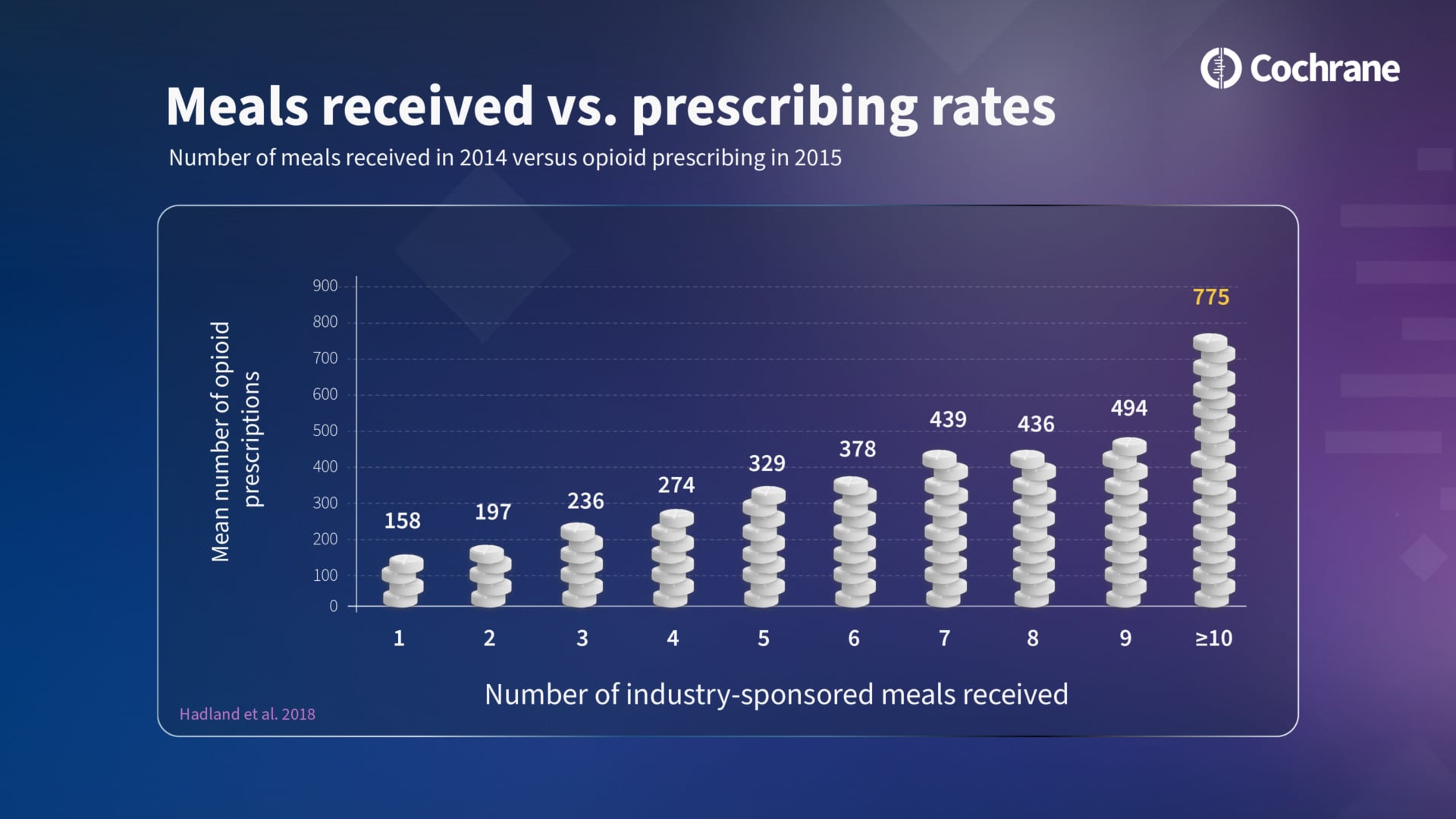
The new analysis, published Friday in the Cochrane Database of Systematic Reviews, documented an almost comical “dose-response” relationship, in fact, between the number of dubious prescriptions written by a doctor for certain drugs and the number of free meals they had received.
“Doctors often think that this is trivial and doesn’t influence them, that they ‘can’t be bought for the price of a sandwich,’ but the data shows this is an effective marketing strategy,” the review’s lead author, pharmacy professor Barbara Mintzes, said in a statement.
Hungry, hungry Hippocrates
“It’s very common for doctors to receive free meals from companies,” according to Mintzes, who works at the University of Sydney in Australia but previously helped lead the U.N. World Health Organization’s Health Action International project. “The more free meals a doctor receives, the more likely they are to prescribe less appropriate or more expensive drugs.”
Mintzes and her collaborators—half a dozen researchers from medical institutions across the U.S., Canada, Australia, and the United Kingdom—found that this correlation proved to be true for a range of drugs covered in the studies they reviewed. The data showed that a given drug company’s opioid painkillers, its antidepressants, and/or its medications for high blood pressure and cholesterol were prescribed more times in direct proportion to the number of complimentary meals they gave doctors.
“This is problematic for a number of reasons and it matters because it directly affects patient care,” study coauthor Lisa Bero, a (now recently retired) professor of internal medicine at the University of Colorado Anschutz School of Medicine, said in a statement.
“These less appropriate, more expensive drugs can have fewer benefits or more side-effects than alternatives, or simply be unnecessary in the clinical context.”
Best medicine
Bero, Mintzes, and their colleagues acknowledged that their systematic review stopped short of achieving the statistical robustness required for what’s known as a “meta-analysis,” in large part because their (still quite thorough) effort covered such a heterogeneous collection of studies. The 93 peer-reviewed studies they examined explored the influence of “payments, gifts, or other transfers of value,” advertising and educational events targeting doctors, and free drug samples.
An overwhelming majority of the studies (88%) focused on doctors within the U.S., largely due to the fact that the Physician Payments Sunshine Act of 2010 has required pharmaceutical firms to report all details of their payments to doctors for inclusion in a publicly searchable database.
But among these disparate studies, several that tackled the impact of medical institutions’ conflict‐of‐interest policies did offer some cause for optimism. Two studies that examined 3,065 prescribers found that these policies improved the “appropriateness” of the healthcare provider’s drug prescriptions, although the jury appears to still be out on whether these policies help bring down costs.
“It’s encouraging to see that robust conflict-of-interest policies in place tended to be effective,” Mintzes noted.