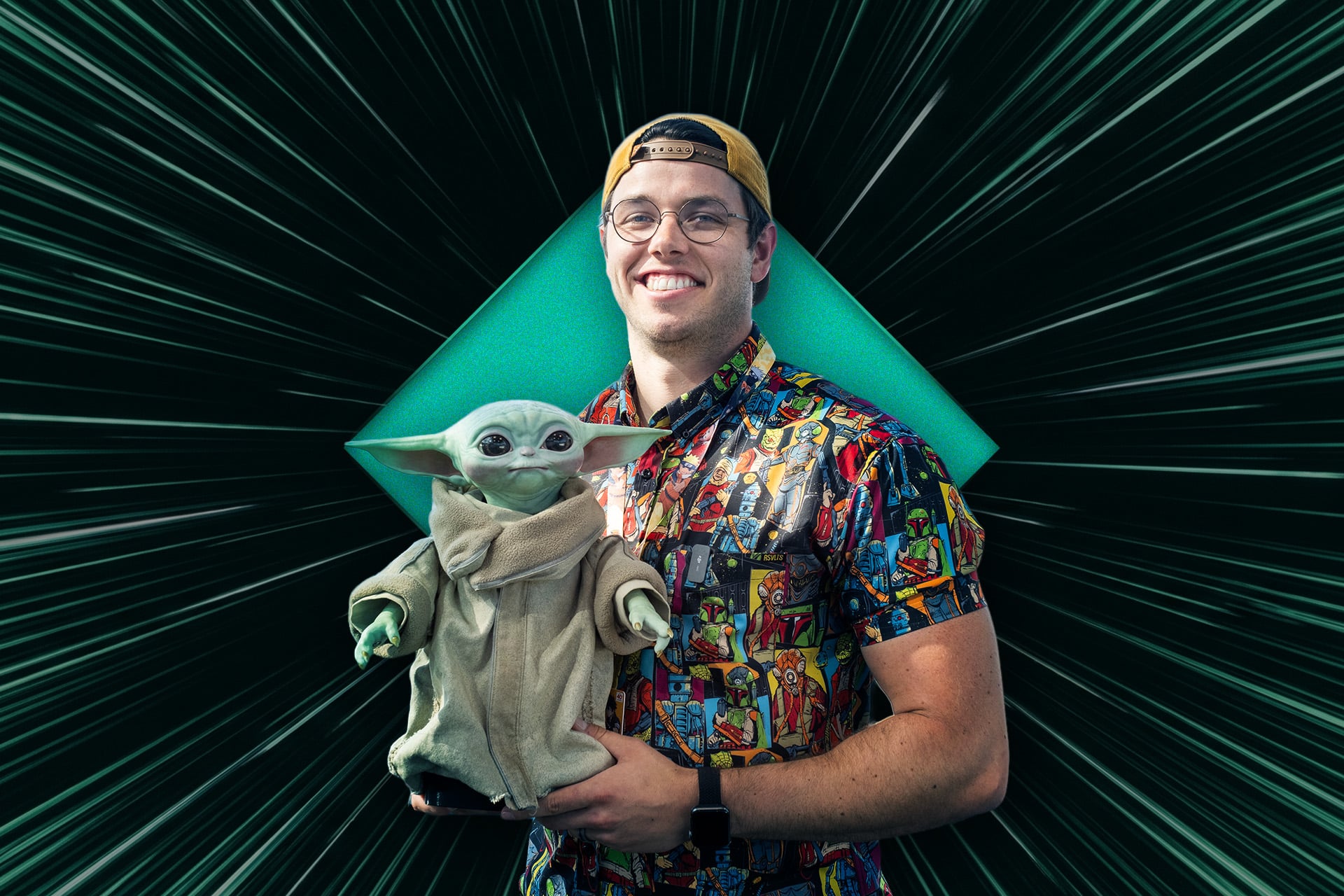
Hunter Smoke learned one of his biggest life lessons from Star Wars: Episode IV — A New Hope. He was struck by Luke Skywalker, a farm boy who dreams of a life beyond fixing droids and picking up power converters. By the end of the series, Skywalker emerges as a hero: a Jedi able to achieve things he never before thought possible.
It’s a lesson that Smoke, a 28-year-old from Michigan, has taken to heart, and one he puts into practice every time he decides to bring a character from Star Wars to life in his garage. One of his most recent creations is Grogu, colloquially known as Baby Yoda, from Disney’s The Mandalorian.
“[Luke] puts in the work,” Smoke told Gizmodo. “He puts in the effort to become this great Jedi. That’s all due to his willingness to push himself and to learn.”
At first glance, you could easily be fooled into thinking Smoke’s Grogu came straight out of Lucasfilm’s studio. The pint-sized, green-skinned creature wobbles around the room with uncanny realism, spinning and moving his tiny hands under Smoke’s control.
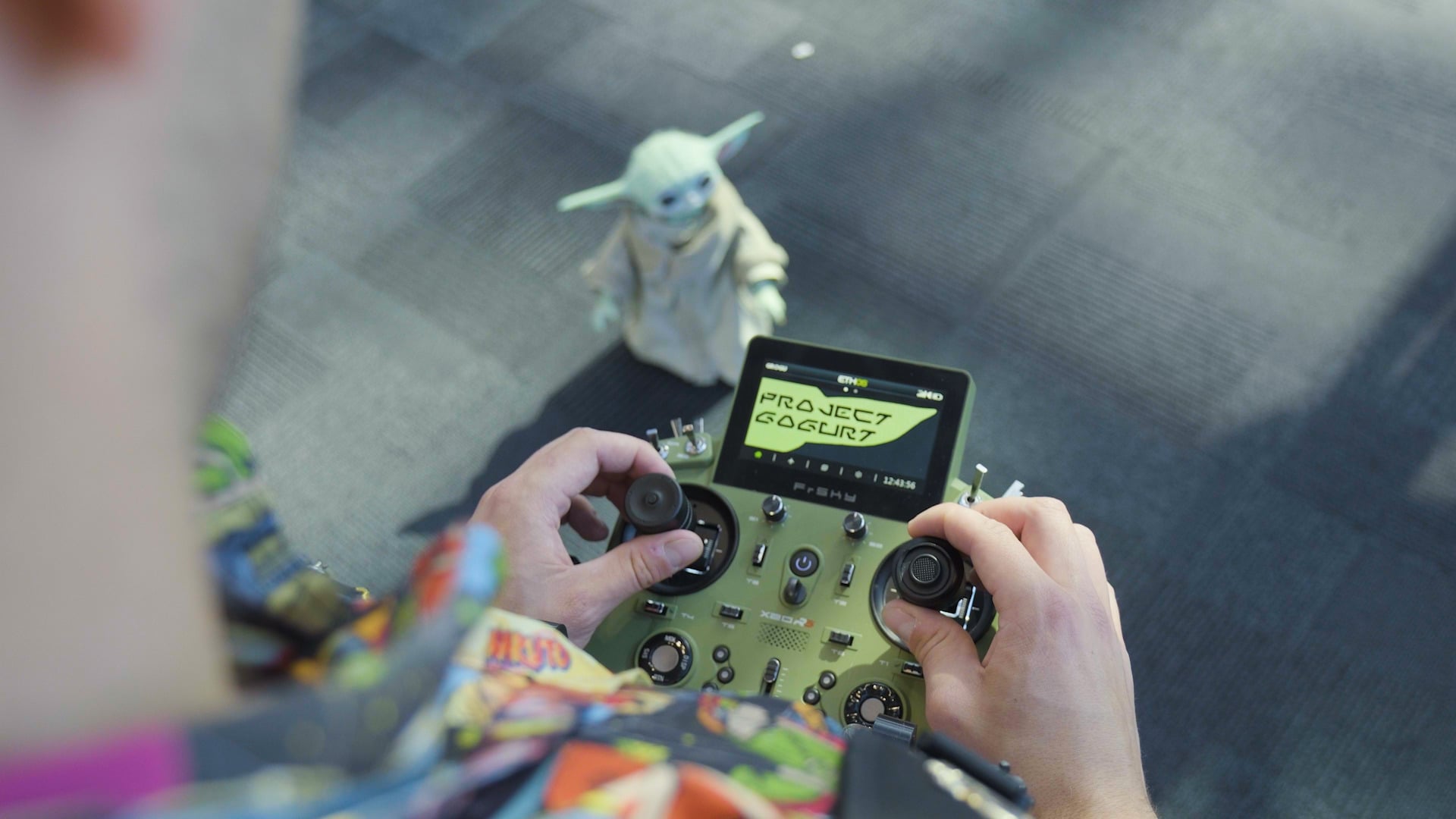
Smoke is deeply passionate about his craft, relishing every step Grogu takes while also thinking up new ideas to further his building skills. Some might find his commitment surprising, as technically, Smoke doesn’t work for Lucasfilm… or any other Hollywood studio, for that matter. By day, he is an automation engineer specializing in concept design for assembly lines. A distant cry from a galaxy far, far away, yes, but that never stopped the puppeteer from opening his toolbox after work.
The Michigan engineer is one of countless makers in the Star Wars cosplay and prop-building community. They spend their spare time building replicas of the characters and costumes George Lucas first introduced to the world in 1977. Many come together in groups like the 501st Legion, an international costuming organization founded in 1997 that participates in fan-based charity events, or the R2-D2 Builders Club, which has served as a forum for fans looking to build their own astromech droids since 1999.
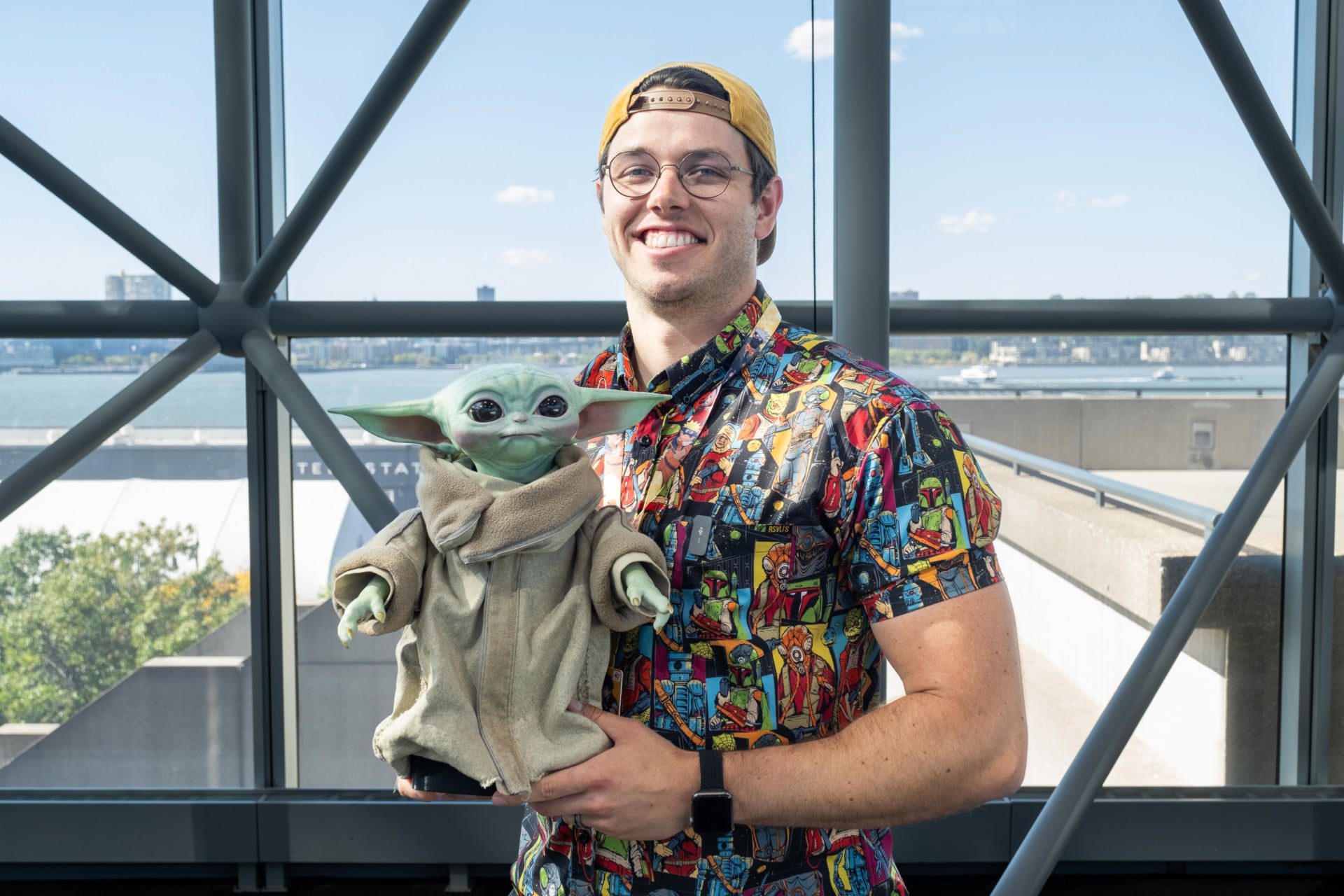
You can often see the fruits of the community’s labor at fan events like Comic-Cons, where working droids zoom around alongside costumed Mandalorians and Imperial Stormtroopers. At times, fans even create their own original characters based on Lucas’ universe.
“Nobody does it to make money,” Smoke said. “Everybody does it as a hobby, which is really special.”
Some community members post about their hobby online. Smoke is one of them. Known as @jaig_eye_hunter (a reference to the jaig eyes emblem that appears on the armor of characters like Captain Rex), Smoke documents how he makes his costumes and droids, sharing tips and tricks along the way.
He began posting about nine years ago, aiming to pay it forward and to inspire others to start a project of their own. Now, this Michigan creator, with 110,000 Instagram followers and nearly 39,000 on TikTok, has started to pick up steam. However, he is still driven to post by the same sentiment that sparked his beginnings all those years ago.
“I didn’t set out to become a content creator,” added Smoke. “I hope that people see what I’m doing and realize that they can do it, too.”
Gizmodo spoke with Smoke about what goes into making his creations, what happened when Grogu’s head popped off in public, and why he’s not putting AI in his droids.
This interview has been edited for length and clarity.
Gizmodo: It’s clear you’re very into Star Wars to anyone who looks at your social media. Why Star Wars?
I connected with Star Wars at a young age, and I think it’s mostly due to the world-building. That’s always what really sells it for me, and the older I get, the more I understand.
When I was younger, there were people who were doing what I do now, making costumes and droids and stuff. I’d see them at conventions, and it was really eye-opening and inspiring. I was like, ‘Whoa, I didn’t realize you could build R2-D2 at home or build this suit of armor at home.’ You assume it’s done in a film studio. But it turns out that you can do this type of thing in your garage.
What kind of tech is involved in making droids, costumes, and creations like Grogu?
You kind of have to be a jack-of-all-trades to really expand on your skill set and the type of projects that you can take on.
I use a lot of different 3D printers, both resin and FDM [which stands for fused deposition modeling, or filament printing]. I recently got a laser cutter and a UV printer. And then you get into more low-tech stuff, too. A lot of hand tools, a lot of hand sanding, some power tools. Obviously, your generic stuff: drills, power sanders, Dremels, you name it. It’s also really dictated by the material of the project that you’re working on. That will influence what you can and can’t use, as well as your space.
With everything you’ve mentioned, this doesn’t exactly sound like a cheap hobby.
It can be expensive, but it can also be cheap. A lot of people, when they get into cosplay, costume building, and prop making, start with cheaper materials. When I was much younger, I built costumes out of duct tape and cardboard.
It takes a lot more manual labor to 3D print something or fabricate it out of foam, then sand, finish, and paint it all yourself. Compare that to buying a resin cast of a part that’s already almost ready to go, and all you have to do is a little bit of sanding and painting.
One of the things that I really try to put out with my content is that anybody can do this kind of thing. You don’t need super fancy equipment. You don’t need formal training in engineering or any artistic field. I don’t have an actual studio space. I work out of garages, so it’s kind of like whatever I can fit in there and whatever will work in that space for what I need to do for my project.
You need a willingness to learn, a willingness to be patient with yourself, and you’ll get there. It just will take time.
How much would you say you’ve spent over the years?
It’s probably in the tens of thousands, but that’s spread out over the years. It’s probably for the best that I don’t keep track of that, because it would be a really stressful number to know, but it’s not really about how much money. It’s about what you can do with the tools and the materials available to you.
What was it like to create Grogu?
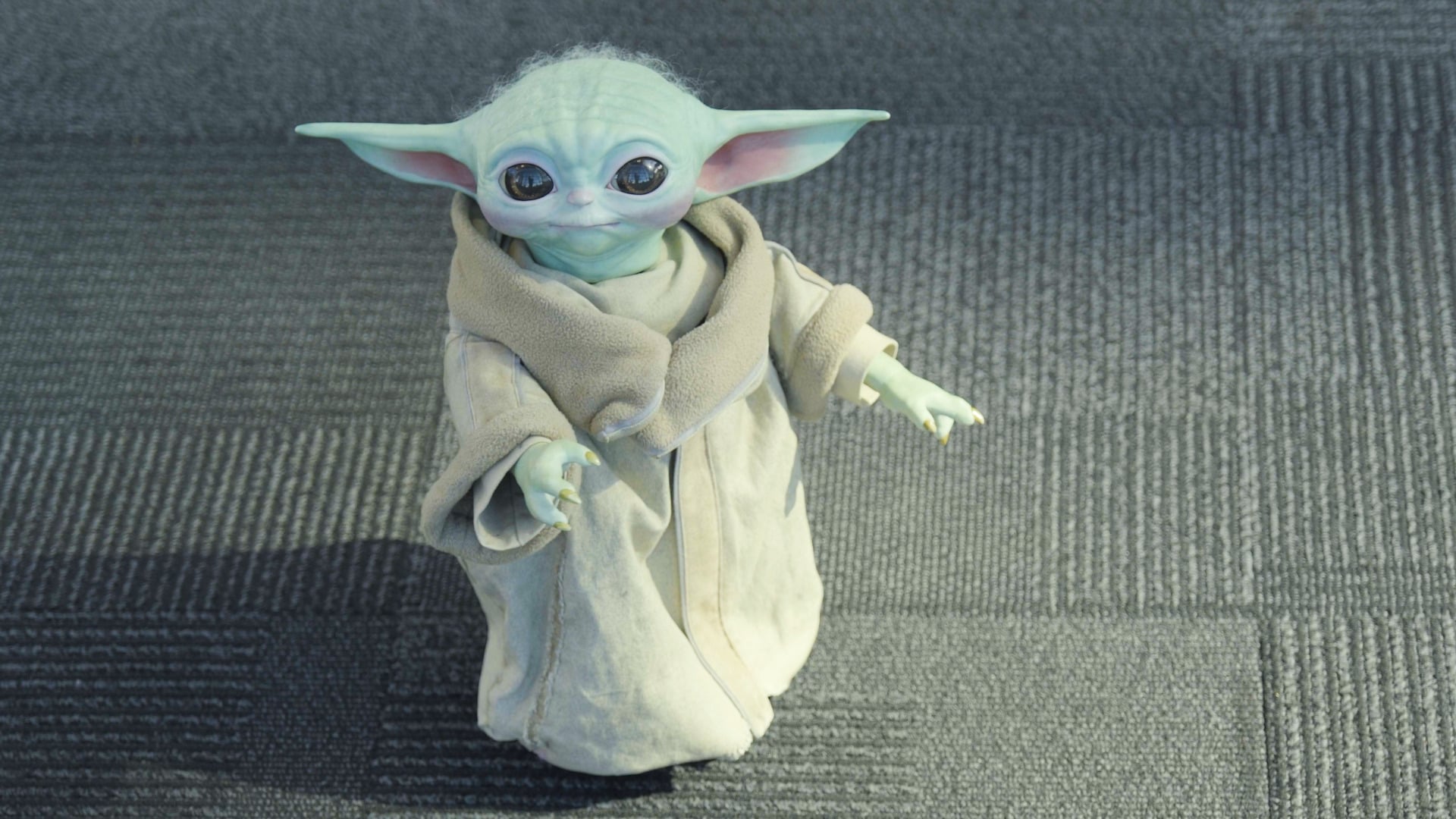
I started with an astromech droid, like R2-D2 but with different colors, then moved on to other droids, and then Grogu. It was a real challenge to fit things into that smaller form factor. He’s a lot smaller than R2-D2, which is like waist height. Grogu doesn’t even come up to my knee. So, it’s an engineering challenge, a packaging challenge, to really get everything in there to fit.
He started out as a static statue that you can buy off the shelf, and that’s what I used for the sculpt. I don’t trust myself to try and sculpt alien creatures like that yet. I did use those parts, but then everything underneath his robe—that’s all my own custom animatronic design. For me, that was a really fun way to push myself, learn more, and try to make it attainable, too.
You posted something on your socials about Grogu’s head falling off at a local community parade. Can you tell us a bit about what happened?
He’s custom-built and is always a work-in-progress. I finished him in May 2026, so he’s still a fairly new build for me. A lot of times at these big events, I find something that’s gonna go wrong. That time, I had Grogu out, and a friend of mine who was dressed as Din Djarin was carrying him in a satchel like he does in The Mandalorian. The shaking from him walking and bumping against the guy’s hip caused a 3D-printed part to fail under the stress of his head rocking back and forth—and it snapped off.
I did my best to fix it on the spot with some super glue, a lighter, and some nails. You kind of have to MacGyver solutions like that sometimes. But yeah, it’s a learning event. I went home, redesigned that part, and printed it out. It has a metal reinforcement in it now. I don’t think it’s going to break anytime soon, but chances are something else will break, and I’ll keep learning from that.
When you take your creations out in public, what is the experience like? Do you think of it as a performance?
Initially, coming onto the scene wearing costumes, you are portraying a character, so there’s a little bit of performance. At the same time, people talk about this suspension of disbelief, which is what happens when you see a really well-built-out theme park environment and you believe it’s real. But that suspension of disbelief has limits.
For instance, when you see a person in a costume at a convention, you can think, ‘Oh, that guy looks like the real deal,’ but he is obviously a fan in costume.
Droids take it to the next level, though. It’s this non-human form factor, and you get these really special interactions where even adults will talk to the droid or talk to Grogu like they’re the real thing.
What’s the hardest thing about this hobby?
The hardest part is staying focused on one project at a time. With the way my brain works, I always have a million things going on, and sometimes it’s hard to stay focused on that one thing and see it through to completion. For every project I finish, a dozen more have been started and aren’t finished. That’s a difficult thing.
You mentioned before that people aren’t necessarily excited by the tech aspect of what you build; they’re excited by the characters, because the characters are part of the story. Can you expand on that?
I get a lot of comments online when I post videos or pictures of my droids or Grogu. A lot of people say, ‘Just put AI in that, and you’ll basically have a real astromech’ or a real R2-D2 or whatever.
The irony is that people fall in love with these non-human, fictional AI characters because a human is behind them driving the interaction. There’s emotion, there’s thought, there’s sarcasm, and that’s not something an algorithm can really replicate when it operates based on what it thinks the average output to an input would be. You can program some of that in, but it’s all a facsimile. It’s all false. It’s not a real, true, genuine, emotional human interaction.
I am not a fan of generative AI because it removes the soul from a lot of what people do as artists. I think there are so many applications for AI to help with menial tasks, like data processing and data analytics. That’s where it excels, because those conclusions are driven by predictable trends in data. And that’s what computers do. They take inputs, they analyze them, they figure out a trend, and then give you that output. There is a place for that alongside art and engineering.
It’s an interesting time to see people rush to outsource their critical thinking and creativity, when in reality we should use these tools to strengthen them.
Adriano Contreras contributed reporting.