On April 1 of this year, several news outlets reported the death of Jonathan, the nearly bicentenarian giant tortoise. Thankfully, the rumors of Jonathan’s demise were greatly exaggerated. The media and others had merely fallen prey to a viral social media post by a fraudster pretending to be his personal vet. In a sign of our modern times, the con artist used the buzz surrounding the fake death to ask for crypto donations.
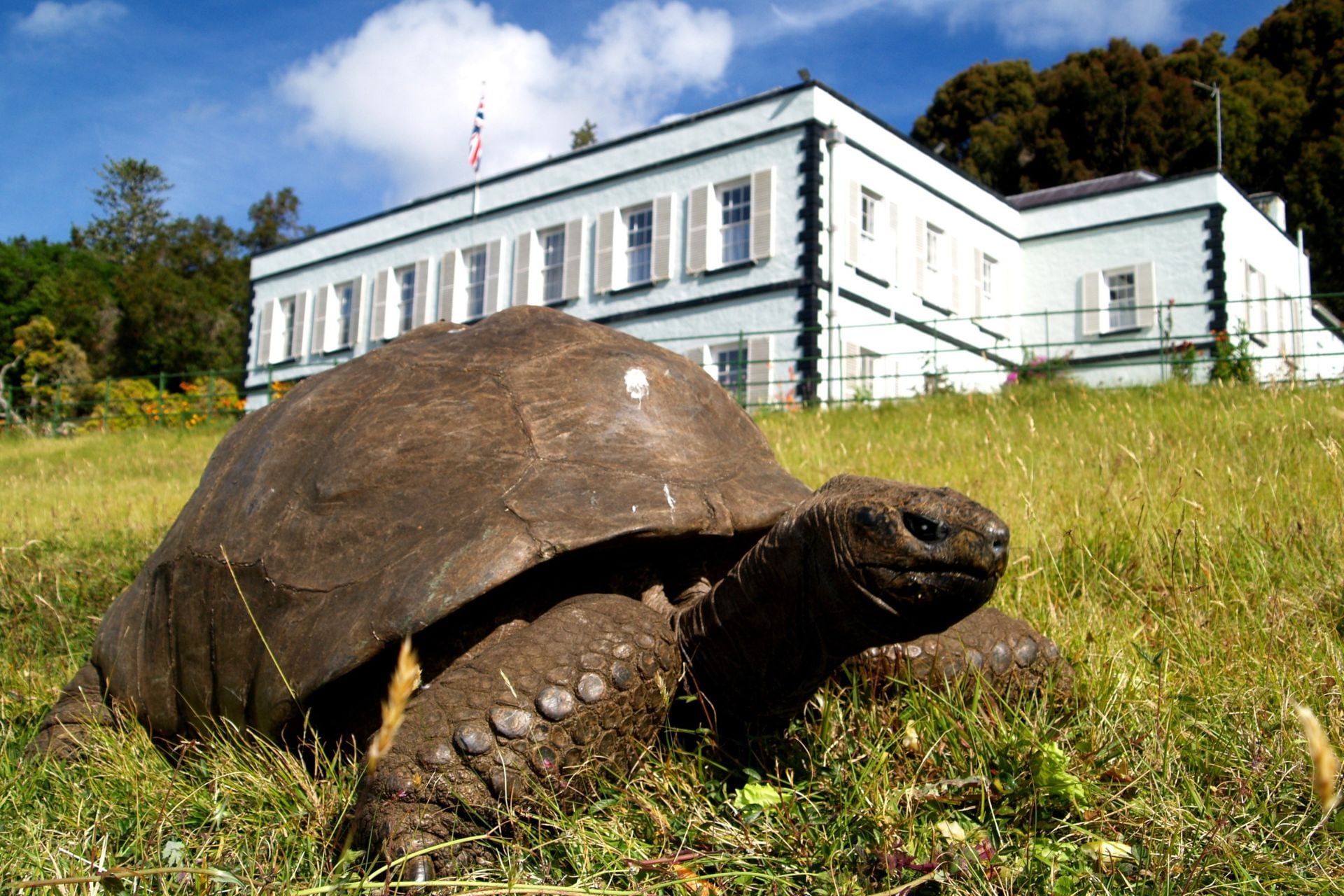
Still, the public’s brief outcry and subsequent relief over Jonathan’s fate illustrates just how enamored people are about the tortoise all these years later. While his exact age isn’t known, Jonathan is estimated to be around 194 years old, and since the late 1800s, he’s called Saint Helena, a small island in the middle of the Atlantic, his home. Though there are sea-dwelling creatures that probably have longer lifespans, like the Greenland shark, along with a multitude of other long-lived organisms not in the animal kingdom, Jonathan is currently the oldest known land animal.
He’s specifically a Seychelles giant tortoise (Aldabrachelys gigantea hololissa), a subspecies of the Aldabra giant tortoise (Aldabrachelys gigantea). Giant tortoises tend to live plenty long, but Jonathan seems to be an unusual specimen even among his own kind. Most of these tortoises are thought to live roughly 100 to 150 years, though there are some that may have lived even longer than Jonathan (tracking the age of these animals is hard, given how they usually outlive the scientists studying them).
Unfortunately, we can’t ask Jonathan about his anti-aging regimen. But for the first time ever, in a study published today in the journal Science Advances, scientists have detailed what his genetic make-up looks like. With a simple swab of his cheek (being a protected animal, taking his blood wasn’t feasible), the researchers were able to sequence his genome, the complete set of his genes. They also unpacked his epigenome, the collection of chemical compounds that can switch genes on or off.
The study was led by scientists from Kallel, a nonprofit organization focused on longevity research. I reached out to senior study author Stephen Clark, a neuro-oncologist and Kallel’s founder, to talk about what his team discovered in Jonathan’s DNA and how these lessons might someday help us live longer. The following conversation has been lightly edited for clarity and grammar.
Ed Cara, Gizmodo: What did scientists already know about Jonathan before this latest study?
Stephen Clark: We knew he was an Aldabra tortoise, and we knew he was old. Two other Aldabras had been sequenced in 2022, but this happened as we were working on Jonathan, and since we did not know this result until it came out, we also sequenced another younger Aldabra named Tank, in addition to Jonathan.
Gizmodo: Given his age, how does Jonathan seemingly differ from others of his species?
Clark: Even though the previous group had sequenced two Aldabras, no one had analyzed their epigenome. So in addition to Jonathan’s DNA sequence, we also obtained his epigenome.
We compared his epigenome to that of a 5-year-old Aldabra to see how his epigenome changed over 189 years (194-5). This was the first time any animal’s epigenome had been compared over such a large time scale. By epigenome, I mean DNA methylation. DNA methylation occurs when a methyl group is added to the DNA, which tends to turn genes on or off. Genes that are methylated are turned off, and those that are unmethylated are turned on. We have known that the epigenome changes over time, but again, no one had compared epigenomes across such a large difference in chronological age.
The biggest lesson we learned is that he appears to have kept his mitochondria very young. When we compared his DNA methylation to five other DNA methylomes ranging in age between 5 and 91 years old, his DNA methylome in some mitochondrial genes was as youthful as the 5-year-old’s, while the 91-year-old’s looked much older.
Gizmodo: Could unraveling Jonathan’s genetics help us better understand or even one day surpass the limits of longevity in people?
Clark: Yes, I think so. Our nonprofit is trying to unlock the secrets of long-lived species like Jonathan and find pathways we can target in humans. One of our next steps with this information is to identify drugs that can target the epigenome (DNA methylation) to keep our mitochondria younger.

Gizmodo: So what comes next? Do you plan to keep studying the inner workings of Jonathan?
Clark: Yes, we do. We plan to do more work with Jonathan and other Aldabras but also to look at the epigenomes and DNA of other long-lived species. As a non-profit, this work is limited by the philanthropic support we receive.
Gizmodo: How was Jonathan as a test subject? And how is he doing today? Is he likely to live even substantially longer?
Clark: Jonathan is amazing. He is blind, but his hearing is still intact. We anticipate that he could live much longer, especially if kept safe from infections and natural dangers.